150 days of TVK govt: How CM Vijay is using old wine for a new high
Promise welfare, expand welfare and give the scheme a name that voters remember. This was the strategy majorly used in Tamil Nadu politics for decades. The governments might change, the political colours might change, but welfare is the one factor that remains constant in the state.
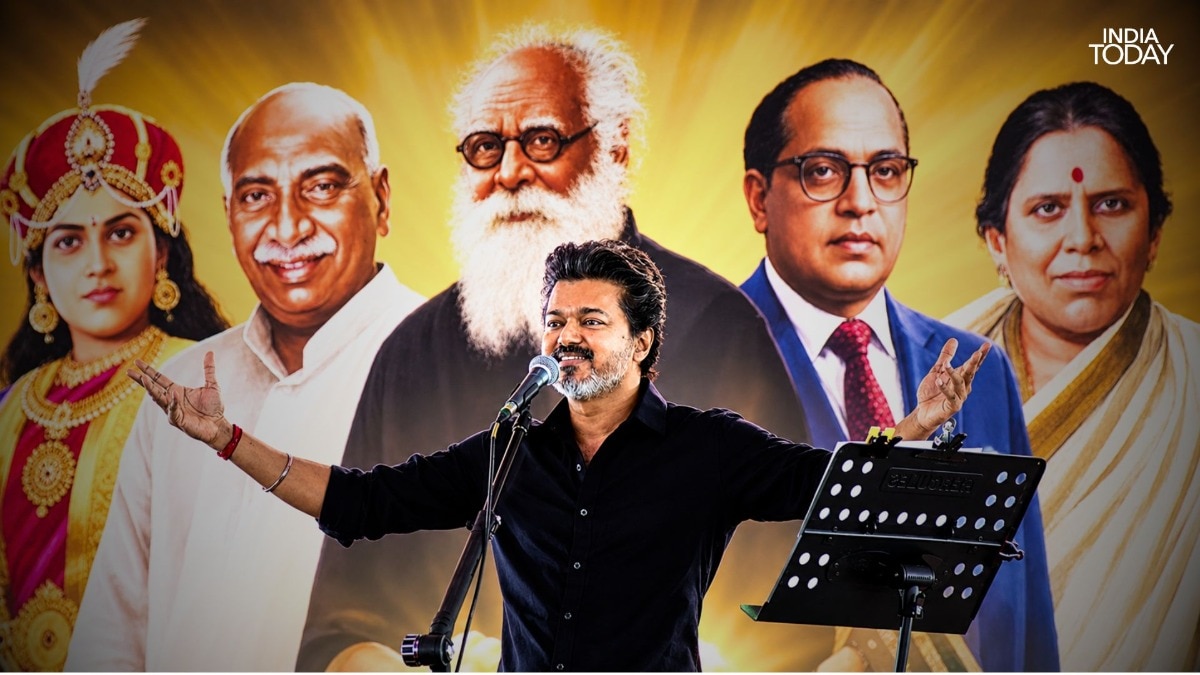
Tamilaga Vettri Kazhagam (TVK) founder and president C Joseph Vijay's first 150 days as Tamil Nadu Chief Minister suggest that he is not trying to overturn the existing formula. He is trying to give it a new dimension.
The Thalapathy of Indian cinema entered politics in 2024 by launching TVK party and has taken several familiar ideas from previous Dravidian parties, given them a twist, and made them glistening new.
He promised free electricity, subsidised transport, breakfast for schoolchildren, welfare for women, farmer relief and assistance for the poor and wrapped them in a new vocabulary of "Vettri (victory)", technology, task forces and a distinctly Vijay-style political presentation.
In that sense, the TVK government is less a departure from Tamil Nadu's welfare politics, but more focused on delivering them to a wider section of the population.
Ravindran Duraisamy, a Chennai-based political and social analyst, spoke about the Vijay government's novelty factor as a strategy.
"In terms of schemes, Vijay is only continuing the Dravida Munnetra Kazhagam (DMK) and the All India Anna Dravida Munnetra Kazhagam (AIADMK) model of welfare schemes, but he is doing it with novelty," Duraisamy told India Today Digital.
This explains the most striking feature of Vijay's first 150 days. He came to power as a political newcomer with no record in government, no ministerial past and, unlike the established Dravidian leaders, little political baggage to carry into the state Secretariat. The question was whether the man who had spent more than two decades delivering blockbuster openings could make the transition from cinema to administration.
Though 150 days is too early for a report card, they are enough to reveal the direction the government has taken.
"The expectations of the Vijay government were exceptionally high because people did not vote for TVK merely as a change of government; there was an expectation of a change in the style of governance itself," Chennai-based senior journalist TR Jawahar told India Today Digital. Rahul Gandhi-led Congress decided to support C Joseph Vijay's TVK after the party fell short of a majority after emerging as the single-biggest in Tamil Nadu. (Image: PTI) THE FIRST 150 DAYS: CM VIJAY'S MESSAGE TO TAMIL NADU WAS WELFARE
What would change for the ordinary citizen was the question everyone had when the 52-year-old was sworn-in as the CM on May 10.
Within hours of assuming office, the actor-turned-CM announced 200 units of free electricity for domestic consumers. The government also announced an anti-drug mechanism across districts and a dedicated women's safety force, later named the Singappen Special Task Force.
Within 48 hours, the government ordered the closure of 717 TASMAC liquor retail outlets operating within 500 metres of places such as temples, mosques, churches, schools, colleges and bus stands.
These decisions were politically significant because they immediately placed Vijay in the welfare-and-public-order space that Tamil Nadu voters are accustomed to seeing from its governments.
The TVK government has since gone much further with the welfare model.
The expanded Perunthalaivar Kamarajar Breakfast Scheme took the existing school breakfast programme from Classes VI to VIII. The midday meal scheme introduced biriyani to the menu. The Thaimaman Thanga Mothiram scheme, launched in September, provides babies born in government hospitals with a one-gram, 22-carat gold ring. The government has also expanded free bus travel for women and transgender persons under Vettri Payanam.
The breakfast and free bus travel schemes are perhaps the clearest example of the old-wine-for-a-new-high phenomenon that the Vijay government has adopted.
The free-bus model was introduced under the previous DMK government. Vijay's government has expanded it to additional categories of buses and renamed it Vettri Payanam. The expanded scheme now covers 12,692 buses and is expected to benefit around 84 lakh women daily.
The political novelty is therefore not necessarily the invention of welfare itself.
The same formula is visible in education, where the government has expanded the breakfast scheme, announced laptops for college students, bicycles for Class XI students and new skill-training initiatives. In agriculture, it has announced loan relief, incentives and employment measures.
Tamil Nadu already has a deep welfare architecture. Vijay is putting his own branding and political language around it. CM of Tamil Nadu, C Joseph Vijay, interacting with a passenger while travelling on the Chennai Metro Rail during a review of ongoing metro rail projects, construction works and trial runs on new routes. (Image: X/@CMOTamilnadu) V FOR VIJAY, V FOR VETTRI IN TAMIL NADU SCHEMES
For over 60 years, the DMK and AIADMK built their political identities around different versions of welfare politics in the state. Vijay has inherited that ecosystem and has attempted to give it a younger and more contemporary identity.
The names chosen by the TVK government are also politically significant. Vettri Tamilagam Vision Document. Vettri Payanam. Vettri Skill Training. Vettri Housing Scheme. Super Clean Super Campus. A proposed Vettri Tamil Nadu Super App. A Citizen Privilege Card. A proposed Right to Services Act. A dedicated push for artificial intelligence in governance.
Even when the policy is not revolutionary, the branding and the packaging are. That is where Vijay's background becomes relevant.
The actor-turned-politician is a different kind of Chief Minister in contemporary Indian politics. For official work, he has frequently appeared in sharply tailored blazers or suits rather than the white veshti that has long been associated with Tamil Nadu's political establishment. On auspicious or culturally significant occasions, however, he has switched to the traditional veshti.
How does attire matter? It does because it captures the larger Vijay phenomenon in Tamil Nadu and beyond.
He does not appear to be trying to look like the politicians who preceded him. He is building his own image, he is trying to look like Vijay, the film star, who became a politician and then became Chief Minister.
A similar pattern was visible in Vijay's approach to Centre-State relations. During the election campaign, Vijay had identified the Bharatiya Janata Party (BJP) as TVK's ideological adversary. But after assuming office as CM, he has adopted a more pragmatic approach to the BJP on the administrative front. While TVK continues to position the BJP as a political foe, Vijay has largely kept that rivalry from spilling over into the Centre-State relationship.
At the same time, around 97 agreements worth roughly Rs 67,452 crore, are carrying the prospect of more than one lakh jobs, indicating business confidence and governmental activity under the Vijay government. Tamil Nadu Chief Minister C Joseph Vijay launched the Thaaimaman Thanga Mothiram Thittam in September, to provide a free 1-gram, 22-carat gold ring to eligible newborns in the state. (Image: PTI) NO POLITICAL BAGGAGE HAS BECOME THE BIGGEST ADVANTAGE FOR TVK CHIEF
Vijay's biggest political asset at this stage is that he is a newcomer.
This gives the new Tamil Nadu CM an edge that his arch-rival, Leader of the Opposition Udhayanidhi Stalin, rarely gets.
But it also created the biggest expectations from Vijay.
"To safeguard Vijay's image as the CM, he needs a corruption-less administration. So the TVK government is completely focussing on delivering a corruption-free administration," analyst Duraisamy told India Today Digital.
The TVK government has attempted to answer that expectation through a 436-point Vetri Tamizhagam Vision Document covering 35 departments and built around 10 pillars inspired by the Tirukkural. It has also released a white paper on state finances, pushed single-window clearances and talked about eliminating "parallel power centres" in the bureaucracy. Tamil Nadu CM Vijay has gained massive popularity among the youths as 'Mama' (maternal uncle). (Image: PTI) TVK IS A NEW POLITICAL TEAM AND THAT IS THE BIGGER TEST FOR VIJAY GOVT
According to experts, the Vijay-led government needs to understand the mechanics of running a state.
Senior journalist Jawahar cited the controversy over the temporary exemption of the Law and Order Department from the RTI Act as an example of this. The order was withdrawn after criticism.
"From one perspective, the original order was a mistake. From another, the speed with which the government has reversed it shows that it is responsive to public and political criticism," Jawahar said.
For a government that promised a different political culture, such episodes become more consequential. The same applies to law and order.
Vijay used law and order as one of his major political weapons against DMK chief MK Stalin-led administration during the election campaign. Now the responsibility rests with his government.
Duraisamy called it the biggest test of the TVK government. "Law and order remains the biggest test for the Vijay government," he said, while arguing that the underlying problem should also be viewed as a wider social issue rather than being attributed solely to the Chief Minister.
Jawahar similarly said law and order remained an area under the "strongest political scrutiny", but cautioned against judging the entire crime situation through individual cases. Tamil Nadu Assembly Speaker JCD Prabhakar (R) looks on, as CM Vijay speaks during the state Legislative Assembly session. (Image: PTI) INEXPERIENCED MINISTERS AND MLAs HAUNTING THE VIJAY-LED TVK GOVT?
The TVK government also has another problem that established parties do not face to the same extent. Many of its ministers and MLAs are themselves political newcomers.
Duraisamy argued that these are both a strength and a vulnerability for the Vijay-led administration. "His [Vijay's] ministers and MLAs are mostly newcomers and youngsters. They have witnessed an overnight success which has become difficult for them to bear. That is why the TVK ministers are seen speaking in arrogance and making controversial statements at times," he said.
The argument of Duraisamy points towards a structural challenge for the 52-year-old CM of Tamil Nadu.
The Chief Minister's personal image can be managed through his public appearances, speeches and administrative messaging. A government, however, is much larger than its Chief Minister.
The real test is whether the new political team can learn to govern without allowing the freshness of the movement to become administrative inexperience. And this is where the next 150 days could matter more than the first 150.BY-ELECTIONS WILL ONLY CONFIRM VIJAY'S POPULARITY
If Vijay's first 150 days of governance prove anything, it is that he has no intention of abandoning Tamil Nadu's welfare politics. The September launch of the gold-ring scheme and the October expansion of Vettri Payanam just add a new layer to this argument.
The gold-ring scheme, for instance, was launched with 1.28 lakh rings procured for the initial phase and carries an annual allocation of more than Rs 755 crore.
Vettri Payanam, meanwhile, extends an existing welfare architecture rather than creating an entirely new one. The government has expanded the facility to express, limited-stop, deluxe and other services, bringing a much larger portion of the state transport network under the free-travel benefit.
The outcome of Tuesday's by-election will offer an early indication of whether Vijay's political approach is resonating on the ground and how his government is being received by voters. Former AIADMK MLAs K Maragatham Kumaravel and P Sathyabama had won the Madurantakam and Dharapuram seats respectively in April. They later resigned from the AIADMK, joined the TVK and are now seeking re-election by the same voters under a different political banner.
Writing in an op-ed for India Today Digital, Jawahar also said the October 6 bypolls would test more than the government's welfare politics.
"On October 6, Madurantakam and Dharapuram will not decide whether welfare is free. They will decide whether the political movement itself should remain free of cost—to the politician who changes sides, but never to the citizen summoned back to the booth," Jawahar wrote.
"Vijay once broke the free television. Tamil Nadu will now discover whether his government has changed the channel—or merely taken possession of the remote," he added. Chief Minister Vijay-led government has seven first-time ministers and two ministers under 30 years of age. (Image: File) VIJAY FACTOR HAS REDEFINED TAMIL NADU POLITICS AFTER MAY 2026
The biggest difference between Vijay and the political leaders who came before him is ultimately not a scheme or a government order. It is the phenomenon surrounding him.
For more than two decades, Vijay understood mass communication through cinema. He knows exactly how to create appeal, symbolism and emotional connection. That skill has now moved from the screen to the Secretariat.
The blazer at the Secretariat, the veshti on auspicious occasions, the carefully branded schemes, direct communication with beneficiaries and the repeated use of "Vettri" all contribute to a political identity that is recognisably his own.
His government is therefore selling welfare to beneficiaries and novelty to voters at the same time.
Duraisamy said that Vijay's mass appeal has extended beyond the traditional caste-based political structures of Tamil Nadu.
"DMK and AIADMK are the OBC-backed parties of Tamil Nadu. On the other hand, Vijay has a mass appeal," he said, arguing that Vijay's support base draws consolidation mainly from SC, ST, Christian and other minority sections. Fans celebrating during the grand release of CM Vijay's Jana Nayagan movie in July. (Image: PTI) NEWCOMER TAG BEGINNING TO FADE. VIJAY'S REAL TEST STARTS NOW
"I would describe Vijay's first 150 days as an energetic beginning rather than a finished report card," Jawahar told India Today Digital.
This might be the most appropriate way to look at this government in the state.
There has been activity. There have been schemes. There has been implementation. There has also been controversy, criticism and the occasional course correction.
But the central question remains that can Vijay turn political novelty into institutional change?
For now, his government has shown that an actor with no previous experience in government can enter the Secretariat and immediately make welfare the centrepiece of his administration. What remains to be established is whether the same political energy can strengthen institutions, produce structural changes, sustain administrative discipline, improve law and order and deliver financially sustainable welfare schemes.- Ends
Avinash Kateel is a multimedia journalist with the India Today Group (Digital), and a cub reporter. His heart belongs to coastal Karnataka, but his mind closely tracks the politics of the entire country and the policies that shape India and the world. From geopolitics to the economy, Kateel covers anything that makes news. He believes in breaking down complex stories into simple versions because news matters when readers understand it.