3 ex-SC justices tell impeachment court: Conviction threshold not fixed at 16 - Rappler
Already have Rappler+? Sign in to listen to groundbreaking journalism.
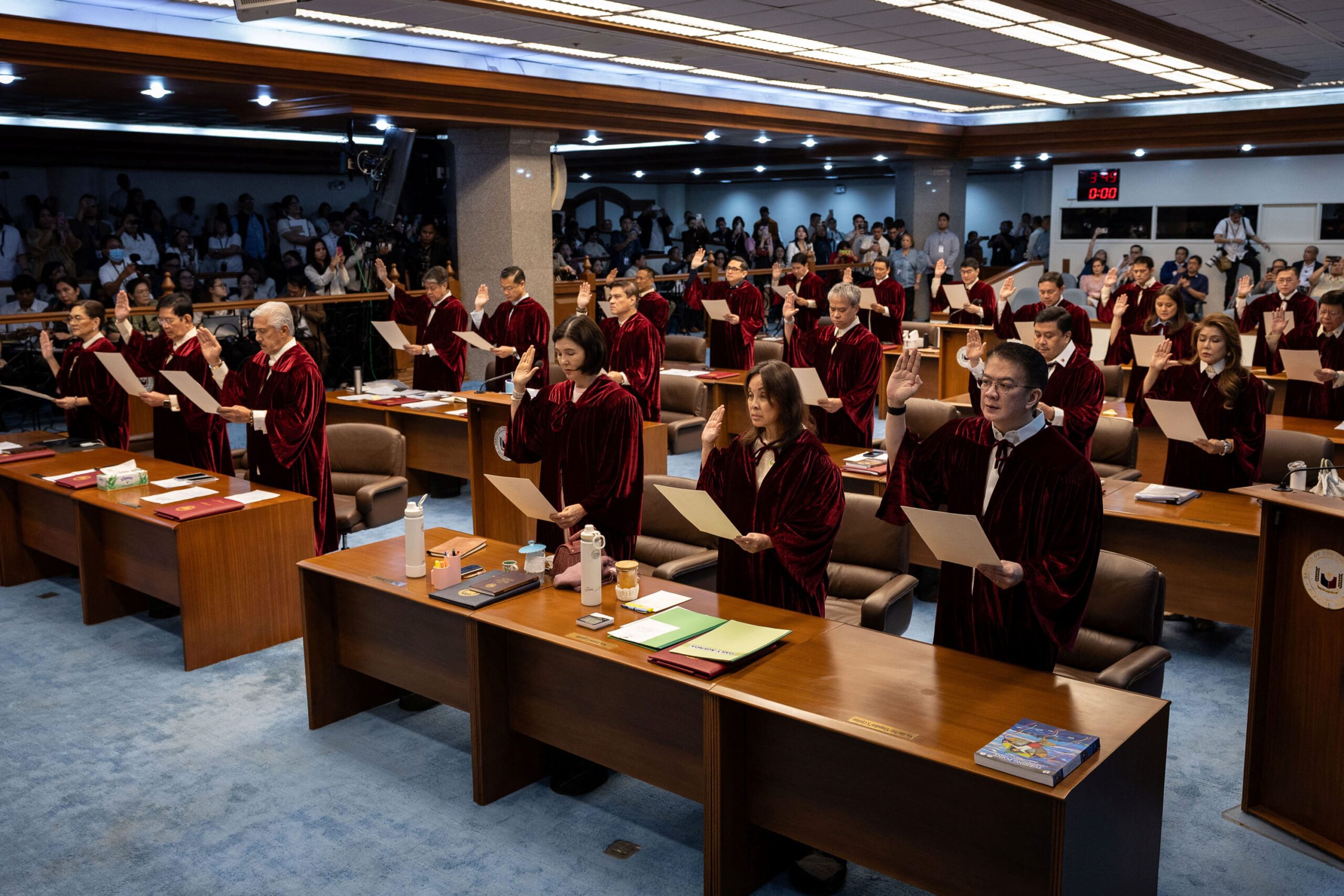
IMPEACHMENT COURT. Senators take their oath as they convene as an impeachment court for the trial of Vice President Sara Duterte, on May 18, 2026.
This is AI-generated. Read the article for full context. Report any errors.
MANILA, Philippines – Out of the four retired Supreme Court justices invited by the impeachment court to advise it on the conviction threshold debate, three of them took the position that the number of votes needed to remove the impeached official is not fixed at 16.
Former chief justices Reynato Puno, Hilario Davide Jr., and Artemio Panganiban said on Wednesday, September 16, the constitutional provision stating that no person shall be convicted without a two-thirds vote of all members of the Senate does not automatically put the denominator at 24.
“The framers of the Constitution of 1935, 1973, and 1986 would never have intended to include in ‘all members’… those who cannot participate in the hearings and deliberations on the impeachment, such as those outside the jurisdiction of the Philippines, or whose whereabouts are unknown or are in hiding to avoid arrest,” Davide said in a written position read by the Senate secretary.
He added that those who cannot exercise their rights and privileges as a senator due to “some legal impediment or restraints” such as plunder charge should be excluded from the count.
Currently, Senator Jinggoy Estrada is suspended from the Senate after his arrest on plunder charges; Senator Rodante Marcoleta is in detention in a separate plunder case; and Senator Ronald “Bato” dela Rosa is evading arrest in connection with a crimes-against-humanity case before the International Criminal Court.
In addition, Senator Loren Legarda has been on medical leave for a number of weeks now, preventing her from attending the trial.
Panganiban said the interpretation of charter framers should not necessarily prevail, and must reflect the “common sense of the people,” guided by truth and fairness.
“Is it fair and truthful should the senators be allowed to vote if they were in hiding, abroad, legally detained, sick, hospitalized, or otherwise absent, and have not been able to access the documents, have not heard the testimonies and have not observed the demeanor of the witnesses?” Panganiban asked.
“Is it fair to the parties, to the country, to allow those abroad, looking at the pyramis along the Nile, and shopping at the fashion houses in Paris?” he added.
Puno argued that if the conviction threshold is fixed at 16, the Constitution should have explicitly said so.
“By using two-thirds, the number of votes to convict will have to move depending on certain factors,” Puno said.
Only retired Supreme Court justice Adolfo Azcuna took the stand to retain the 16-vote conviction threshold.
According to Azcuna, the Senate should count all 24 members in determining the denominator for the voting threshold, including senators who were unable to participate in the trial.
“I respectfully submit, Your Honors, that the reference in this provision is to all members of the Senate, as long as they are members of the Senate, they constitute the denominator in computing the threshold of two-thirds, because all means all,” said Azcuna.
Azcuna said framers of the Constitution intended the supermajority requirement to prevent the impeachment from being used as a tool to “remove a political rival or an official from a disfavored party, effectively overturning an election result through legislative fire rather than through the ballot box,” adding that convictions in impeachment cases are “final and largely irreversible.”
“A simple majority threshold… would make impeachment conviction achievable by whichever coalition happens to control the chamber at any given moment, collapsing the distinction between removable for cause and removable because we have the votes,” the retired associate justice said.
“Requiring two-thirds forces conviction to rest on a coalition that cuts across ordinary partisan lines, which is precisely the point. It signals that the wrongdoing is serious and broadly, not merely factionally, recognized,” he added.
Azcuna also described the voting requirement as an internal check, stressing the threshold should be fixed and determinable from the outset.
“We need a supermajority because of the gravity of the exercise. Basing the denominator on only those who actually participate and are present can effectively reduce the two-thirds to a simple majority,” he said.
“That is not the purpose of the internal check of a threshold. A threshold must be fixed not variable, it must be determinable from the start. It cannot be something that will be figured out as we go along depending on how many are present,” Azcuna added.
During the interjection of the senator-judges, Azcuna stood firm in his position, reiterating the denominator remains anchored in the entire membership of the Senate unless a senator dies, resigned, or was removed from office.
He also said detained senators should be allowed to vote and suggested the Senate may pass a law allowing them to participate in the trial.
“One way of remedying that is to pass a law saying that any senator who is detained may still participate in the proceedings may be allowed to participate,” said Azcuna.
“Right now, there’s no law prohibiting them from participating but it’s the Sandiganbayan does not allow them to come, participate. So pass a law saying that a person who has obliged to attend the impeachment proceedings must be allowed to attend. After all, they are not yet guilty, they are presumed innocent. There is no final judgement against them so, a law requiring the Sandiganbayan to allow a detained senator to come and participate will, I think, be a valid law,” he said.
It remains to be seen whether Senate impeachment court presiding officer Chiz Escudero’s initial ruling to keep the threshold at 16 will be sustained, but the legal luminaries’ position are expected to give a boost of confidence for the prosecution, which had been vocal before the start of the trial about lowering the minimum number of senators needed to convict Vice President Sara Duterte.
Oral arguments on the subject are scheduled on September 23. – with reports from Sundy Locus/Rappler.com