3 Things Xi Won From Trump - Newsweek
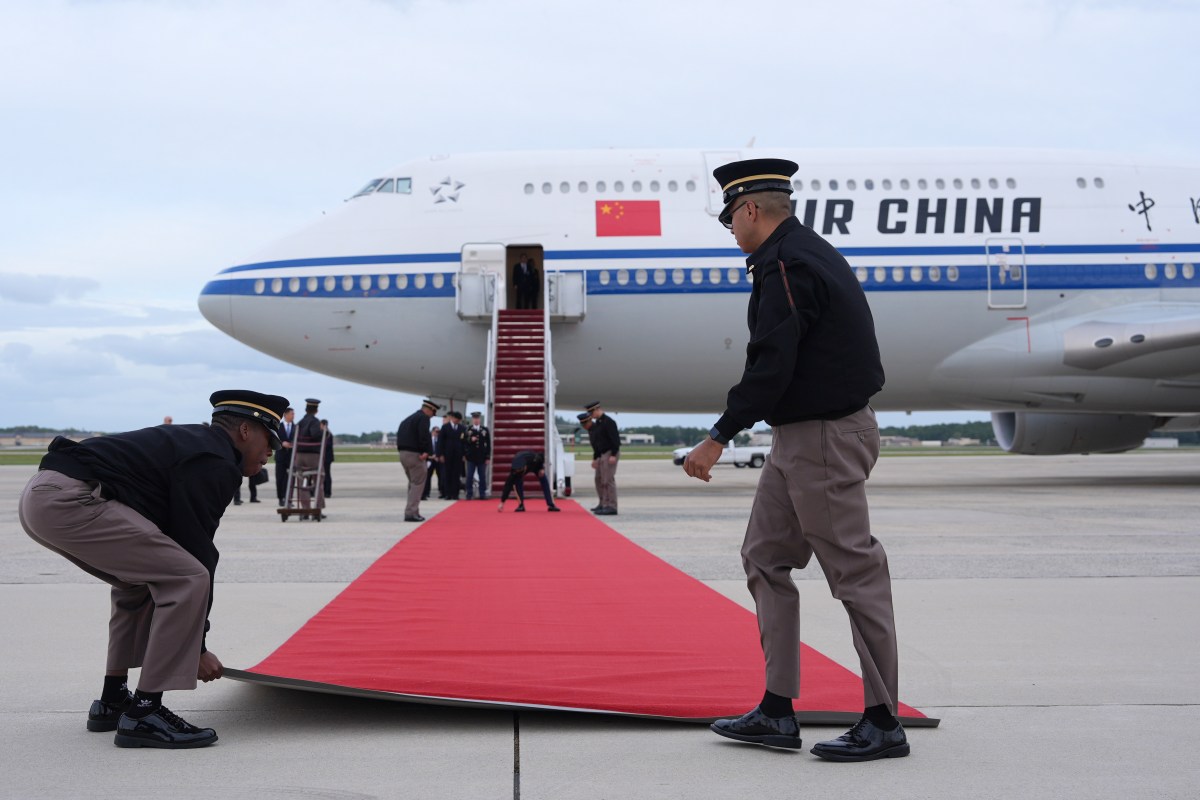
Chinese leader Xi Jinping wanted three things from his recent state visit to the United States. He left with everything he needed and more thanks to bargains with President Donald Trump that seemed to lock in a strategic stalemate in Beijing’s favor.
Xi’s red carpet welcome at Joint Base Andrews in Maryland and Trump’s unprecedented decision to greet his plane on the tarmac became front-page news in Chinese state media, not for what they said about often quarrelsome ties with main rival America, but for the status and legitimacy they granted China’s most powerful leader in a generation.
It was important for Xi to tick the pageantry box for audiences back home, but he also sought to show the Beijing-led, emerging anti-Western bloc that he alone could tame the U.S. president with a combination of personal rapport and economic carrots and sticks, all while securing quiet acquiescence to China’s core interests, namely Taiwan.
Trump walked away from the summit with his own material gains but had to work twice as hard to reverse the effects of his tariff war with China. While Trump turns his attention to next month’s midterms, Xi already has a plan to keep the U.S. leader sweet for the remainder of his presidency.
China has grown more confident under Xi’s leadership and believes it deserves to be treated as a coequal with the U.S. around the world. It already has the deference of much of the Global South, but it needed America’s recognition too.
The White House gave Beijing the equal power status it craved and did so amid bipartisan pressure in the U.S. to counter China’s rise—economically, militarily and technologically. That Trump got his administration’s China hawks to take a back seat, at least publicly, is no small win for Xi.
China’s ruling elites believe the West’s liberal democratic order is in collective decline, mired in class inequality, social tension and financial decay. The U.S., despite its systemic advantages, is the poster child for this rot, according to Chinese academic literature.
The east is rising, Xi often says; China is catching up and time is on its side. A constructive relationship of "strategic stability" between the two countries, in which the two sides compete but avoid war, is just the type of stalemate that Beijing wants. Xi’s accord with Trump achieved that.
Xi has spent years warning America about the perils of standing in the way of its designs on Taiwan, the democratically governed island that China claims as its own. U.S. leaders including Trump have wavered publicly on the issue, but none has given in to Beijing’s demands to cut defense ties with Taipei.
Neither the U.S. nor Chinese post-summit statements mentioned Taiwan, but China’s state media carried new words of caution from Xi to Trump. Washington’s relative silence on the sensitive subject has allowed Beijing’s propaganda machine to fill in the gaps, including by leaning into Trump’s long-running grudge against Taiwan’s chipmaking industry.
Trump, who has dialed back his tough talk on China, gave Xi several parting gifts as a bonus: he avoided direct criticism of Chinese pressure against U.S. allies in Asia, posed no hard questions about China’s role in the new AI Cold War and, unlike former President Barack Obama in 2015, spared Xi from the scrutiny of American reporters at a joint press conference.
But he did secure enough concessions to go into November’s midterm elections claiming a victory for his Republicans.
A Chinese commitment to reduce tariffs on $30 billion worth of U.S. agricultural imports will be welcome news for farmers in middle America, who represent an important segment of the electorate. Lower duties could lead to an increase in U.S. exports.
Similarly, the U.S. plan to cut tariffs on $30 billion worth of Chinese-made household products—nonsensitive everyday items that the average American will find difficult to source from anywhere else—promises to mitigate the rising cost of consumer goods, if not by this holiday season, then certainly the next.
Most surprising, on the foreign policy front, Xi backed Trump’s position that Iran should never have a nuclear weapon and mustn’t impose tolls on the Strait of Hormuz—a much needed win for the U.S. president as war in the Middle East becomes his biggest distraction.
However, Xi’s support for Trump’s preferred language on Iran wasn’t a guarantee that Beijing would stop aiding Tehran in other ways, including as the biggest buyer of its sanctioned crude oil—the lifeblood of the Iranian economy.
The thawing of relations since Trump and Xi’s Beijing summit in May benefits both leaders but favors Beijing in the long term. That Trump has agreed to travel to China for more in-person talks with Xi in November, before hosting the Chinese president in Miami the following month, is a sign that both leaders are satisfied with the current detente.
Leader talks are useful for chasing down specific asks, such as China’s agreement to purchase U.S. soybeans and Boeing jets. And Xi can use the promise of more face time to convince Trump to indefinitely delay or dilute a $14 billion deal to sell weapons to Taiwan, or risk upsetting their high-level diplomacy.
Trump appeared the more eager of the two leaders to lock in stable economic relations to ensure steady stock prices through the midterms. If the GOP comes out the other end largely unscathed, he will be on a stronger footing to negotiate with Beijing; if not, Xi will have the advantage over an American president whose agenda likely will be hamstrung by a Congress controlled by the Democrats.
Xi benefits from calmer relations with the U.S. in a big way. The Chinese leader is already casting his eye on the Communist Party’s 21st national congress in a year’s time. Many expect Xi to stand uncontested for a fourth term as general secretary—unprecedented in modern times—and he has no clear successor.
Stability is key for Beijing because the Chinese economy is at an inflection point. The old way, driven by manufacturing and excess manpower, took it far, but China ultimately failed to match and won't overtake the U.S. by the end of the decade, as both internal and external forecasts had predicted. The new way, based on the promise of emerging technologies, represents its best shot at becoming No. 1.
In the meantime, managing what Beijing views as America’s inevitable and at times messy decline is Xi’s highest priority because, as Russia has proved, even a crumbling superpower can be extremely volatile.