31 APC Govs vs wike: Tinubu faces difficult options - Vanguard News
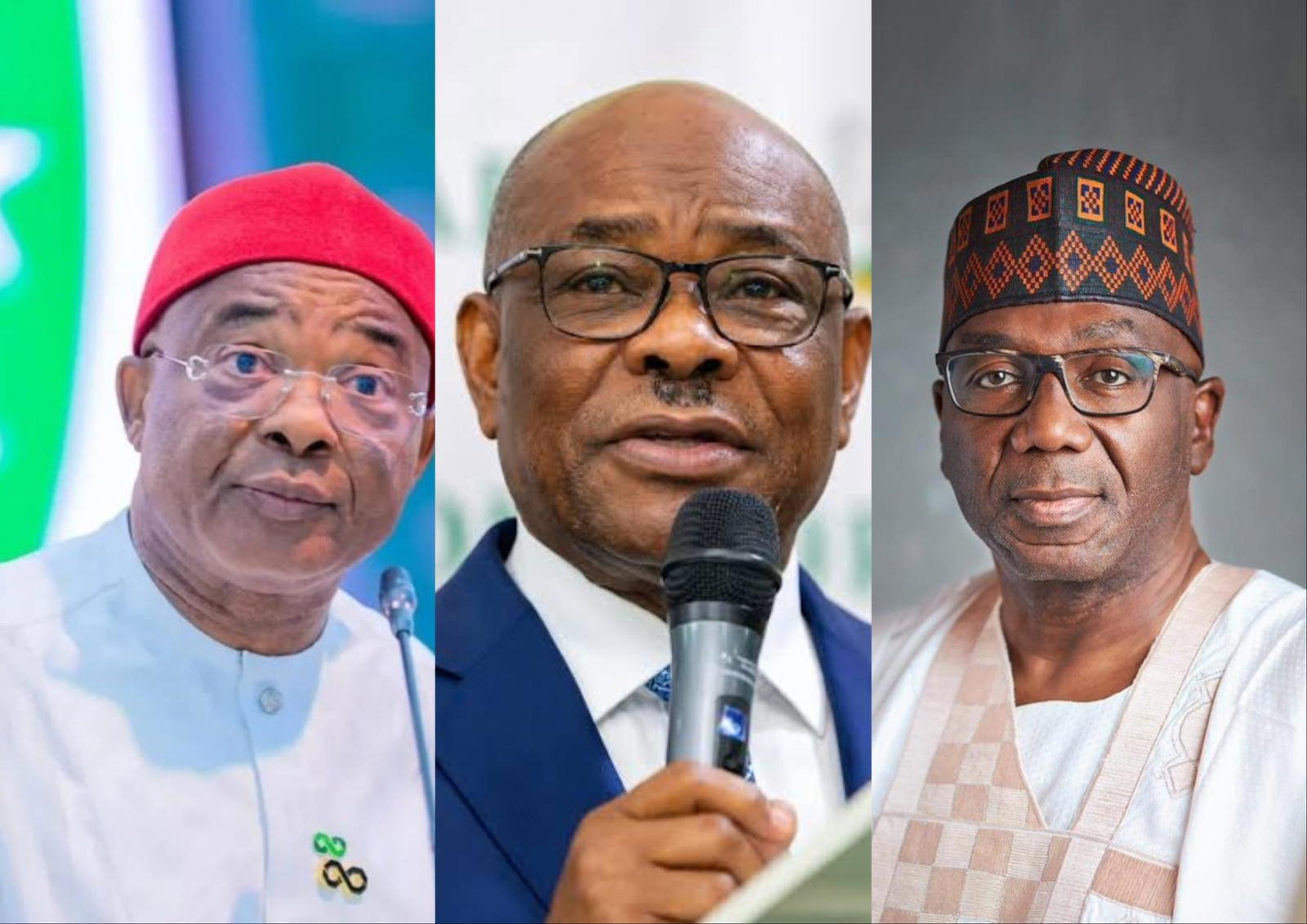
Photo collage of Imo State Governor, Senator Hope Uzodimma; FCT Minister, Nyesom Wike; and Kwara State Governor, AbdulRahman AbdulRazaq.
Tension that had simmered for months within the All Progressives Congress, APC, and the immediate circle of President Bola Tinubu has finally spilled into full public view, setting the Minister of the Federal Capital Territory FCT, Nyesom Wike, against a bloc of governors elected on the party’s ticket, and raising hard questions about how the president plans to keep his disciples intact heading into the 2027 election.
The governors staked out their position at a closed-door session of the Progressive Governors Forum PGF in Abuja last Monday, presided over by Imo State Governor, Hope Uzodimma.
Accounts of that meeting indicate the forum resolved that the party would throw its weight behind official APC candidates alone, refusing to endorse anyone emerging from an outside coalition. Their reasoning centred on the fear that backing candidates beyond APC’s own fold would dilute the party’s strength, sow confusion among voters at the grassroots, and split loyalties within the ranks.
Speaking on behalf of the group, Uzodimma warned that the party had no appetite for arrangements likely to fracture internal loyalty or put Tinubu’s second-term ambitions at risk.
The governor’s fears might not be misplaced but it is simply about self-preservation and not for the love of the president. In the days of the defunct Alliance for Democracy AD when its governors agreed to work for the reelection of then President Olusegun Obasanjo, only Tinubu, as Lagos State Governor, survived the aftermath. His othe colleagues lost their states and Obasanjo became the greatest beneficiary. The governors are concerned that Wike’s rainbow coalition, of allowed to stand, could cause political mishaps for them.
Wike has met the governors’ position with open defiance rather than any attempt at reconciliation. Appearing on Arise Television, he flatly denied ever seeking the governors’ endorsement for what his Rainbow Coalition, a grouping that pulls together politicians from rival parties who, by his account, are mobilising for Tinubu’s re-election rather than for the APC as an organisation.
“There is no day I went to the Governors’ Forum to align with any rainbow coalition—there is no such day. I have never, one day, gone to the APC Forum for an alliance.” His pushback did not stop there; he went on to brand the governors as “politically lazy,” and compared their handling of the matter to fraudsters who talk big but lack any real strategy for delivering the president votes.
The minister has also worked to place himself beyond the governors’ reach by invoking his direct relationship with the presidency. “There is nothing that I do that I don’t tell Mr President. I am not answerable to APC governors,” he said.
This confrontation did not appear overnight. Political analyst Uche Igwe, traced its origins to the day Wike was named FCT minister, an appointment that unsettled long-standing power arrangements among Tinubu’s southern allies, where Wike and Uzodimma both wield considerable influence without necessarily pulling in the same direction. Wike himself has alluded to this.
Denge Josef Onoh, a former South-East spokesman for Tinubu, has placed the present standoff within the broader sweep of Wike’s political history, pointing back to his role in the G5, a bloc of PDP governors who withheld their backing from the Peoples Democratic Party PDP’s Atiku Abubakar in 2023 after Wike’s own bid for the party’s presidential ticket fell to Atiku. Onoh contended that the episode ended up benefiting Tinubu by widening the cracks inside the PDP, a precedent he implies is worth watching as this fresh dispute plays out.
What lit the fuse this time is the Rainbow Coalition project itself, which Wike has spent weeks publicly championing as his contribution to securing Tinubu a second term by pulling opposition figures into the president’s camp without asking them to formally defect.
He has spoken of the coalition’s potential to keep expanding, citing Osun State Governor-elect Ademola Adeleke’s visit to the president as proof of a broadening political realignment. Yet it is exactly this openness to politicians outside the APC that troubles the governors, who see any Rainbow Coalition candidate elected under a different party’s banner as another seat lost to the opposition, regardless of how loyally the occupant or candidate may serve Tinubu personally.
A president preparing to seek re-election can ill afford an open clash between his governors and one of his most prominent ministers becoming public spectacle. The APC’s Presidential Campaign Council (PCC) has already sounded the alarm. One of its spokesmen, Ima Niboro, has warned that the standoff could damage the party’s fortunes in 2027 if it is allowed to fester, even while describing it as an internal disagreement among allies chasing the same objective.
Tinubu faces a dilemma cutting both ways. The governors hold the levers of party structure, local government networks and, in many states, the grassroots machinery that actually turns out votes, resources that Wike, whatever his public profile, does not directly control across most of these states. Yet Wike has cast himself as the one broadening Tinubu’s appeal beyond the APC’s traditional base, drawing in politicians who might otherwise stay neutral or throw their support behind a rival. His development exploits in the Federal Capital Territory FCT is, arguably, the major bragging right of the ruling party. Whichever side ends up feeling sidelined, the cost will be real, and the governors’ formal rejection of the Rainbow Coalition, matched by Wike’s equally public refusal to answer to them, means this is no longer something Tinubu can allow to quietly work itself out.
Has Tinubu stepped in, and where would he lean?
So far, the president has kept his own counsel publicly, and that silence is precisely what has fuelled growing calls for him to step forward. Niboro’s appeal to the president, framed around Tinubu’s political experience and capacity to settle the matter internally, is itself an admission that no such intervention has yet materialised. Wike, meanwhile, maintains that Tinubu is already fully informed of his political moves and, by implication, sympathetic to his side, insisting there is nothing he undertakes politically without first briefing the president.
Party opinion is already splitting along the same fault lines as the two principals. Former lawmaker Abdulmumin Jibrin has publicly rallied to Wike’s defence, saying the minister does not deserve to be publicly humiliated and arguing that virtually every APC member has, directly or indirectly, benefited from Wike’s role in delivering the president and running the affairs of government. Others, chiefly the governors themselves, appear to be banking on Tinubu ultimately favouring party discipline and structure over loyalty to a single minister, however valuable his contributions may be.
If Tinubu comes down firmly on the governors’ side, compelling Wike to bring the Rainbow Coalition under strict APC control or to soften his public attacks on the PGF, he stands to alienate a minister who has been central to his political strategy in the South since 2023 and who has already demonstrated, through his G5 role that year, a willingness to damage a campaign from within when he feels disrespected. A sidelined Wike, denied the coalition project he has poured months of public effort into, becomes a far less predictable ally than one working in step with the president. Should Tinubu instead back Wike, effectively giving the Rainbow Coalition his blessing over the governors’ objections, he risks a different kind of fallout: a Progressive Governors Forum left feeling that its authority over party discipline has been overruled in favour of a minister who is not even a registered APC member. Since governors run the party apparatus in their respective states, a bruised PGF could quietly scale back enthusiasm on the ground come 2027, a subtler but no less damaging form of disengagement than an outright public revolt.
The PCC’s description of the dispute, as a disagreement between allies working toward a shared goal, hints at the kind of compromise Tinubu is more likely to pursue than a decisive choice between the two camps. Such a settlement might involve the president acknowledging the Rainbow Coalition’s value to his re-election bid while insisting it stop short of fielding candidates directly against sitting APC officeholders, an arrangement that would let Wike keep his project alive while letting the governors keep their territory intact. Given Tinubu’s track record, illustrated by his earlier efforts to broker peace between Wike and Rivers State Governor Siminalayi Fubara, of favouring negotiated truces over blunt rulings, a similar brokered outcome between Wike and the PGF remains plausible, though it would require both camps to climb down from positions they have, so far, stated without much room for compromise.
Perhaps the greater danger lies in the president continuing to say nothing. Each day the standoff goes unaddressed, it calcifies into a public storyline of disunity within the APC just as the party heads into a contest it cannot afford to fight divided. Wike’s sharpening rhetoric, including accusations levelled at named governors over greed and political laziness, combined with the governors’ decision to formalise their rejection of the Rainbow Coalition through an official forum resolution, points to a rift that has moved well beyond private grumbling into a matter of public record ripe for exploitation by opposition parties.
Left to fester, it also threatens to stall cooperation between the FCT minister and APC governors in states where their combined, if uneasy, efforts have previously proved necessary to deliver results for the president, precisely the sort of quiet structural damage that becomes far harder to undo once campaign season is in full swing than a dispute settled early and decisively. The onus is on the president.
Comments expressed here do not reflect the opinions of Vanguard newspapers or any employee thereof.