5 Hard Truths for Putin About a Russia-NATO War - Newsweek
For months, European allies have cautiously warned about the prospect of war with Russia, urging the continent to take the threat seriously and rearm itself for the possibility.
The warning was always hedged: a Russia-NATO war was still unlikely.
In the past week, something appears to have changed, and so has the urgency.
Polish Prime Minister Donald Tusk told parliament that Russia intends to send drones or missiles into NATO territory and then call the strikes accidental. The Czech Republic’s intelligence chief put the timeline for such a test at months, not years.
CIA Director John Ratcliffe flew to Moscow in August to warn against precisely this. There is a growing sense of imminence in Western capitals; that Russia has chosen to escalate with NATO over Ukraine in a way that could provoke conflict.
All of it rests on one assumption: that Russian President Vladimir Putin has the ability to escalate into a direct confrontation with NATO.
He has the option to provoke, certainly, and the Russian threat to NATO should not be underestimated. Putin can be an agent of disruption and chaos, as he is currently with Russia’s hybrid warfare against NATO allies.
But there is good reason for cool-headedness about what Russia is capable of doing to NATO. Five hard truths for Putin suggest he does not have the option to fight the West in a major open war, even if he wanted to.
Russia has already spent much of the force a NATO war would require in the killing fields of eastern Ukraine.
The security think tank CSIS estimates 1.4 million Russian battlefield casualties and as many as 450,000 dead between February 2022 and June 2026. For perspective, that is more than four times all U.S. fatalities in every war since World War II combined.
In 2026, monthly casualties of 30,000 to 34,000 outrun recruitment of roughly 27,000. The IISS, another think tank, which puts Russian deaths above 300,000 by early this year, has tracked a recruitment slide since late 2025, though not enough to end Russia’s campaign.
What all that death and injury bought Russia on the battlefield is negligible.
Russian forces advanced 50 to 90 meters a day in this year’s main offensives, CSIS says, roughly the pace of the Somme in World War I. In April and May they lost more ground than they took, the first net monthly losses since August 2024.
An army struggling to break fortified Ukrainian defenses would face an even more formidable challenge against a U.S.-led NATO coalition.
Russia imports more than 90 percent of its sanctioned technology through China, Bloomberg reported this year, citing anonymous sources, and Chinese goods made up 57 percent of Russian imports by 2024.
Russia is a minor Chinese trading partner in return, and a U.S. congressional commission concluded in August that the dependency runs essentially one way.
Trade fell in 2025 for the first time since 2020, and Reuters, citing unnamed Russian sources, reported that Putin went into the September 2025 summit in Beijing with Chinese President Xi Jinping seeking to reverse that slide.
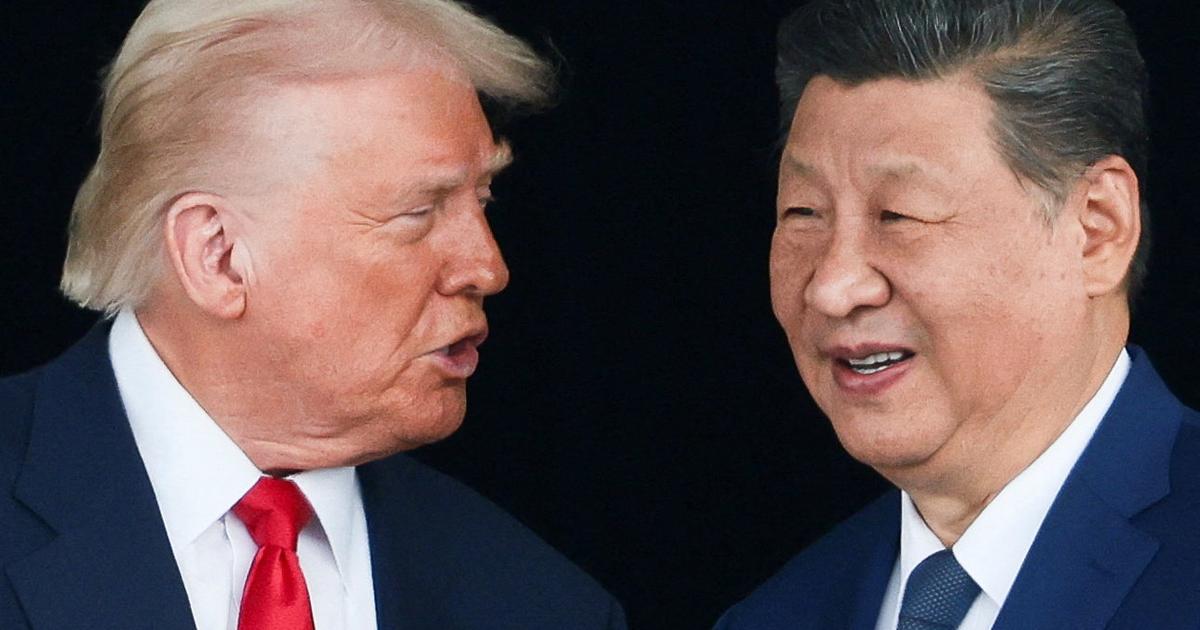
This asymmetry became even more apparent at the Putin-Xi summit in May 2026, when the Russian leader failed to secure an agreement with China on the Power of Siberia 2 gas pipeline. Xi knows he can hold out for lower prices when Russia becomes more desperate.
Moreover, Xi has not publicly committed any military support for Russia in its Ukraine war, despite their supposed "no limits" partnership, and maintains a diplomatic position that calls for an end to the conflict through a negotiated peace.
Beijing has no use for a Russia-NATO war, which in many ways runs counter to China’s interests.
A RUSI analysis in May argued that such a conflict would not stay regional, would raise the odds of nuclear use, wreck the conditions China needs to pursue Taiwan, and endanger the European market Beijing depends on.
The new sanctions law, signed by Trump on Friday, gives him the power to impose tariffs of up to 100 percent at the five largest buyers of Russian oil and natural gas. China is the foremost purchaser.
If Russia ups the ante with NATO, Trump, who hosts Xi at the White House in a few days, could choose to retaliate with those tariffs against China. It’s an outcome Beijing, which seeks a deeper and more stable trading relationship with the U.S., would much rather avoid.
China could either hit back hard with its own levies against the U.S., or pressure Putin to ease up. Xi holds more leverage over Putin than he does Trump.
The Russian economy shrank 0.3 percent in the first quarter of 2026, its first year-on-year contraction in three years, and the government cut its full-year growth forecast to 0.4 percent from 1.3 percent.
The central bank held rates at 14 percent on September 11, its first pause in 15 months, with inflation at 6.3 percent.
Meanwhile, Ukrainian drone strikes have gutted Russian refining. Export revenues from Russian oil products fell 32 percent in August from the month before, the lowest level of the war, and Moscow has paid refiners almost 916 billion rubles in subsidies since January.
Liquid reserves in the National Wealth Fund were down to about $48 billion by mid-year, from as high as $117 billion before the full-scale invasion.
Russia is simply much poorer because of its war against Ukraine.
Then there is the basic math of defense spending. Russia spent $190 billion on defense in 2025, about 7.5 percent of GDP. NATO’s members spent $1.58 trillion. How that money is spent matters enormously, of course. But so too does how much.
The New START nuclear arms control treaty lapsed on February 5, leaving the world’s two largest arsenals without binding ceilings for the first time since the 1970s.
Inspections had stopped long before that, when Russia suspended its participation in the verification regime in 2023.
Nuclear coercion is a popular tool in Putin’s box, one he and his allies in Russia wield frequently, but it cuts both ways.
NATO contains three nuclear-armed states and five allies formally host American B61 bombs. French President Emmanuel Macron said in March he had ordered an increase in the number of French warheads and opened deterrence talks with Britain and Germany, while the U.K. is buying 12 nuclear-capable F-35As to rejoin NATO’s nuclear-sharing mission.
There are signs that parts of Russia's nuclear modernization program are facing difficulties. Another Sarmat test failed in 2025, and the arms research institute SIPRI linked the program’s troubles partly to sanctions and the war in Ukraine.
"The significant increase in Russia’s non-strategic nuclear warheads predicted by the USA in 2020 has still not materialized," SIPRI’s analysis said in June.
Four and a half years of aerial attacks on Moscow, of Ukrainian troops moving into Kursk, of deep strikes on Russian strategic bombers—much of it facilitated in some way by NATO allies—have produced no nuclear response by the Kremlin so far.
Russia has developed and demonstrated hypersonic missile capabilities, including those that can carry nuclear warheads, such as the Oreshnik.
But these are matched by NATO’s advancing capabilities, and corruption brings elements of Russia’s nuclear arsenal into question.
On July 6, a Russian drone sent toward a gas station in Ukraine’s Zaporizhzhia crashed into a nearby apartment block and killed three civilians, in what The New York Times identified as the first recorded strike by a fully autonomous Russian attack drone.
Its brain was a commercial Nvidia minicomputer and that detail is really the key constraint the Kremlin faces as AI changes the shape of modern warfare.
Russia’s autonomy program depends on Western silicon it cannot make and cannot legally or easily buy.
Gray market imports of AI servers have collapsed from thousands in 2024 to dozens this year under the weight of sanctions, according to Russian media, and domestic Baikal accelerators are not expected before 2029.
This is a race decided by scale. American private AI investment reached $285.9 billion in 2025, and the Pentagon alone requested $53.6 billion for autonomy, drone platforms and contested logistics in its fiscal 2027 budget.
CSIS, studying Russia’s flagship drone maker, found grand claims about swarming and autonomy that did not convert into the capability the Kremlin’s forces actually fielded or deployed.
Russia improvises brilliantly, as it has needed to do for a long time because of sanctions. But improvisation is not a substitute for computing power, and there’s little sign it’s capable of building its own.
Domestic AI capabilities will help determine leadership in autonomous weaponry, targeting, intelligence gathering, and advanced cyberwarfare. They will also shape who can solve AI's operational shortcomings and develop effective defenses against it.
If you are not at the cutting edge now, you will soon be left behind. This is the risk Russia faces.
None of this is a guarantee that Russia will not take a rash course of action against NATO.
Putin has repeatedly absorbed costs the West judged prohibitive, and a limited probe of NATO’s commitment to collective defense appeals precisely because it is cheap to Russia.
As Chatham House analyst Keir Giles has argued, the only way Moscow can learn whether Article 5 holds is to test it.
U.S. intelligence reportedly sees the period between this fall and 2029 as the most likely window for a test of NATO, while rating a ground incursion least likely, because that is what triggers Article 5.
U.S. intelligence assessments reportedly suggest Putin's weakness may actually increase the incentive to escalate with NATO. Losing in Ukraine, or exiting without something Putin can sell as a victory at home, means he needs a bigger distraction or to undermine support for Kyiv by testing NATO unity.
NATO is also exposed where a probe would likely land.
The IISS says European land forces are not yet the conventional backbone NATO needs, GLOBSEC calls allied air defense "far too thin," and Washington is weighing the withdrawal of 25,000 or more of its roughly 80,000 troops in Europe.
Slovakian Prime Minister Robert Fico even said he does not want his country fighting "because of some Article 5," casting fresh doubt on the commitment of certain member states to the founding principle of NATO.
Still, the U.S., Canada, and major European allies have repeatedly made clear that they would rally to each other’s defense under Article 5. It would take a lot of faith in Russia’s strength, and NATO’s fracturing, for Putin to pull the trigger.
For now, unless the situation materially changes for the worse, beyond sabre-rattling, expect more probing from Putin, not war.