90 elite soldiers, CIA’s help, a decoy: Inside US operation to rescue pilot from Iran - The Indian Express
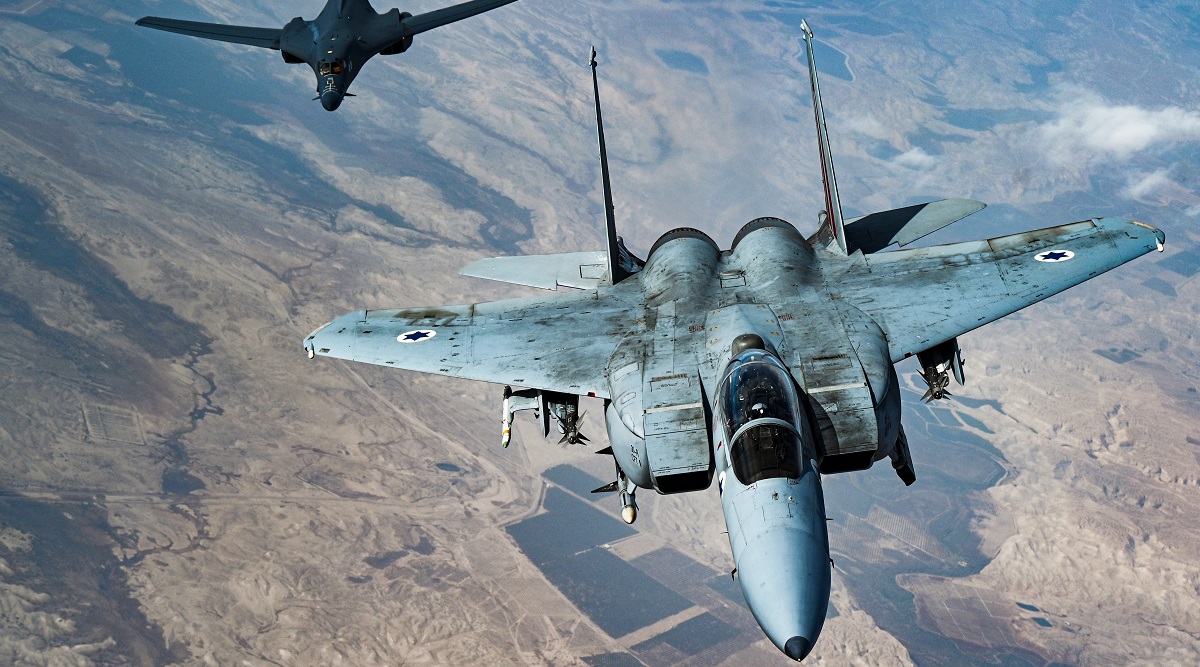
Five months after a US fighter jet was shot down over Iran, a US Air Force officer has recounted the events that led to his rescue two days after the crash.
The US Air Force colonel was aboard F-15E Strike Eagle near the city of Isfahan to conduct strike on an Iranian arms facility on the night of April 2 when the aircraft was brought down by a shoulder-fired missile.
The airman was the backseater on the twin-seat aircraft, flying alongside a pilot. His mission call sign was Dude 44.
Recalling the first memory of crash, Dude 44 said he was in a free fall at around 112 kmph to 160 kmph, with a damaged parachute.
“At one point when I looked up and saw no parachute, that was the most terrifying thing I’ve ever seen,” the pilot, identified as Bravo, said in an interview with CBS News’ 60 Minutes programme.
“So I paused, right then, and I prayed, ‘Lord, your will be done. But if I’m getting through this, I need help’,” he added.
After the plane crashed, the two pilots ejected from the damaged plane, but were separated during the fall. Alpha was rescued in a risky daytime operation, involving American helicopters, six hours after the crash.
However, things turned challenging for Bravo, who had sustained injuries during the high-velocity fall. He broke his back, an arm and a shoulder after hitting the ground.
“I believe that it’s a testament to God’s provision in my life to bring me through that moment in a way that didn’t prevent injuries, but prevented any catastrophic injuries that would have affected my ability to survive,” Bravo said.
The crash involving the F-15E Strike Eagle fighter jet over Iran was unique in American military history for many reasons. The April crash was the first instance when a manned US aircraft had been shot down over Iran during the US-Iran conflict. Also, the last American fighter jet to have been shot down in combat was an A-10 Thunderbolt II during the 2003 US invasion Iraq.
The F-15E, a dual-role fighter used for both air-to-air and air-to-ground operations, was near a mountainous area south of Isfahan, which houses Iran’s highly enriched nuclear material.
According to Admiral Brad Cooper, the commander of US Central Command leading American forces in the Middle East, cited in the interview, the mission for the two pilots was to conduct a strike on industrial facilities related to Iran’s drone and missile program.
The $30 million jet was brought down by a shoulder-fired missile, which can cost around $100,000.
The missile hit felts like “getting hit by a freight train”, Bravo said, adding the first that the two pilots did everything they could to try to save the fighter jet. However, it became clear the plane couldn’t be saved and the duo ejected the aircraft.
While Bravo fell hard, while Alpha landed 5 miles with his damaged parachute.
“I had injuries, but we all train to adapt and overcome the things that we’re faced with,” Alpha said in a statement to CBS News. “I moved as quickly as I could, despite the injuries, away from the place that I landed,” the statement read.
Bravo recalled that he was stranded in the middle of high desert valleys and cliffs. He realized that the only route to escape would be climbing up the cliff despite broken bones.
“And in the heart of Iran, where we were, there are high desert valleys, but also amazing craggly cliffs. And so I find myself in one of those valleys with cliffs on either side,” Bravo said in the interview.
Back in the US, Defense Secretary Pete Hegseth was woken in the middle of the night to update on the incident. His immediate concerns were: if the crew was ok and whether Iranians knew about the stranded pilots.
“Whether they’re alive or not, we’re going to go get them,” Hegseth reportedly said.
Meanwhile in Iran, television footage had already started airing footage of the wreckage and announced a $60,000 bounty to any citizen who locates the downed pilots. Evidence of the wreckage was shared by Iranian media and videos showed armed Iranian groups hunting for the downed crew.
US military sources told American media outlets that the Iranians had reached close to few hundred meters from Bravo.
Then began a rescue operation involving 90 of the US military’s “most elite service members”. The operation also involved the intelligence support from the CIA. The deploying of the US service members on the ground inside Iran was the first time in over 4 decades that American forces were operating inside Iran, according to Admiral Brad Cooper.
Mehr News Agency reports: an Iranian projectile struck a U.S. #helicopter during an operation to search for a downed pilot.#BreakingNews #Iran #US #War pic.twitter.com/IHspdc64RZ
During the “race against time,” the US military closely tracked Iranians in the area.
Within six hours of crash, the US was able to rescue Alpha in a risky daytime raid using helicopters, with incoming fire from Iranian soldiers. However, the rescuers couldn’t locate Bravo and withdrew.
Bravo was able to send a message to the US military, reigniting the hope of a rescue. He alerted the US forces that he was injured, but moving.
“When I got to the moment where I could review and think about all that I’d gone through, I sent, ‘God is good,’ as a recognition of all that he had brought me through,” Bravo said.
But the rescue would take another 24 hours. And Bravo was left with almost no water or food, in the cold of the high mountain desert for another day.
It was here that the CIA’s covert role came into play. The US agency launched a deception campaign to confuse Iranian forces looking for Bravo. It also used top-secret technology to pinpoint Bravo’s location, according to the report.
To make way for Bravo’s rescue, US bombers and drones hit Iran’s Revolutionary Guard forces near the location where he was hiding.
The rescuers came in on two large search-and-rescue planes and landed on a makeshift airstrip. Then they launched small “Little Bird” helicopters to rescue Bravo who was several miles away.
Upon seeing the rescuers, Bravo said it was “one of the greatest moments of my life”. The first words that came from Bravo after they first got to him was “Let’s go.”
However, the roadblocks were far from over. The rescue planes could not take off from the makeshift airstrip as the landing gear got stuck in the desert sand. The US military had to send an Air Force unit to rescue the 90 elite soldiers, along with rescued pilot.
However, before evacuating from Iran, the US destroyed the two defunct aircraft, along with the Little Bird helicopters, to prevent it from falling into Iranian hands.
Majid Alam is a Senior Copy Editor at Indianexpress.com. With over seven years of experience in journalism, he has worked across leading newsrooms, managing online news desk operations, heading shifts, and handling breaking news in fast-paced environments. While his primary experience has been on the news desk, his interests extend to field reporting and in-depth storytelling. He has reported stories on government policy, health, climate, and migration. He has previously worked with Hindustan Times, ABP LIVE, and News18. Majid holds a Master's degree in Convergent Journalism from the AJK Mass Communication Research Centre at Jamia Millia Islamia. He was also selected for an international mobility programme to study International Affairs at Sciences Po, Paris. He is part of the OCEANS Network, the alumni network of Erasmus+ exchange scholars, where he serves as the National Representative for India. ... Read More