A Catholic media star will be beatified in St Louis, moving a step closer to sainthood
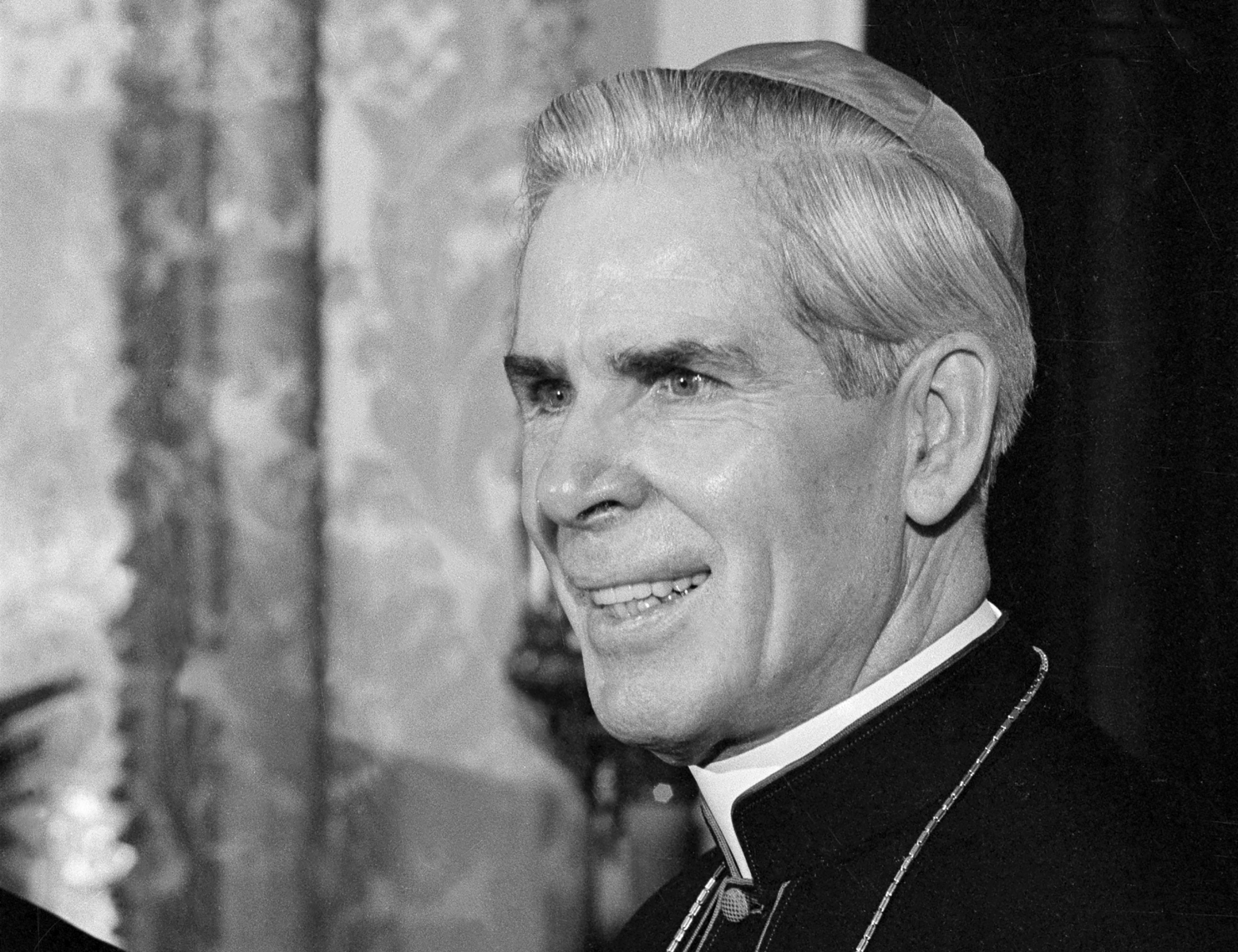
Bishop Fulton J. Sheen at his office at in New York during the 1950s. Sheen will be beatified on Thursday in St. Louis. Eddie Adams/AP hide caption
(RNS) — In 1953, Lucille Ball, the star of the hit show "I Love Lucy," was up for an Emmy for "Most Outstanding Personality."
She lost — to a Catholic bishop. then-New York Auxiliary Bishop Fulton J. Sheen.
"I feel it is time I pay tribute to my four writers — Matthew, Mark, Luke and John," then-New York Auxiliary Bishop Fulton J. Sheen reportedly quipped as he accepted the award.
This Thursday, the Catholic bishop who charmed millions while explaining theological concepts and scrawling on a blackboard for his show "Life Is Worth Living" will come one step closer to being declared a saint. His beatification — which comes after the Vatican found that he lived a life of "heroic virtue" and that his intercession was responsible for a miracle — leaves him one miracle shy of sainthood.
Sheen's beatification Mass will take place in St. Louis' former NFL Stadium, the Dome at America's Center, and will be presided over by Cardinal Luis Antonio Tagle, a media start of his own in the Philippines. It will also be broadcast by Catholic media giant EWTN and livestreamed on the YouTube channel of the Diocese of Peoria, Illinois, the diocese where Sheen was ordained.
For Sheen's fans and the team promoting his sainthood cause, the beatification is a moment to celebrate his enduring impact on evangelization, Catholic media and U.S. spirituality.
"One of his lasting legacies," said Peoria Bishop Louis Tylka, the promoter of Sheen's cause for canonization, "is the example and invitation for us to, like him, deepen our friendship with Jesus each and every day by being people of prayer, and in particular, praying in front of the Blessed Sacrament."
Tylka said Sheen's example of praying for an hour an day before the Eucharist — a practice he called the Holy Hour — helped popularize the devotion.
Artifacts and memorabilia depicting the late Archbishop Fulton Sheen are displayed in the Sheen Museum on July 15, 2026, in Peoria, Ill. Jessie Wardarski/AP hide caption
Sheen was born May 8, 1895, in El Paso, Illinois, and was ordained a priest in 1919. He taught theology and philosophy at the Catholic University of America from 1926 to 1950. After Sheen's time in the Archdiocese of New York, he was appointed Bishop of Rochester in 1966 and then was named an archbishop in 1969.
In 1930, he began hosting a Sunday night radio show, called "The Catholic Hour," that reportedly drew 4 million weekly listeners through national syndication on NBC Radio Network. In 1951, after he became auxiliary bishop in New York, he began hosting his TV show, "Life Is Worth Living."
Lonnie Carter, an award-winning playwright, remembers being "captivated" by the Tuesday night program as a child. "The bishop had a wicked sense of humor," and a following that extended beyond his fellow Catholics to his Jewish friends, said Carter.
Carter later met Sheen at the wedding of Sheen's niece and Carter's Marquette University classmate. "I found him to be present, dignified of course, humble in a sort of arrogant way and devilishly handsome," Carter told Religion News Service.
Carter, inspired by the upcoming beatification, has written a one-man play about Sheen, where Carter mixes excerpts from one real Sheen sermon with imagined sermons written by Carter on topics like football and poetry.
Organizers expect 50,000 people to attend the beatification Mass on Thursday — many with their own memories of Sheen and his show.
Bonnie Engstrom, who believes the late Archbishop Fulton Sheen helped save her son's life after he was born in 2010 without a pulse, looks at a photo of Sheen on display at the Sheen Museum in Peoria, Ill., on July 16, 2026. Jessie Wardarski/AP hide caption
In the Diocese of Peoria, Sheen's prayer life has also inspired lay Catholics. Bonnie and Travis Engstrom had the custom of putting each of their children under the patronage of a saint, but when Bonnie was pregnant with her son James Fulton in 2010, she began to watch recordings of Sheen's shows on YouTube, and they decided to pray for Sheen's intercession.
"He was so intelligent, but I felt like he had a way of taking really complex philosophy and political thought" to "break it down" for the masses, said Bonnie Engstrom.
During Engstrom's pregnancy, "everything pointed to a healthy baby," she said. James would be her third planned home birth. But when the midwife handed James to her, " he was completely limp" and a "bluish-gray" color.
As the midwife began CPR, her husband performed an emergency baptism and her friend left to call 911, Engstrom was in "a state of shock." She said, "I just remember sitting on the floor and not really being able to process anything, but I remember thinking in my head, 'Fulton Sheen, Fulton Sheen, Fulton Sheen.'" Engstrom said it was like when you're walking next to a friend, and you trip and then call out their name.
James' heart didn't beat at their home or in the ambulance or even when he first arrived at the emergency room. Days later, an attending physician in the neonatal intensive care unit added up the minutes James had been without a heart beat — and to the doctor's disbelief, it had been one hour and one minute.
Because of her faith, Engstrom was not shocked to have witnessed a miracle. "I think very much so that Bishop Sheen made a Holy Hour, and when that Holy Hour was over, that was when Jesus Christ brought James back to life," she said. "It was at 61 minutes, not 59," she explained.
James is now a healthy 16-year-old and the team manager for his high school's freshmen football team. He and his family will be present at the beatification.
Engstrom said watching the Vatican's meticulous process for verifying her son's miracle — that it did not have a medical explanation and that Sheen was responsible — has reassured her faith in the Church.
" I now know how thoroughly that has been investigated, and there's a lot of rigor that goes into it," she said.
NPR does not offer or accept money for coverage or interviews. Anyone who makes such an offer or request is not an NPR employee and does not represent NPR.