
‘A home not a hotel’: Coalition promises largest migration cut in Australian history
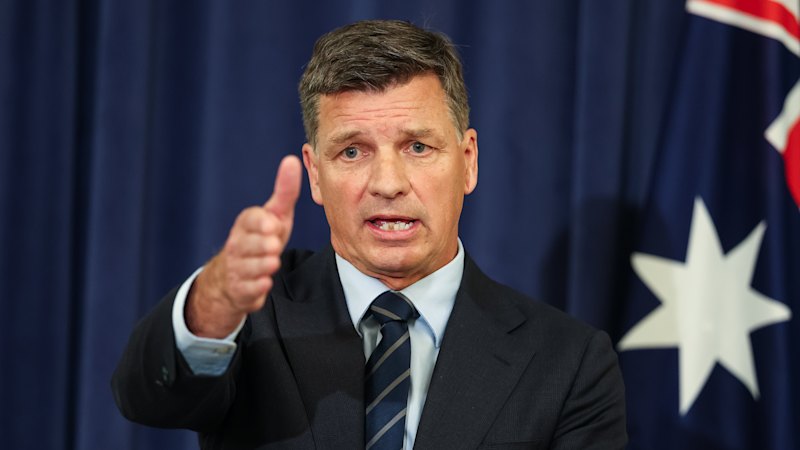
A Coalition government would slash temporary visa holders by 650,000 over four years in an immigration crackdown that Angus Taylor insists would not damage the budget bottom line.
The opposition leader billed Tuesday’s announcement to cut Australia’s net overseas migration by two thirds from the current net intake as “the biggest cut to immigration in the history of this country”.
Opposition Leader Angus Taylor and deputy Liberal leader Jane Hume.Louie Douvis“Australia should be a home, not a hotel. And right now, we’re seeing under Labor a guest worker economy,” Taylor said, accusing the government of using population growth to prop up the economy.
The opposition leader vowed the Coalition would reduce net overseas migration – the number of long-term arrivals minus the number of departures – from 292,000 to 100,000 in the first and second year. The Coalition’s target would increase to 160,000 by year four, he said.
The Coalition has announced its migration policy after months of internal debate as One Nation’s tough-on-migration stance fuels its rise in the polls.
Labor is trying to bring net overseas migration down to 225,000 in two years, while One Nation wants to drive the country into net negative migration for three years – more departures than arrivals.
Temporary visa holders would bear the brunt of the cuts under the Coalition policy. Temporary graduate visas for those entering the workforce after finishing university would be abolished, and visa applicants would be required to leave Australia before applying for another visa to “virtually eliminate” bridging visas, which have more than doubled in the past three years. Australia’s refugee intake would also be halved, to 10,000.
Taylor said while 650,000 temporary visas would be cut, 100,000 skilled migrant visas would be added. He said a focus on skilled migration meant the changes would not cost the budget because skilled workers brought in $30,000 in tax and economic contributions – three times that of temporary students and graduates.
“We are very, very confident that that simple approach – reducing the numbers but raising the standards – ensures that it’s budget neutral and will strengthen the economy, improve productivity, improve competitiveness, improve the skills,” Taylor said. In a statement, the Coalition said the overhaul would generate $260 million over four years.
Attracting skilled migrants remains a persistent challenge for critical fields such as medicine, with experts warning Australia’s slow and complicated approvals process increases the risk of losing foreign talent to other nations.
Jonno Duniam, who has shepherded the policy as the opposition’s home affairs spokesman, vowed that a Coalition government would fund the Department of Home Affairs to clear the backlog of more than 400,000 bridging visas.
“The fact that they take this long is unacceptable,” Duniam said. “There is no excuse.”
He slammed Labor for relying on delayed visa applications as a way to control migration numbers.
Duniam said the Coalition would repeal Labor’s cap on the number of working holidaymakers staying longer than a year, and instead charge higher fees for each year. Second- and third-year backpackers would have the fee waived if they completed farm work in the regions. This would include British backpackers, whose numbers have ballooned since a Morrison-era free trade agreement waived the requirement for regional work.
Andrew McKellar, the chief executive of the Australian Chamber of Commerce and Industry, said Australia’s economy was not strong enough to handle such sweeping cuts.
He accused the country’s politicians of chasing arbitrary migration targets instead of boosting productivity, and implored them to refocus the debate on skills shortages, over-regulation and high taxes.
“Business rejects the false binary that Australia must choose either fewer migrants with higher skills or more migrants with lower skills,” McKellar said in a statement.
“The Coalition is right to call for better prioritisation of critical skills, stronger integrity measures and a bigger productivity agenda, but the scale of these cuts will hurt our economy.”
The Coalition’s policy lands somewhere between One Nation’s uncosted plan and Labor’s forecasts.
One Nation previously advocated for 130,000 more people arriving than departing. But last month, under pressure from its right-wing online base, it backflipped and released a policy to go into negative territory, meaning more people would depart than arrive, for three years. After three years of negative inflows, One Nation said the figure would then settle at the 130,000 figure.
Barnaby Joyce said earlier on Tuesday that his party was driving the political agenda.
“I congratulate the Coalition for basically coming up with our policy,” Joyce told Nine’s Today show. “We are moving both the Labor Party, we’re moving the Coalition.”
Cut through the noise of federal politics with news, views and expert analysis. Subscribers can sign up to our weekly Inside Politics newsletter.
You have reached your maximum number of saved items.
Remove items from your saved list to add more.


