AI data centres are springing up in communities across the country. Now, residents are fighting back
You have reached your maximum number of saved items.
Remove items from your saved list to add more.
Since this edition of Good Weekend went to print, Goodman has withdrawn its proposal for the Project Mars data centre. This story has been updated to reflect this announcement.
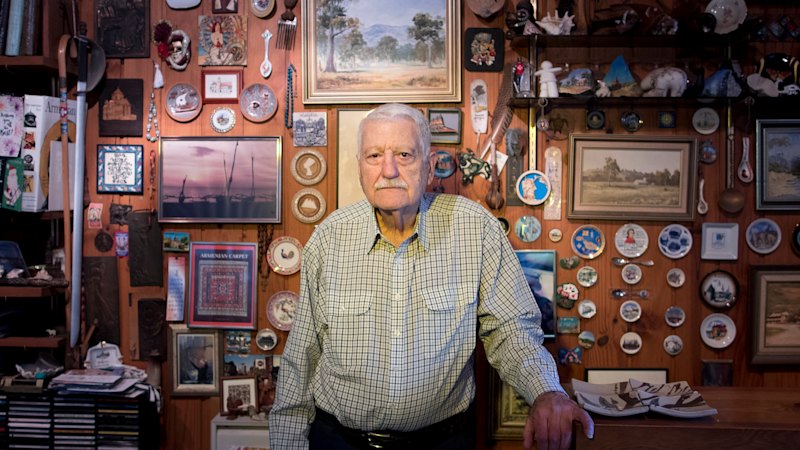
Shavarsh Bedrossian might be 82 years old, but he remains a man of restless energy and boundless interests. He carves wooden toys at his neighbourhood men’s shed, which he donates to orphanages in PNG. He organises scenic lunches at his local Probus Club. He regularly plays ping pong at the Hunters Hill Glades Table Tennis Group, where he is the president, vice president and treasurer. But perhaps his greatest love is his home, a modest brick bungalow in Lane Cove, on Sydney’s north shore, where he has lived for 56 years and four months. “I bought it for $15,900 in May 1970,” he tells me, sitting at his dining-room table. “The owner threw in his dog, too, a little dachshund, because he was going to a nursing home and couldn’t take it with him. So I got the house and a dog!”
Bedrossian, who was born in Egypt to Armenian parents, has seen plenty of change in Lane Cove, which used to be the site of a rubbish tip, but has long been gentrified by professionals and young families. There are daycares and primary schools, a national park and, of course, the Lane Cove River, a remnant natural area painstakingly restored by bushcare volunteers. He had hoped to live out his final years here in peace and quiet.
Then, one day in April 2025, he received a glossy flyer from a company called Goodman, announcing plans to build a new data centre, Project Mars, in the nearby business park in Lane Cove West. According to the flyer, the data centre would provide “increased speed of digital access” and “better security of sensitive data” for businesses all over Sydney. The flyer featured an artist’s impression of the proposed development, a futuristic facility with an elegant, curved facade and rooftop garden.
Bedrossian knew what a data centre was: a US company called AirTrunk had built one across the other side of the business park, in 2020. That building was boxy, windowless and irremediably ugly, and it made a constant humming noise like a meteor-sized fridge. Its only saving grace was that it was almost half a kilometre away from the nearest houses. But Goodman’s data centre, which would be three storeys tall, was meant to be just four metres from the community garden nursery and 16 metres from Bedrossian’s fence. The local primary school and daycare centre were only a block away. The facility would run 24 hours a day, seven days a week. “It certainly seemed very big,” says Bedrossian. “And so close!”
Concern began to spread. People began reading about the impacts of data centres in the US. Over the coming months, residents, sporting organisations, dog-walkers, and just about anyone else who loved the suburb began meeting, informally, to consider their options. Paul Trainor, who has lived in Lane Cove for 25 years, was one of them. “At that stage, we didn’t have much detail about Goodman’s proposal,” he says. “So our discussions were pretty vague.”
Homes behind the Vantage Data Centre facility in Sterling, Virginia, which has the world’s highest concentration of data centres.AdvertisementBy early 2026, however, Goodman had begun lodging more documents. It became apparent, for example, that the data centre would rely for back-up power on 49 diesel generators, requiring the storage of more than one million litres of diesel fuel on site. It also emerged, thanks to the local newspaper, that Goodman wasn’t the only developer eyeing off the site, and that were four more data centres in the pipeline. “That’s when we got really scared,” says mother of two, Sasha Titchkosky. Residents formed an action group, called Lane Cove Responsible Planning (LCRP), with Titchkosky as its spokesperson. It became clear to the group that, if the projects were approved, their suburb could, within five years, be host to a whole data-centre cluster. “They’d use almost 400 megawatts, which is enough to power 200,000 homes,” says Titchkosky. The buildings, up to 34 metres tall, would sprawl across the site, looming over the streets and bushland like a crippled space station, pulsing with heat and light.
But Goodman couldn’t have known what the locals had in store. Over the next six months, LCRP would mount a formidable community campaign, an all-hands insurgency against Australia’s largest industrial property developer. “We had so many moments where we felt it was inevitable,” says Titchkosky. “It seemed pretty hard to stop it, but we were committed to doing everything we could to protect our community.”
Data centres are sometimes called AI factories, insofar as they store and process all the information that makes the digital age possible. Notwithstanding the recent suggestion from tech chiefs that AI could make humans extinct within the next decade, demand for the technology is still surging and, along with it, the need for more data centres. At last count, Australia had 296 of them, with another 90 in the pipeline. Anthropic, the company behind the AI model, Claude, just signed a deal to use a $32 billion data centre, Australia’s largest, in western Queensland. According to CommBank, more than $150 billion will be spent on AI infrastructure in the next four years, mostly in NSW and Victoria.
Sasha Titchkosky, who heads local opposition to data centres, hopes for a moratorium on their construction.Brent LewinPoliticians find it virtually impossible to say no to this kind of money, and have given the industry the red-carpet-and-petals treatment. Data centres are routinely deemed to be “essential infrastructure”, allowing them to bypass local planning laws. NSW and Victoria have agreed to assess applications in 75 days, quicker than most councils take to tick off on a cat flap. As Craig Scroggie, CEO of NextDC, one of the biggest players in Australia, put it recently, “when we need access to [planning ministers] … we just make the request and generally they are very, very happy to support what we’re doing.”
But data centres have several large and well publicised problems, including their profligate use of water for cooling and their appetite for land that could otherwise be used for housing. Noise is also an issue. In August, Victoria’s Environment Protection Agency lodged an objection to the Project Dune data centre in Campbellfield in Melbourne’s northern suburbs. The data centre, which is being developed by Singapore-based multinational, Zerra DC, will house 294 massive rooftop chillers, each of which would emit 80 decibels of sound – about the equivalent of a running petrol mower. (In September, Victoria announced new regulations banning the use of drinking water for cooling, and mandating a 150-metre buffer between any new data centres and homes.)
Among the most troubling aspects, however, is data centres’ power consumption. The Australian Energy Market Operator expects data-centre energy demand to triple to nearly 12 terawatt hours by 2030, or about enough to power all the homes in Victoria. As it stands, most data centres in Australia are powered off the grid with diesel generators as back-up. (Some data centres, including a 673-megawatt facility planned for Moss Vale, in the NSW Southern Highlands, intend to use gas-fired generators, a particularly carbon-intensive form of power.)
In the US, extra demand on the grid from data centres has seen energy bills spike by up to 267 per cent over a five-year-period. In an effort to avoid this happening here, Prime Minister Anthony Albanese has said new projects must provide their own energy and that it must be renewable, conjuring images of shiny new facilities with their own solar farms next door or wind turbines on the roof. NSW Treasurer Daniel Mookhey has even framed this as a “virtuous cycle”, where data centres drive demand for renewable energy, which powers more AI, which drives further demand for renewable energy.
But overseas experience suggests this is unlikely. According to the International Energy Agency, only 27 per cent of the electricity consumed by data centres globally comes from renewables, and much of that involves Power Purchase Agreements, which often include nuclear power. Indeed, Meta, whose AI drives Facebook and Instagram, is now one of the largest private buyers of nuclear energy in history.
Goodman planned to power Project Mars from the grid, with diesel generators for back-up. While some data-centre operators are exploring the use of recycled water for cooling, this was never going to be an option in Lane Cove, however, since the appropriate infrastructure doesn’t exist at the site.
Goodman is one of Australia’s largest infrastructure companies, with $90 billion worth of property in 15 countries. The company’s motto is “make space for greatness”, but mostly it’s been making space for data centres, 16 of which it has built since 2005, including in Los Angeles, Hong Kong and Barcelona. Community engagement is a crucial part of such projects, but in Lane Cove, locals felt that the process was, from the beginning, a glorified box-ticking exercise. The company held two community information sessions at Lane Cove Mall in April 2025, but locals were given only three and seven days’ notice for each, and the sessions were poorly attended.
One of those to go along was Paul Trainor and his wife. “It was just a few people standing beside a fold-out table with a few little A4 maps of the project,” Trainor says. “I asked them about how the construction would affect transport in the area. They said they didn’t know but would get back to me, but they never did.” Four months later, Goodman held more meetings and a webinar. They also distributed surveys and questionnaires. Afterwards, they asked for community feedback.
The results were conclusive: 85 per cent of residents surveyed believed they would be negatively affected by the data centre and most struggled to identify any positive benefit. (Residents submitted 374 objections to the project, with only nine in support.) Despite this, in December 2025, the company released its Engagement Outcomes Report, which concluded that the data centre would “contribute to community activation and skills development”, with “minimal to no visual impacts” on the surrounding parks. As the overall impact of the data centre would be “low to moderate”, Goodman announced it had no further need to involve the community. “From that point on, we weren’t being engaged any more,” says Titchkosky. “We were being told.”
Local resident Paul Trainor worried the data centre’s impact was being downplayed.Brent LewinIn March 2026, Goodman released its Environmental Impact Statement (EIS). It was more than 3000 pages long. As a semi-retired investment manager, Trainor was accustomed to reading long, technical documents, and began slogging through it. Titchkosky and others did the same. The more they read, the more worried they became. The document was riddled with errors, inconsistencies, and what Trainor calls “sleights of hand”, the cumulative effect of which was, in his opinion, to minimise the development’s size and impact. For example, the nearest houses were repeatedly reported as being 200 to 250 metres away. (The nearest is, in fact, 16 metres away.) The data centre’s total power consumption was described as both 81 megawatts and 60 megawatts. (The state government, meanwhile, still has it listed on its planning website as 90 megawatts.) In earlier submissions, Goodman had variously estimated the maximum height of the project as 15 to 25 metres, then 33 metres, before settling on 28.3 metres in the EIS. “This is important,” says Trainor, “because in the photomontages they use for the visual impact assessment, it’s not clear if they’re relying on 25, 28.3 or 33 metres.” (According to Goodman, the facility was intended to be 81 megawatts, and any references to the nearest houses being 200 to 250 metres away were due to “administrative inconsistencies”.)
One of the most troubling aspects of the EIS was the air-quality assessment. Goodman’s facility embodied the awkward paradox of data centres everywhere, in that while they boast of being at the bleeding edge of the computer age, they are reliant for back-up power on a decidedly outdated form of energy: diesel engines. There were 49 large diesel generators planned for Project Mars, the operation of which would have emitted substantial quantities of nitrogen dioxide, a reddish-brown gas that can cause everything from watering eyes to chronic lung disease, along with fine particulate matter, and benzene, a well-known carcinogen that is particularly linked to leukaemia and other blood cancers. (Unlike diesel cars and trucks, industrial diesel generators, including those in data centres, remain entirely unregulated in Australia, meaning that facilities like Goodman’s can be approved without any requirement to quantify or mitigate their local pollution impacts.)
The company claimed its generators would only fire up under “infrequent emergency scenarios”. But as climate change is making clear, emergency scenarios are no longer so infrequent: there have been at least four mass power outages in NSW alone since 2020, some lasting up to a week. This doesn’t count planned outages and localised blackouts. Besides, diesel generators in data centres must undergo regular testing. Goodman intended to test its generators quarterly, and for a total of no more than 200 hours, or eight days, a year. But as Titchkosky explains, Goodman’s data centre was just one of five such facilities planned for the Lane Cove site, resulting in potentially hundreds of generators, all of which would have to be regularly tested. “You have to look at the cumulative effects to realise what’s at stake,” she tells me.
Despite this, Goodman maintained that its effect on air quality would be negligible. But when the Department of Planning, Housing and Infrastructure reviewed Goodman’s EIS in May, it discovered that the company had neglected to measure the potential effect on air quality in some of the locations closest to the site, including the community nursery, the local skate park and tennis club. The department wrote back to Goodman, directing it to do more modelling, and to clarify inconsistencies and assumptions in no less than 15 areas, including the noise and vibration impacts on the local primary school and nearby houses. (Goodman told me requests for additional information were “normal” and that the company was working on the responses.)
An artist’s impression of the now withdrawn $1.2 billion Goodman data centre development.Goodman GroupAdvertisementGiven the level of community opposition to the project, the department also encouraged Goodman to undertake further consultation. And so, in August, the company hosted a couple of webinars, together with a series of one-on-one sessions with residents, to be held at Lane Cove Library. Goodman said the sessions were intended to “give local residents an opportunity to discuss their individual questions and feedback in a constructive and confidential setting. We have found that this format encourages more open and detailed conversations.”
But some locals found it intimidating. When Titchkosky turned up, there was a security guard on the door of the room. Inside, she was surprised to find six representatives from Goodman sitting at the table. “So it wasn’t one-on-one so much as six-on-one,” she says. Other locals found themselves contending with as many as seven Goodman employees. When I asked Goodman about this, I was told that the company wanted to ensure all the relevant experts were on hand to answer whatever questions might arise. “We’re sorry to hear that some people felt uncomfortable.”
Still, Titchkosky and Trainor left the meetings undeterred. A few weeks later, the group lodged a shareholder action with the Goodman board, questioning the company’s mandate to proceed with its Lane Cove project. The action, which still stands, obliges the company to raise the issue at its upcoming AGM in November. “The shareholder action is a signal to the data-centre industry that it requires a social licence when choosing sites that impact communities,” Titchkosky says.
Fighting a data centre takes time and energy, not to mention a good end-to-end encrypted messaging app. Members of Lane Cove Responsible Planning, which now number about 130, communicate mostly on WhatsApp, where they plan initiatives including letterbox-drops, information sessions and government submissions. When the core group of organisers meet in person, they usually do it around the dining-room table at Trainor’s house. “Most of the other people in our group have young kids, but our two children are grown up and at uni, so it’s easier for people to catch up here.”
Trainor, 61, lives just down from the primary school, where his wife still works in the uniform shop. “I’m particularly worried about the kids, with them breathing in the emissions,” he tells me. “COVID was all about saving old people. But I think we need to focus more on the young ones: they’re the future.”
Trainor was also worried about the fire risk. Project Mars’ generators would have required the storage of 1 million litres of diesel fuel on site, together with almost 200 tonnes of lithium-ion batteries. Together with the four additional data centres, those numbers were set to blow out to extraordinary proportions. Titchkosky calculated that such a cluster could necessitate the on-site storage of more than 5 million litres of diesel fuel and 900 tonnes of lithium-ion batteries – a frightening prospect. While data centre fires are rare, when they catch alight, they stay alight, thanks in part to “thermal runaway”, a phenomenon where lithium-ion batteries undergo an uncontrollable chemical reaction, resulting in a self-sustaining and powerfully toxic fire.
Data centre proponents tend to wave away such concerns, while pointing out that data centres are, whether we like it or not, part of our critical infrastructure, securely storing data for essential services including hospitals, government and business. AI enables triple-zero calls and air traffic control, and is embedded in our military. AI also has other applications that, while strictly speaking not critical, could be defined as a net benefit. For instance, Social Protect, an Australian-founded software app, uses AI to detect and delete abusive, racist or sexual comments on social media posts (just in time for AI to generate more abusive, racist, or sexual comments. But still.) AI is also being used to help identify endangered species, and assist in disaster-response planning. “Not everyone understands what data centres do,” says Belinda Dennett, the CEO of Data Centres Australia (DCA). “We need to do a better job of explaining that to people.”
Dennett is a veteran tech lobbyist. She worked for 12 years as Microsoft Australia’s director of corporate affairs before becoming head of government relations for data centre operator AirTrunk. As the head of DCA, she has become both an indefatigable AI-advocate and unflinching human piñata, a data centre super fan in a world that increasingly hates data centres. “The stuff you read is so blown out of proportion,” she tells me on a Zoom call. Take the water issue. “Only 2.3 per cent of the water that’s used in manufacturing is used in data centres. It’s not like you go stick a pipe in a lake and drain the lake.” Besides, “We wash down manufacturing equipment with drinking water and no one seems to object.” Concerns about energy are similarly misguided, she says. For instance, the hair-raising figures on power consumption are actually due to something she calls “phantom demand”: “Many data centre proposals do not proceed to being built. We know there are speculative and duplicative applications in the system that make demand look much larger than it is.”
Belinda Dennett, CEO of Data Centres Australia, believes the fuss over data centres will fade. “The outrage will move to something else.”Oscar ColmanDennett is bargaining that the fuss over data centres will fade. “The outrage will move to something else,” she says. Fifteen years ago, she worked on the rollout of the National Broadband Network, a similarly contentious piece of infrastructure. “We faced all this sort of backlash about the NBN. ‘Why do we need it? It’s just for downloading movies. It’s too much money. It’s ripping up footpaths.’ And now we never talk about it, and it’s just accepted that it’s there.”
But the distrust of Big Tech is more visceral, not to mention global, than anything faced by the NBN. Indeed, it’s hard to think of another major technology that has squandered its social licence faster than AI. Just years ago, AI was regarded as a breakthrough technology of unlimited promise, every bit as transformative as electricity and the railroad. Now, it’s seen as the malformed offspring of a small clique of malignant narcissists in Silicon Valley, delusional futurists toying with algorithms that promise to render redundant hundreds of millions of jobs around the world, all the while poisoning the planet.
Shavarsh Bedrossian compares the industry to Big Tobacco. “Remember the cigarette and asbestos companies?” he told me when I visited his Lane Cove home. “Remember what they said about their products? That they were safe to use?” He mentions the noise that comes from data centres. “It doesn’t matter to me, I’ll just take my hearing aids out, but what about the kids in the area, and the dogs? Animals hear different frequencies. And the kids, who will compensate them when they get older for damaged hearing?” As for the politicians, “what they say in public has nothing to do with what they decide in private. And those AI companies have unlimited lobbying funds.” He smiles wryly. “I’ll leave that to your imagination.”
On September 15, 1830, the world’s first steam-powered passenger train departed Liverpool, in north-west England, for Manchester, 58 kilometres to the east. Powered by a 20-horsepower locomotive, the Liverpool and Manchester Railway was a sensation, capable of hauling people and freight at speeds hitherto undreamt of, revolutionising trade and transport. More railways soon sprung up, sparking an investment frenzy. Ordinary people mortgaged their homes to buy railway shares, convinced they were securing a piece of the future. Investment ballooned before the bubble burst in October 1845, precipitating one of Britain’s worst financial disasters.
The speculative delirium that fuelled “Railway Mania”, as it became known, set a template for tech-bubbles to come, including, most notably, the dotcom crash of 2000, where investors feared missing out on what was breathlessly touted as the “new economy”. A similar story is being told now, only this time the technology is AI.
Investment in AI certainly seems disproportionate. Morgan Stanley estimates at least $US3 trillion ($4.2 trillion) will be spent on AI infrastructure by 2028. That is, to be clear, three thousand billion US dollars – almost double the size of the Australian economy (and 230 times what the world spends annually on global hunger). Nobel Prize-winning economist Joseph Stiglitz, among others, believes such spending is unsustainable. Indeed, with the technology yet to demonstrate a convincing return on investment and the biggest AI companies astronomically in debt, the industry has had to resort to what market observers, including famed Wall Street investor Jim Chanos and macro-economist Dean Baker (one of the first people to predict the 2008 housing collapse), consider to be little more than tech-utopianism and financial gimmickry.
“The AI bubble is just a series of different ghost stories used to ignore financials,” British journalist Ed Zitron told The Tech Report podcast in August. “It’s fantastical thinking.” But AI is no longer a parlour game for transhumanist kooks and libertarians. The seven biggest AI companies now represent about one-third of the value of the US stock market, the highest index concentration in modern market history. Any collapse could have catastrophic implications.
Where does that leave Lane Cove? For now, at least, Titchkosky has one less data centre to worry about. In late September, Goodman unexpectedly announced it was abandoning its plans for Project Mars, citing changes to the regulatory environment and “the views of the local community”. Titchkosky was elated. “We had a drink or two,” she tells me.
The fight against Goodman has been won, but more battles lie ahead. Last week, Titchkosky and Trainor appeared before a federal inquiry into the impact of AI and data centres on local communities. They are now advocating for a moratorium, like that in the US, where at least 294 cities and towns have paused construction of AI infrastructure. “Every week it feels like there’s some new development,” she says.
But no matter how busy she is, she makes time every morning to paddle her single scull along Lane Cove River. She’s usually in the water at 5.30am, just as the sun is rising. It is still and quiet, with thick mangroves and misty stands of paperbark. “I love the birds,” Titchkosky tells me. “This morning I saw pelicans, herons, cormorants and a spoonbill.” Spoonbills are rare in this part of the river, so close to the city. “I always notice them, because they’re white, with a feathered mohawk, a black, spoon beak and long black legs. They remind me of what’s at stake.”