
America’s Far Left and Far Right Are Converging on Critical Midterm Issues - Newsweek
Politicians have long joked that if you go far enough to either extreme, left or right, you end up somewhere pretty similar.
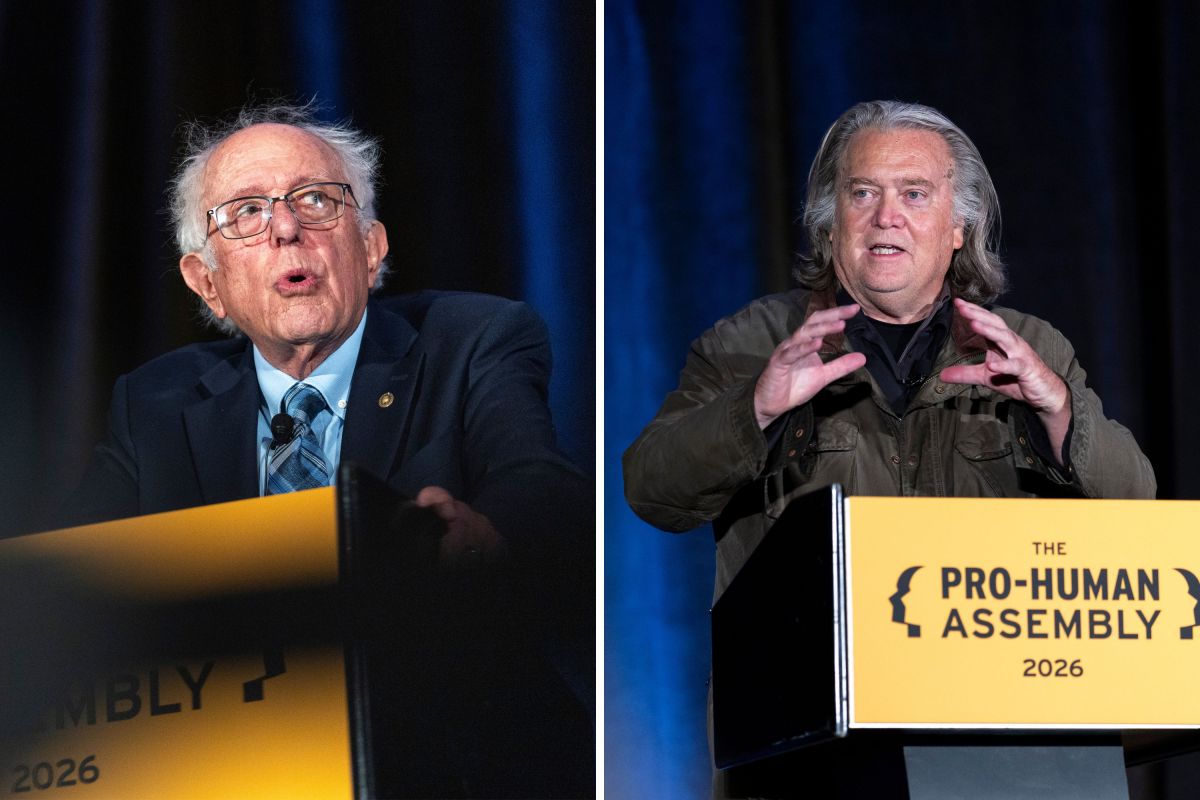
Voters may see some version of that play out before November's midterms. Vermont Senator Bernie Sanders shared a stage with Steve Bannon this week at an event calling for limits on artificial intelligence. Former Fox News host Tucker Carlson is using his platform to back Democratic hopeful Abdul El-Sayed over Republican Mike Rogers in Michigan's Senate race.
The war with Iran pushed Carlson further still, alongside commentator Candace Owens and former Georgia Representative Marjorie Taylor Greene, toward positions on Israel and foreign wars long associated with the progressive left.
The partisan divide hasn't disappeared — the two sides remain far apart on most fundamentals. But months into President Donald Trump's second term, an unlikely bond has formed between the political extremes.
Sanders and Bannon spoke back-to-back Tuesday at the Pro-Human Assembly, an all-day gathering organized by the Future of Life Institute, a nonprofit pushing to keep humans in control of advanced AI, in a packed Washington ballroom.
Speaking to nearly 300 people, Sanders said he'll introduce legislation next week with Texas Representative Greg Casar, a Democrat, to permanently ban development of artificial superintelligence — a hypothetical form of AI that would outperform humans at nearly every cognitive task. "Like nuclear weapons, artificial superintelligence is a threat to humanity, and it must be treated as such," Sanders said.
He saved his sharpest words for Washington itself: "Congress, under both Democratic and Republican control, has been asleep at the wheel, and we now have a president whose ignorance regarding this issue is truly embarrassing."
Bannon took the stage right after and opened with a nod to the senator: "I think Senator Sanders did a very good job of summarizing the risk." He then accused AI executives of exploiting their own calls for a slowdown to lock in market dominance. "All they're trying to do is to use a crisis and turn it to their advantage by creating a moat, a cartel," he said. "We're not doomers. But we aren't gonna give these guys carte blanche. Their arrogance is overwhelming."
Their solutions diverged fast. Sanders hopes Trump and Chinese President Xi Jinping will negotiate a treaty pausing advanced AI development when they meet at the White House next week. Bannon wants curbs on any exchange of chips, technology or knowledge with China: "Take all Chinese nationals out of the labs and back to mainland China."
The speaker list ran well beyond the two men — Republicans Marsha Blackburn and Chip Roy, Democrats Greg Casar and Lori Trahan, AFT President Randi Weingarten, San Francisco Archbishop Salvatore Cordileone, actors Ashley Judd and Joseph Gordon-Levitt, and parents of children who died by suicide after talking to AI chatbots.
The event landed amid rising alarm over the technology itself. Jacob Coxon, a former Anthropic researcher, resigned last week and wrote on X that researchers at the leading labs believe AI could kill all humans but keep pushing forward anyway. Anthropic CEO Dario Amodei followed with a call to slow the pace of AI capabilities — a position OpenAI's Sam Altman and Elon Musk later echoed.
Trump hasn't budged. In a string of Truth Social posts Monday, he dismissed the warnings outright: "AI taking over the World, destroying Humanity, and all other things bad, is a HOAX." In another post: "There is a SICK conspiracy going on against AI and Data Centers, and the only one that is happy about it is China. WHOEVER WINS AI, WINS!" He compared the backlash to the Russia investigation, saying it "is even wilder than the RUSSIA, RUSSIA, RUSSIA HOAX, or the Global Warming Scam."
Voters aren't so dismissive. A recent NBC News Decision Desk poll found 70 percent more worried than excited about AI, with discomfort holding steady across party, gender, education and geography. Forty-four percent trust neither party to handle the issue; 20 percent picked Democrats, 16 percent Republicans. Seventy percent said AI is costing jobs — a view held by 78 percent of Democrats, 69 percent of independents and 62 percent of Republicans.
NBC surveyed 7,105 adults August 20 through September 1.
Data centers have become the sharpest flashpoint. An Annenberg Public Policy Center survey found 61 percent oppose new facilities locally — 69 percent of Democrats, 54 percent of Republicans. Campaigns and outside groups have spent more than $45 million since January on ads mentioning data centers in governor, House and Senate races, an NPR analysis of AdImpact data found; more than 99 percent of that spending attacked the projects, according to a separate CNN review. By July, data center- and AI-related ads made up more than 8 percent of all broadcast campaign spending, up from under 1 percent a year earlier.
CNN has reported that some White House officials privately question Trump's approach, leaving vulnerable Republicans to navigate an issue showing up more and more in campaign ads. A University of Massachusetts Amherst poll conducted August 21-26 found just 23 percent of Americans said Trump handled AI well, versus 57 percent who said he handled it poorly — though 51 percent of Republicans gave him credit.
Gary Marcus, an AI researcher and professor emeritus at New York University, told Newsweek the backlash reflects a public that sees AI enriching a small number of people while dumping the costs on everyone else. "The backlash is intensifying because the public is waking up to the reality that AI is becoming more about making a few people rich than about helping society, and that all the downsides are being offloaded to humanity. It's jobs, it's the environment, and the fact that the big companies don't seem to know how to make their own software safe," he said.
Foreign policy has produced the deepest overlap of all. A cluster of prominent right-wing figures broke with Trump over the war with Iran and U.S. support for Israel, often using language long associated with the left.
The U.S. and Israel struck Iran on February 28. Within days, Tucker Carlson told ABC News the war was "disgusting and evil." Trump fired back, reportedly telling ABC's Jonathan Karl: "Tucker has lost his way. I knew that a long time ago, and he's not MAGA."
Marjorie Taylor Greene sided with Carlson. By April, she wrote on X that Trump "has gone mad as he wages war against Iran, a broken campaign promise" — this after Trump attacked Carlson, Candace Owens, Megyn Kelly and Alex Jones in a single post. "We NEVER changed, Trump did," Greene wrote.
Owens said she was "embarrassed" to have backed Trump after he first ordered strikes on Iran in June 2025. She and Greene have since suggested Trump's Cabinet should consider invoking the 25th Amendment to remove him from office, CNN reported.
Greene's break over Israel predates the war — in July 2025 she called the crisis in Gaza a "genocide," breaking with her Republican colleagues. Carlson has called Israel a "client state" of the U.S. and said Washington should push Israel to accept a ceasefire with Iran.
Greene's language during the 2025 strikes tracked closely with Sanders': "foreign wars/intervention/regime change put America last, kill innocent people, are making us broke, and will ultimately lead to our destruction." Sanders made nearly the same case about a Senate vote in April. "It's clear that Democrats are beginning to listen to the average American who is sick and tired of spending billions of dollars to support Netanyahu's horrific wars when people in this country can't afford housing or health care," he said after 40 of 47 Senate Democrats backed his resolution on April 15 to block a $295 million bulldozer sale to Israel. A second resolution, targeting 1,000-pound bombs, drew 36 Democratic votes. Both failed against unanimous Republican opposition.
Kentucky Republican Thomas Massie, who has feuded publicly with Trump, joined California Democrat Ro Khanna on an Iran war powers resolution that would have blocked further strikes without congressional approval.
The measure failed 212-219 in March.
Analysts trace the overlap to shared anger at corporate power, rising costs and wars abroad, even as the two sides land on different answers.
Eduardo Gamarra, a political science professor at Florida International University, told Newsweek the insurgent left borrowed a page from the insurgent right. Looking at state Representative Angie Nixon's surprise DSA-backed win in Florida's Senate primary, Gamarra found she'd endorsed roughly half the DSA platform. "She picked out the planks that already poll well nationally and draw some bipartisan support, such as expanding Medicaid," he said.
The strategy worked, Gamarra argued, because primaries reward candidates who mobilize a committed base, the same dynamic that powered the Tea Party and Trump's early primary runs. Mainstream Democrats, he said, would be better served absorbing the left's most popular positions on affordability, health care and wages than trying to purge the left flank, as Republicans once tried and failed to do with the Tea Party.
"Democrats have a real opening to borrow pieces of the DSA platform without absorbing the label. Skip defunding the police, and stick to the fundamentals, and there's something to gain," he said.
Republican strategist Alex Patton, founder of Ozean Media, made a similar point about the left's economic agenda once the ideological label comes off. "Socialist policies, when tested without the socialism tag, tend to poll fairly well, because of the economic turmoil and gross wealth inequities the public is seeing," Patton told Newsweek.
On the left, organizers describe their movement's anger in terms that echo Bannon's and Sanders' attacks on "oligarchs." Joseph Geevarghese, executive director of the progressive group Our Revolution, said internal polling found corporate corruption ranked as members' top concern after the 2024 election — ahead of health care and wages, for the first time since the group started surveying its base in 2016. "They're not falling in love with an ideology," Geevarghese told Newsweek. "They're done with a government that answers to corporations instead of to them."
Newsweek’s reporters and editors used Martyn, our AI assistant, to produce this story. Learn more about Martyn here.
Contact Newsweek editors on this story: Jason Lemon and Gray R. Thomas


