An Alaska storm scattered artifacts. Archaeologists are racing to save what's left
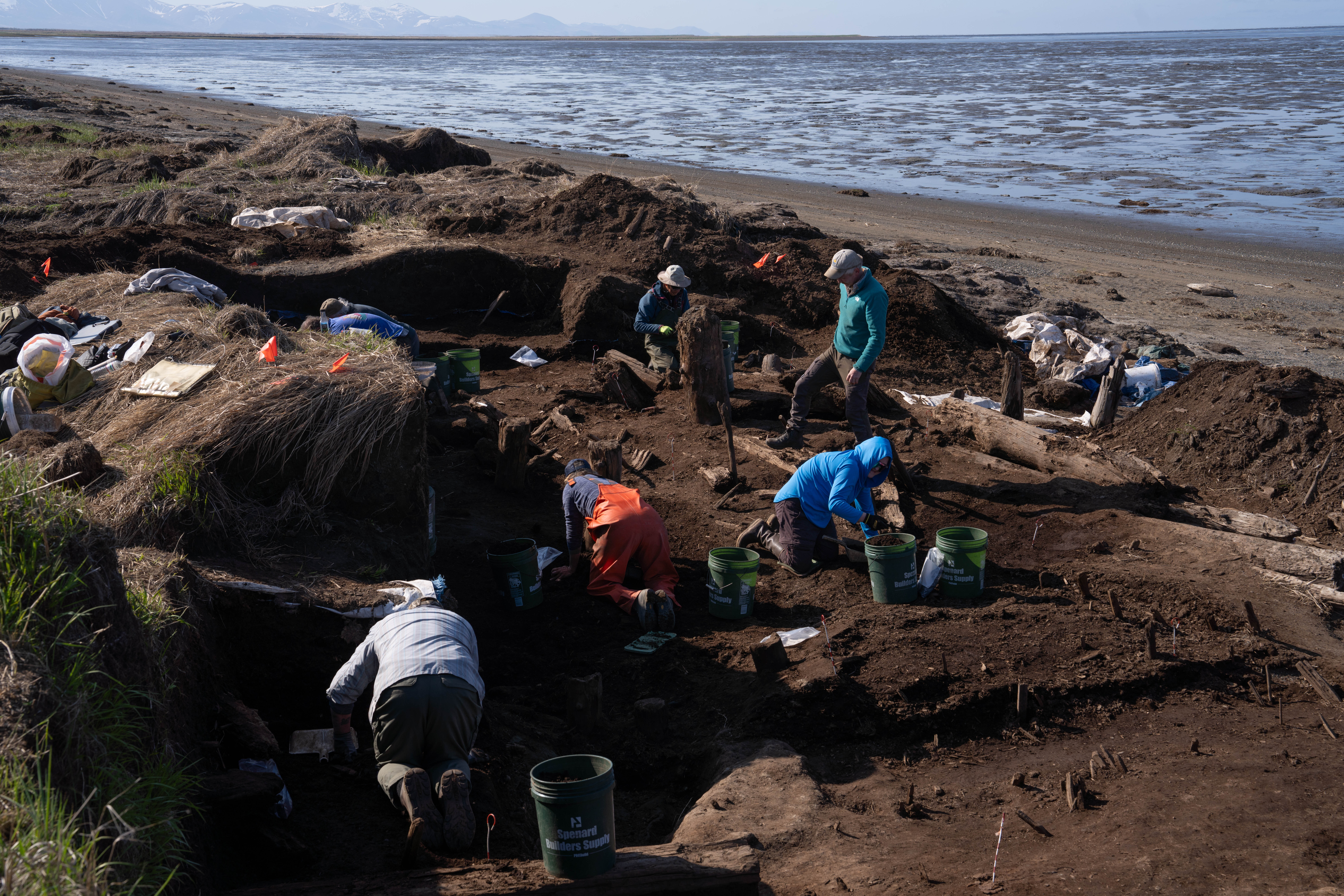
A crew of volunteer excavators and archaeologists searches the soil for artifacts at the Nunalleq dig site near the coastal village of Quinhagak, Alaska, on June 8. MaryCait Dolan/KYUK hide caption
Last October, remnants of Typhoon Halong swept through western Alaska — causing widespread flooding and displacing over a thousand people in multiple far-flung villages off the state's road system.
In the coastal village of Quinhagak, the storm shook houses and damaged some buildings and infrastructure. And the day after it hit, Jenny Matthew and her husband rode four-wheelers along the torn-up beach, assessing the damage.
Only on NPR People's houses are collapsing into the ocean. FEMA gives them no other option The wind and floodwaters had peeled the tundra up like discarded carpeting. And as Matthew scanned the debris, suddenly, something caught her eye.
"I said to my husband, 'Look, what's that?' We stopped. He got up and took it, and it was that bowl," Matthew remembered.
The bowl was wooden and smooth. It was carved by Quinhagak residents somewhere between 400 and 600 years ago and was one of thousands of cultural objects scattered along the coastline.
Science This High Arctic rhino may change what we know about ancient animal migrations The storm had unearthed it from an archaeological dig site called Nunalleq that sits near the village. It's renowned as one of the best examples of Alaska Native Yup'ik culture before Western contact and serves as an important link to Quinhagak's past. Not only had the storm scattered many objects from the site, it also increased the risks for what was still in the ground by eroding more of the land buffer between the Bering Sea and where these artifacts are buried.
This past summer, a team of archaeologists came to the village for an emergency dig to recover as much as possible before the next big storm.
Principal archaeologist Rick Knecht examines an artifact found by volunteer excavator John Rundall. MaryCait Dolan/KYUK hide caption
Charlotta Hillerdal holds up a wooden doll found in the soil at Nunalleq. MaryCait Dolan/KYUK hide caption
Archaeologists have been working at this dig site since 2009, according to lead archaeologist Rick Knecht. He says that after thawing permafrost revealed significant numbers of these objects in the early 2000s, the village deliberated and decided to try to save these pieces of their culture.
They include hand-carved animals, grass rope, sewing needles, ornate wooden masks and pieces of kayaks.
According to the archaeologists, the frozen ground has helped preserve artifacts composed of organic material, which they say would have likely eroded under different conditions.
History This year's list of endangered historic places focuses on equality and erasure The team, Knecht says, is mostly made up of volunteers and has a shoestring budget with funding from the Pacific Northwest Archaeological Society and the Daughters of the American Revolution, among others.
The whole archaeological site is about the size of two Olympic-size pools, but the emergency dig area is smaller, about the size of a backyard pool. It's a hole that has been dug around the buried remnants of several sod houses that date back 400 to 500 years.
Kenneth McElroy examines pieces of leather he excavated from the Nunalleq dig on June 8. MaryCait Dolan/KYUK hide caption
Charlotta Hillerdal, who has been part of this excavation for over 15 years, was home in Scotland when she heard about the storm damage.
"I was crying," Hillerdal said. "It was a horrible feeling."
Knecht said that since the dig began, they've watched the Bering Sea creep closer and closer to the site. Shorelines in this part of Alaska are now more vulnerable to erosion due, in part, to decreasing sea ice and permafrost thaw. Both are fueled by human-caused climate change.
Climate Houses floated away in this Alaska Native village. Now residents want to move Last October's storm closed the distance even more. Now, at some high tides, seawater can reach into the pit.
"It's every bit as tough as working in front of bulldozers," Knecht explained.
In October, the flooding was so extensive that the site was covered by feet of water. When it receded, it took many valuable objects with it. They're worried that could happen again.
Climate Thawing permafrost threatens Alaska's rural villages. And time is running out Knecht said they hope to return to the site next summer, though they're still raising the money to do so through a GoFundMe campaign and Quinhagak Heritage Inc., the nonprofit that oversees the dig.
"I'll be damned if I'm going to leave this for the waves," Knecht said. "It's like you might as well take those pieces of artwork we're finding and skip it off into the Bering Sea."
Stephanie Harold creates watercolor illustrations of artifacts excavated from the Nunalleq dig site. MaryCait Dolan/KYUK hide caption
At the Nunalleq Culture and Archaeology Center — a museum-style building and lab — these pieces of Quinhagak's past are available for their direct descendants to access, along with the public.
"We all as humans want to know who we are and where we come from, and having the Nunalleq there for us strengthens that," said Elizabeth Church, director of Quinhagak Heritage Inc., which manages the center as well as the dig.
Education In Alaska, a new Yup'ik coloring book aims to strengthen culture for the next generation Church said seeing the artifacts exploded onto the beach was traumatic. It underscored the community's desire to steward their ancestors' belongings.
Kenneth McElroy excavates an artifact from the Nunalleq dig site. Monica Shah places wooden artifacts in a polyethylene glycol solution. MaryCait Dolan/KYUK hide caption
"They are interwoven into us as people, and we feel a great sense of responsibility to care for them well, and to take them into the future with us," Church said.
There's evidence of people adapting to environmental change and making technological progress.
"When you know that you come from a people that were so resilient and so capable and so talented and so smart — you get a boost," Church said. "It's amazing."
She said that with fall storm season fast approaching, the scramble is urgent to recover what they can of this past.
NPR does not offer or accept money for coverage or interviews. Anyone who makes such an offer or request is not an NPR employee and does not represent NPR.