An expanded BRICS is becoming a stronger force for development
By continuing to browse our site you agree to our use of cookies, revised Privacy Policy and Terms of Use. You can change your cookie settings through your browser.
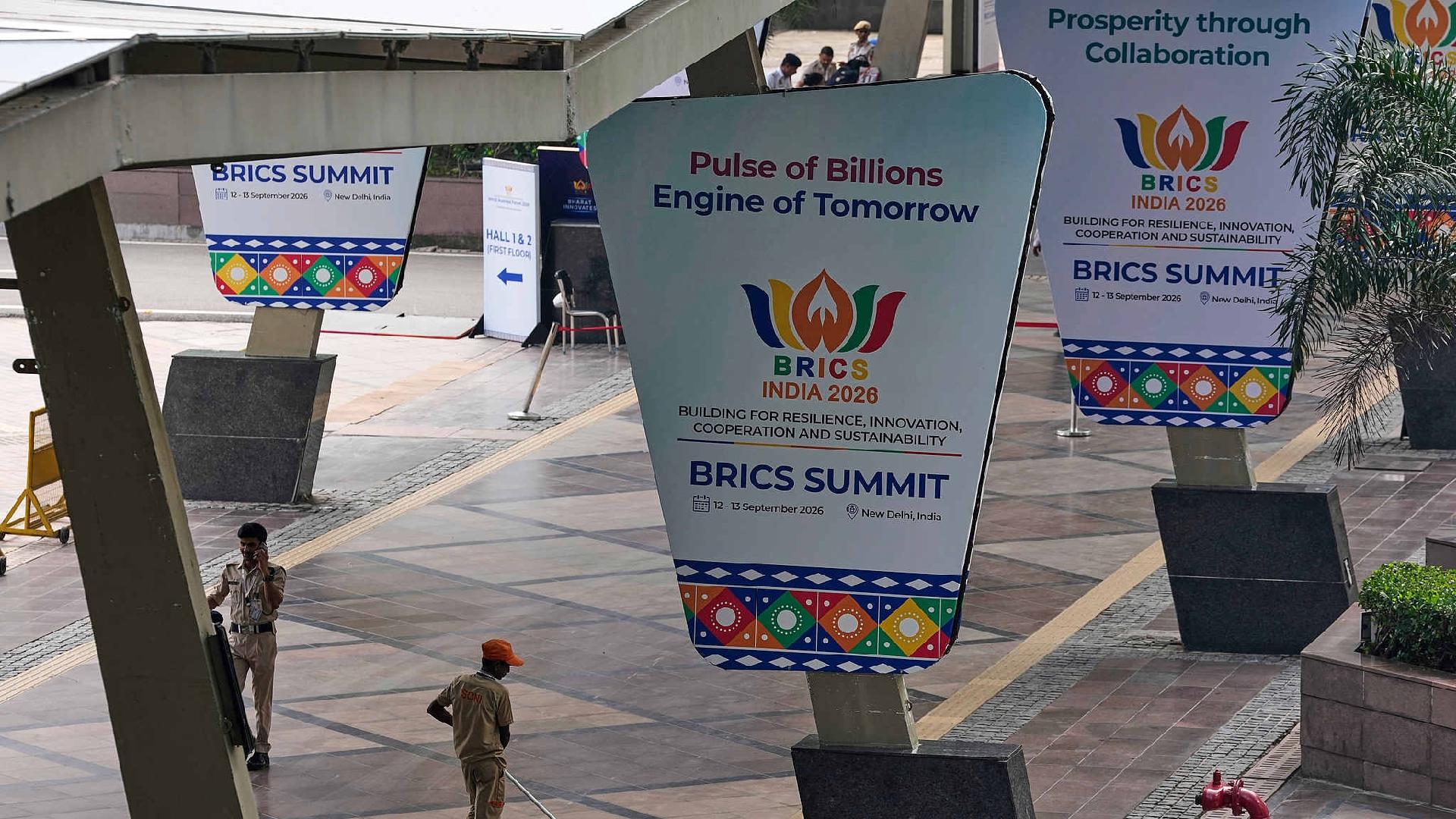
Signs put up for the BRICS Summit, in New Delhi, India, September 12, 2026. /CFP
Editor's note: Hao Shinan, a special commentator for CGTN, is an associate professor at the School of International Relations and Public Affairs, Shanghai International Studies University, and deputy secretary-general of the Shanghai Political Science Association. Li Mingyan is an assistant research fellow at the Institute of State Governance, Peking University. The article reflects the authors' opinions and not necessarily the views of CGTN.
Chinese President Xi Jinping delivered an important speech at the 18th BRICS Summit in India on Saturday. Although overseas coverage has focused on whether BRICS’ growing diversity will make consensus harder to achieve, the expanded grouping should also be judged by its ability to widen access to development finance for the Global South.
Xi pointed out that BRICS countries have achieved historic expansion, established an all-dimensional and multi-tiered cooperation architecture, continuously deepened cooperation in trade, investment, finance, science and technology, and entered a new stage of high-quality development of greater BRICS cooperation.
Expansion has given the grouping unprecedented reach. BRICS now has 11 members and 10 partner countries, representing around 49.5% of the world's population, 40% of global GDP at purchasing power parity and 26% of trade. This gives developing economies a stronger voice in setting priorities.
Yet, representation has practical value only when it enables countries to finance roads, clean energy, water systems and digital infrastructure on terms they can sustain. From this perspective, greater diversity may make negotiations more complex, but it also brings a broader range of development experience, capital and projects into the same institution. This is why we should look first at what the New Development Bank (NDB), BRICS’ flagship multilateral lender, can deliver in its next phase. By June 30, the bank had approved 141 projects worth $44 billion and disbursed $25 billion; local-currency operations were close to 30%. As its 2022-2026 strategy closes, the priority should be not merely to approve more, but to make finance fit borrowers better. Loan currency, interest costs and repayment periods should reflect a project’s revenue and economic life. A utility paid in domestic currency, for example, should not be left unnecessarily exposed to a rising foreign-currency debt burden.
The bank's 7-billion-yuan ($1.04 billion) worth of Panda bonds shows how member-country capital markets can broaden its funding base. Its planned onshore rupee-denominated "Maharaja Bond" could do the same in India. The value of these instruments lies in enabling the NDB to offer affordable local-currency loans, limit exchange-rate risk and mobilize additional private capital. The same practical standard should guide the current discussions on faster cross-border payments within BRICS. For the Global South countries, lower costs and greater interoperability matter more than talk of replacing existing currencies.
The headquarters building of the New Development Bank in east China's Shanghai, September 8, 2024. /CFP
However, money alone does not produce development. Local governments may know what they need but lack the resources to conduct feasibility studies, assess environmental impacts or prepare tenders. The NDB's technical assistance for the Kohima Town Water Supply Augmentation Project in India offers a useful model. Expanding such support would help smaller economies turn development needs into projects ready for financing.
In this process, China can share its experience in infrastructure and green development while working with other multilateral banks and respecting local priorities. The aim should be not only to build projects, but also to help local institutions operate and maintain them over the long term.
Looking ahead, BRICS should pay more attention to development achievements, not just the number or value of loans. The real test is whether projects provide reliable water, bring electricity to more households, shorten travel times and remain in good condition. Explicit goals and regular public reporting can show what works and what needs improvement. By delivering visible benefits, an expanded BRICS can demonstrate its value.
As Xi noted, BRICS countries should lead efforts to advance innovation and development, uphold peace and stability, promote mutual learning among civilizations, and reform and improve global governance. This year marks the 20th anniversary of the launch of BRICS cooperation, with solidarity and cooperation remaining the driving force behind its development.
A stronger BRICS need not be a zero-sum rival to existing institutions. It can broaden the choices available to developing countries while working with other partners where interests overlap. By placing development and tangible results at the center of its agenda, the 2026 BRICS summit marks an important step toward turning an expanded BRICS into a stronger force for development across the Global South.
(If you want to contribute and have specific expertise, please contact us at opinions@cgtn.com. Follow @thouse_opinions on X to discover the latest commentaries in the CGTN Opinion Section.)