Andrew Phillips: What Carney’s revelation of preparing for a U.S. attack tells us about his evolving Trump strategy - Toronto Star
For Canadians, even acknowledging he’s thought about the military option underlines the seriousness of the moment, of the “rupture” Carney says has happened in the world order and more specifically in the Canada-U.S. relationship.
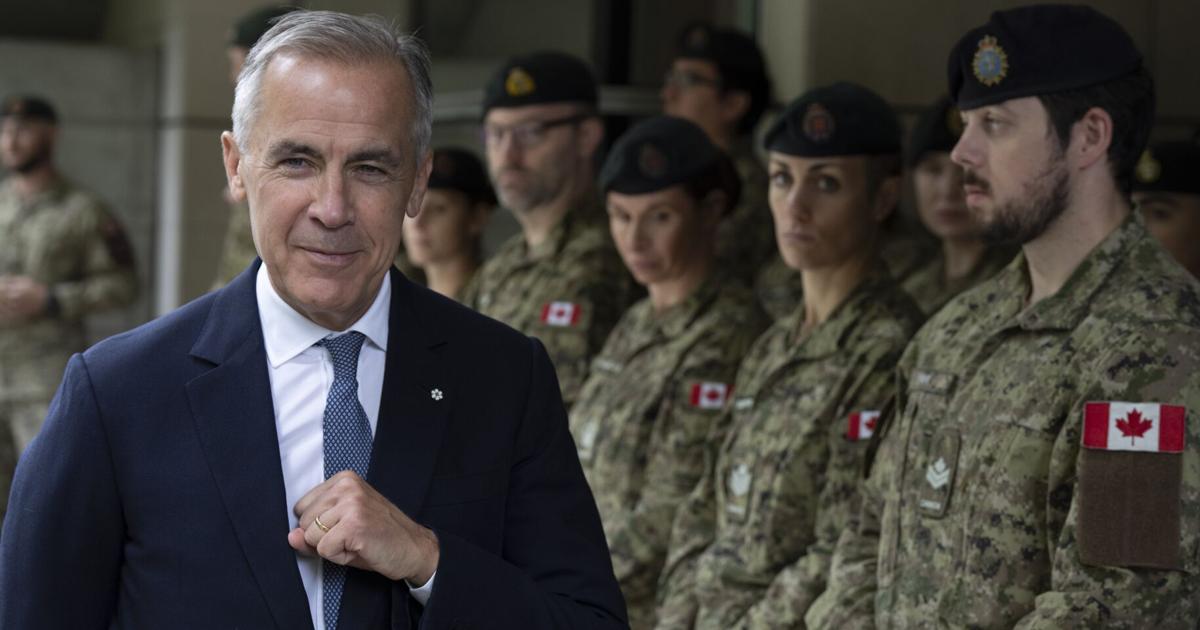
Prime Minister Mark Carney with Canadian Armed Forces stationed in Poland in August, 2025. With Carney’s admission to the New York Times that Canada made plans in case of an unlikely U.S. invasion, the PM seems to have been “sending a message to Canadians, to Trump, and to the world at large” about the seriousness of the situation, writes Andrew Phillips.
Andrew Phillips is a Toronto-based staff columnist for the Star’s Opinion page. Reach him via email: aphillips@thestar.ca
We’ve known for months that Canada’s Armed Forces have done some thinking about the admittedly remote possibility that Donald Trump’s United States might launch some kind of military action against this country.
Anonymous government officials told the Globe and Mail back in January that the military had modelled a “hypothetical” U.S. invasion, apparently for the first time in a century. So there’s nothing brand-new about that kind of thought experiment — however shocking the prospect might be.
But what does it mean when the prime minister himself airs the same scenario and does it in the New York Times no less, at the Times headquarters in midtown Manhattan no less, in a way that Trump himself couldn’t possibly miss?
Times reporters asked Mark Carney whether he takes Trump’s “51st-state” taunts seriously. The PM could have answered in any number of ways. He chose to talk about what he called the “extreme tail risk” (financier-speak for a very small possibility) of American military action.
The way the Times reported his remarks was that “Mr. Carney suggested that he had carefully examined the possibility of U.S.-led military action.” That, he told the Times, “is just risk management” and “it would be irresponsible not to” prepare for every eventuality.
Still, Carney could have ducked the whole idea. He could have bobbed and weaved and done nothing to feed the image of American troops storming onto Canadian soil. Instead, he gave it just enough oxygen to fuel headlines in the Times and elsewhere.
Why? There’s always the chance it was just a gaffe (i.e. what happens when a politician inadvertently lets slip an awkward truth). But coming from a leader so careful with his words, it doesn’t feel that way. Instead, it seems Carney was sending a message to Canadians, to Trump, and to the world at large.
For Canadians, even acknowledging he’s thought about the military option underlines the seriousness of the moment, of the “rupture” Carney says has happened in the world order and more specifically in the Canada-U.S. relationship.
For Trump, it’s another in a series of rather direct remarks Carney has been making about the relationship and the president himself. The PM isn’t stifling himself as much as he did until a few weeks ago. He’s allowed himself to push back against Trump’s insults. He isn’t just taking it, as he clearly felt he had to when making nice with Trump at all costs seemed vital to getting a trade deal. The message: we’re not afraid of you.
For the world at large, it’s another step in Carney’s emergence as the de facto leader of those countries that are taking their distance from the United States, hedging their bets against Trump’s unpredictability and hostility.
More concretely, Carney used the same interview to make clear he’s aiming at “systematically reducing Canada’s reliance on the United States for key technology — from space satellites to fighter jets,” as the Times summed up his message.
He specifically mentioned the need to diversify away from Elon Musk’s Starlink satellite internet system, which has been manipulated for political ends. And he talked about the government’s coming decision on whether to go ahead with a planned order of 88 F-35 jet fighters from Lockheed Martin.
Carney didn’t spell out where he’s at on that, but he did say he wants to make sure Canada acquires aircraft that can operate well in the Arctic. That’s a not-so-subtle hint that he hasn’t ruled out acquiring at least some of the F-35’s main competitor, the Swedish-made Saab Gripen E fighter, which is built with Arctic conditions very much in mind.
More than that, it would be hard to reconcile Carney’s comments about weaning Canada off reliance on U.S. technology (not to mention the niggling concern about American military action) with a decision to go all-in on a U.S.-made-and-controlled defence system like the F-35.
Other U.S. allies share similar concerns about tying themselves more closely to the U.S. at this point. If Washington controls the parts and software, ultimately it controls whether your planes can fly. And let’s face it, no one’s ever worried about the prospect of Canada being aggressed by Sweden.
Carney wasn’t all doom-and-gloom with the Times. He said he thinks he still has a good relationship with Trump, talked up the value of an integrated auto sector, and said he doesn’t contemplate using energy as a weapon in the trade dispute.
That’s all fine. But what a moment when the prime minister acknowledges he’s been contemplating the possibility of the U.S. turning its guns north.
Error! Sorry, there was an error processing your request.
There was a problem with the recaptcha. Please try again.
You may unsubscribe at any time. By signing up, you agree to our terms of use and privacy policy. This site is protected by reCAPTCHA and the Google privacy policy and terms of service apply.
Opinion articles are based on the author’s interpretations and judgments of facts, data and events. More details
Andrew Phillips is a Toronto-based staff columnist for the Star’s Opinion page. Reach him via email: aphillips@thestar.ca