Angie Nixon Proposes Building Data Center on Mar-a-Lago - Newsweek
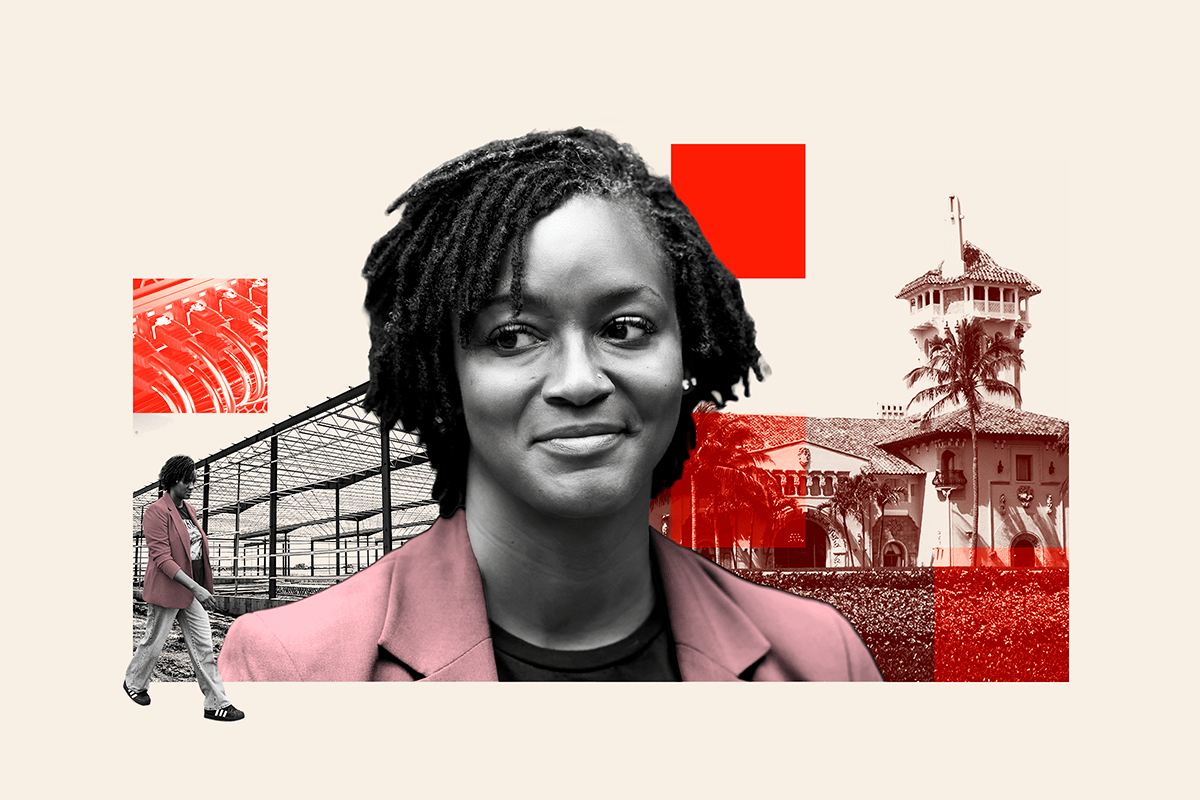
Florida Democratic Senate candidate Angie Nixon believes the country should consider pausing the construction of new artificial intelligence data centers—and jokes that if companies insist on building them, they should start at President Donald Trump’s Mar-a-Lago estate in Florida.
Speaking to Newsweek in a wide-ranging interview, Nixon, a state representative who scored an upset victory in Florida's Democratic Senate primary last month, called for greater scrutiny of the rapidly expanding facilities amid concerns about their impact on electricity costs, water supplies and the environment.
"I think there needs to be a moratorium until more research is done," Nixon said. "Or if people want to build a data center, they should put it on Mar-a-Lago."
The issue is becoming increasingly politically salient as the AI boom drives a surge in proposed data centers across the country. Bipartisan opposition has emerged from communities concerned about their impact on electricity grids, water usage and utility bills.
Both Republican- and Democratic-led states have taken or proposed steps—including moratoriums—to address concerns, but Trump has downplayed the widespread unease. The president has repeatedly spoken out against AI regulations, referring to the backlash as a “hoax” and suggesting opposition will result in communities becoming “backwards and poor.”
Nixon told Newsweek she was not opposed to AI or technological innovation but wanted tougher guardrails around privacy, employment and the construction of data centers.
She also floated a proposal modeled loosely on Alaska's system of distributing revenue associated with its natural resources: requiring or creating a mechanism for communities affected by data centers to receive some form of financial benefit.
"Do we do what they do in Alaska, which is like, they give dividends to people who are impacted by the pipeline?" Nixon said. "Do we do the same thing for the now existing AI data centers?"
Nixon did not detail how such a program could work, but similar ideas are being considered already. Illinois lawmakers have proposed requiring certain data centers receiving state tax incentives to make payments to host communities, with some of the money benefiting homeowners through payments, credits or rebates, while proposals in New York would provide electricity-bill credits or energy improvements to residents near large data centers.
At the federal level, Democratic lawmakers have proposed taxing data centers to offset some of their economic and community impacts. While Nixon's Alaska comparison is not precise—the state's Permanent Fund invests mineral revenues and uses investment earnings to help fund annual dividends—the proposals share the principle of returning some economic benefit to communities affected by major development.
Beyond the raging debate over AI, Nixon's campaign is testing whether this year's political environment can make a state that has shifted sharply toward Republicans competitive again.
Trump, who has made Mar-a-Lago his primary residence, won Florida by about 13 percentage points in 2024, taking nearly 56 percent of the vote compared with Democrat Kamala Harris' roughly 43 percent. Republicans also now hold a commanding voter-registration advantage. As of August 31, Florida had about 5.65 million active registered Republicans compared with 4.10 million Democrats—a gap of more than 1.5 million voters.
The Cook Political Report currently rates the Florida Senate race Solid Republican, underscoring the scale of Nixon's challenge. Recent polling has produced a range of results—including two recent survey showing a dead heat.
A St. Pete Polls survey of 913 likely voters, conducted September 15-17, found Republican Senator Ashley Moody and Nixon effectively tied, 45.2 percent to 44.8 percent. A Change Research poll earlier in September also put the candidates at 47 percent each, although that survey was conducted for the Democratic-aligned Freedom Project USA.
Other surveys have shown Moody with a clearer advantage. Quantus Insights put her ahead 50.1 percent to 42.7 percent, while an InsiderAdvantage survey conducted September 20-21 found Moody at 49.3 percent and Nixon at 41.8 percent. Another poll released this week by Stetson University Center for Public Opinion Research showed the Republican ahead by 11 points, 51 percent to the Democrat's 40 percent.
There have also been signs this year that Florida voters are at least willing to cross traditional partisan lines in lower-turnout contests.
In March, Democrat Emily Gregory won a special election for Florida House District 87, which includes Mar-a-Lago, defeating Trump-endorsed Republican Jon Maples by roughly 51 percent to 49 percent. Trump had carried the district in 2024. Democrat Brian Nathan separately flipped a Florida state Senate district that Trump had won by about 7 points.
Those results came amid a broader national environment that has recently favored Democrats. A Reuters/Ipsos poll conducted in September found Democrats holding an 8-point advantage over Republicans among Americans asked which party they would support in the midterms, while Trump's approval rating stood at 32 percent. Democrats have also consistently overperformed in a slate of off-year and special elections across the country since Trump returned to office for his second term.
Republicans nevertheless enter November holding a 53 to 47 Senate majority, including the two independents who caucus with the Democratic side. Democrats, therefore, need a net gain of four seats to reach 51 if the rest of the map remains unchanged. Florida, however, is not currently considered among the central battlegrounds. A Nixon victory would signal a significant victory for Democrats, demonstrating that the Southern state increasingly viewed as a pro-Trump Republican stronghold is still in play.
Nixon's membership in the Democratic Socialists of America (DSA) is another possible headwind the Senate candidate is seen by many to face. Florida is home to large communities of Cubans, Venezuelans and other Latin Americans, many of whom themselves fled, or grew up in families that fled socialism and communism. Moody has capitalized on these factors in her bid to get Florida voters behind her reelection campaign.
"The rise of Marxist organizations promoting communism should scare every American," the Republican incumbent wrote on X Friday. She urged Floridians to vote in the November midterm to prevent socialism from taking "root in our country."
Nixon joined the DSA in June but has repeatedly said she does not consider herself a socialist and does not agree with the organization's entire platform. She has specifically rejected calls to defund the police or abolish prisons, while supporting ending for-profit prisons.
Asked by Newsweek why she joined the organization despite rejecting the socialist label, Nixon pointed to its support for policies including universal healthcare, public education and affordable housing. She noted that she also joined the Working Families Party and became a lifetime NAACP member around the same period.
"For me, it was all hands on deck," Nixon said. "We have the ultra wealthy getting richer and richer and richer, and meanwhile, the rest of us are just breaking." Pressed on whether the DSA affiliation could hurt her with Florida's Cuban and Venezuelan communities, Nixon said she would not "insult the intelligence of the voters."
"They're smart and they do their research," she said, arguing Republicans were attempting to exploit voters' fears about socialism.
Moody has sought to make Nixon's DSA membership a defining contrast in the race. The issue has followed Nixon since her primary victory, and she said again this week that the campaign was "not about three letters," referring to DSA.
"There is no place in America that better understands the true cost of socialism and communism than Miami," Moody posted on social media earlier this month. "OUR FREE State of Florida will tell the Socialist Squad’s newest recruit, Angie Nixon, her destructive policies have no place in Florida," the Republican wrote.
Nixon also offered pointed criticism of her own party. Asked whether national and state Democrats were providing enough assistance after her primary victory, Nixon said they "could definitely give me more support."
"It's true what my husband has said sometimes," she added. "The Democratic Party and the Republican Party, they're just two different wings on the same bird."
Nixon said that some Democratic leaders receive money from the same interests that fund Republicans, adding that her own reliance on small-dollar donations made her a "threat" to that system. She also noted, however, the support she has received from prominent Democratic senators and progressive leaders, naming Senators Lisa Blunt Rochester, Kirsten Gillibrand, Bernie Sanders, Elizabeth Warren and Cory Booker.
Her criticism comes amid broader tensions within the Democratic Party ahead of November, particularly between progressive candidates and more establishment-aligned Democrats in several competitive races. While Democrats have overperformed in recent elections, there has been a strong strain of anti-establishment energy, with young and often more progressive candidates winning notable victories against incumbents.
This movement has also pointed its frustration at key Democratic leaders, including Senate Minority Leader Chuck Schumer and House Minority Leader Hakeem Jeffries. Some progressives have already begun calling for Schumer's ouster as leader. For her part, Nixon declined to commit to supporting Schumer but also did not rule it out.
"I'm going to run this race, I'm going to win, and then I'm going to assess who I want to vote for leader," she said. "And so it is going to be based on the vision that the folks have."
Nixon repeatedly returns her messaging to affordability concerns, saying that economic frustration could allow her to reach Floridians who previously supported Trump. Asked to identify three policies that would most directly lower household expenses, Nixon pointed to universal healthcare, repealing tariffs and universal childcare.
"People are going bankrupt because they're trying to stay alive," she said while advocating for universal healthcare.
On tariffs, Nixon described them as a tax on working families and argued that repealing them would reduce prices on everyday goods. She also contended that universal childcare would allow parents who left the workforce because of high childcare costs to return.
Nixon also called for eliminating federal taxes on Social Security benefits and recounted watching her 70-year-old mother return to work after retiring because her benefits did not stretch far enough.
"My mom's 70 years old and she should be enjoying her retirement," Nixon said. "She's worked her entire life."
Asked whether Trump had enacted any policy that she believed benefited working-class Americans, Nixon offered one concession: "Eggs are lower than what they were."
"That is the only thing that that man has done," she added, before criticizing the rest of his economic record.
Trump and Republicans have argued that their tax, trade and economic policies are designed to boost domestic production, increase investment and benefit American workers. Moody's campaign has sought to tie Nixon to the left wing of the Democratic Party, criticizing her agenda and warning that her economic vision would lead the country down a dangerous path.
Nixon also reiterated a position that puts her firmly on the progressive side of one of the Democratic Party's most divisive foreign policy debates. She told Newsweek she does not currently support sending U.S. money to Israel.
"At this moment, no, I do not support sending any money over to Israel," Nixon said.
She called for aggressive diplomacy and said Israeli Prime Minister Benjamin Netanyahu "needs to go," while arguing that Israelis and Palestinians must ultimately be brought together in pursuit of peace.
Pressed on concerns from Jewish and pro-Israel Democrats who view some anti-Israel rhetoric as antisemitic, Nixon drew a distinction between criticism of the Israeli government and hostility toward Jewish people.
"I push back on anti-Semitism," she said. "I believe Israelis have a right to exist."
"It's not anti-Semitic if I'm upset at their leadership," Nixon added. "I'm also upset at Donald Trump and his leadership in the administration. That does not make me anti-American."
Despite her sharp criticism of the American Israel Public Affairs Committee (AIPAC), Nixon said she would work with Democratic colleagues who accept support from the pro-Israel group if doing so helped advance policies she believes would benefit Floridians.
Throughout the interview, Nixon repeatedly targeted Moody, dubbing her "AI Ashley Moody" and accusing the Republican senator of siding with corporations and wealthy interests.
Nixon also argued that Trump had sold working-class voters a "pipe dream" and said some who backed him were now reconsidering their support amid frustration over costs.
But despite her repeated criticism of the president, Nixon rejected the idea that her campaign is primarily anti-Trump.
"I'm not pushing an anti-Trump message," she said. "I'm pushing a message about how people should decide what their economies and communities look like."
Her argument is that voters who may disagree with her ideologically could nevertheless be persuaded by an economic message centered on healthcare, housing, childcare and the cost of living. Whether that can overcome Florida's pronounced Republican shift remains an open question. The state's registration numbers, recent statewide election results and independent race ratings all favor Moody.
But Nixon is betting that the same voter dissatisfaction that has helped Democrats in special elections—including in the district surrounding Trump's own Florida home—can make a race few expected to be competitive considerably closer in November.
Contact Newsweek editors on this story: Edward T. Cummins
Correction, 9/26/2026 7:45 AM ET: The article previously included an inaccurate reference to the Sabato Crystal Ball rating for this race.