Anthropic quietly sets up biology lab as it ramps AI drug programme
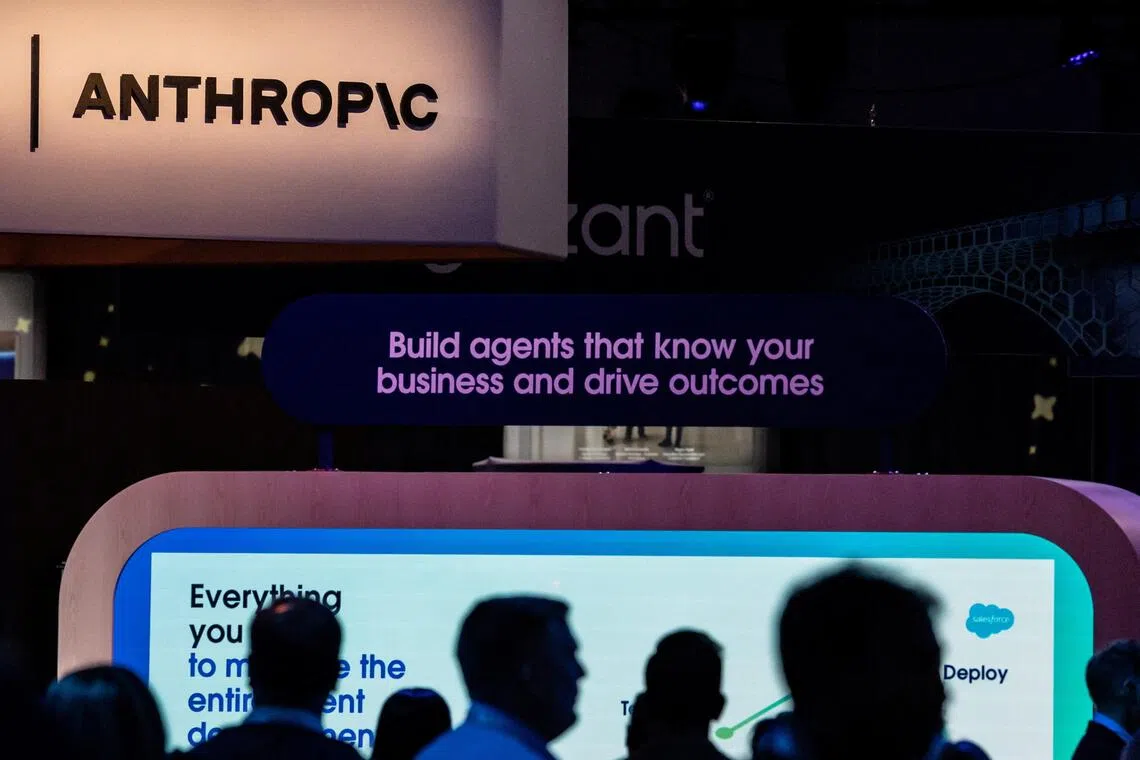
People visit an Anthropic booth at Moscone Center during the Dreamforce 2026 technology summit in San Francisco, California, on Sept 17.
SAN FRANCISCO – Anthropic has quietly set up a laboratory to do physical biology work as it pushes its artificial-intelligence ambitions into the world of drug science.
At a time when fears of AI are gripping the public, the start-up has built a wet lab, or place for physical experiments, in the San Francisco Bay Area, two people familiar with the matter said. Anthropic has said it wants to unlock treatments for rare diseases, and its biology work has gone beyond “in silico” or computer evaluations.
In a Reuters interview on Sept 15, Anthropic’s head of life sciences, Eric Kauderer-Abrams, confirmed the start-up’s wet lab.
“We believe that to do biology, the final test is still and will be for a while in real lab work,” he said. “We absolutely are doing that today, and I would describe our approach as being typical of what you would see in most biotech companies, where there’s some amount of that that we’re doing in our own facilities and some amount of that that we’re working with external partners on.”
A spokesperson later clarified that Anthropic’s lab is not for drug discovery specifically, declining to elaborate.
The move represents a small step toward Anthropic’s enormous ambition to tackle diseases that it thinks the pharmaceutical industry is neglecting – and to do so before staff and the public lose faith that AI justifies erasing jobs and possibly human life, one of the people said. The success of any drug programme it runs is not certain; most drugs fail to pass trials for clinical safety and efficacy.
For Anthropic CEO Dario Amodei, the effort is personal. A disease killed his father only a few years before a cure came about, he said in a recent essay. Kauderer-Abrams echoed the sentiment.
“The mission of the company is to develop powerful AI in such a way that benefits the world,” Kauderer-Abrams said. “By far, we see the biggest opportunity for that in the life sciences, and that is motivating everything that we’re doing.”
Like other biotech companies, Anthropic is embracing physical automation, said the two people, who spoke on condition of anonymity.
The start-up wants to push how its Claude AI can direct robotic units to carry out science experiments with limited human intervention, one of the people said. Still, Anthropic believes that human oversight and involvement are essential for safety, its spokesperson said.
“We’re in the very early innings of using AI to automate the execution of lab work,” said Kauderer-Abrams, “an area that has the potential to bring about meaningful acceleration in so many different processes.”
Anthropic’s race to apply rapidly evolving technology to a biology lab comes at an extraordinary time for the company.
In the past two weeks, some of its researchers warned that AI could lead to human extinction, and Anthropic said it found examples where its systems could have been used towards biological weapons development, which met some scepticism.
Amodei also called for a development slowdown, saying that a future AI more capable than the OpenAI agents that hacked Hugging Face could cause catastrophic damage. At the same time, Anthropic is preparing to go public in a potentially US$2 trillion (S$2.56 trillion) IPO to raise more money for such AI development.
“In our life-science work, we’re always balancing these things,” Kauderer-Abrams said, “making models better in ways that we think will uplift and accelerate developing medicines, and being thoughtful and careful about how we deploy it to limit the risk.”
Anthropic staked out its intention to start running drug programmes, at a San Francisco event in June. On stage there, Kauderer-Abrams said Anthropic would do pre-clinical work in areas that traditional companies did not find attractive financially.
The company also launched software called Claude Science, and it earlier added Novartis CEO Vas Narasimhan to its board and bought the start-up Coefficient Bio for about US$400 million in stock, according to media reports. Anthropic confirmed the acquisition, which will help it build tools for drug development, but it had no comment on the deal price.
Now, Anthropic is bulking up its in-house lab efforts for speed and for first-hand experience in biology, though it outsources work when efficient, Kauderer-Abrams told Reuters.
“There’s some things that we can do much faster in our own hands,” he said, with the goal “to operate at the largest possible scale”.
Anthropic has looked to hire a leader who could ramp up procurement and other operations, it said in a recent LinkedIn job post. Another Anthropic role solicited via Jobera sought an expert on “protein and nucleic acid characterisation,” among other biochemical work. A third Anthropic job listing read: “Our goal is to speed up progress in the life sciences by an order of magnitude.”
Life sciences already represents one of Anthropic’s biggest investment areas by headcount and resources, Kauderer-Abrams said.
His view is that AI could fast-track development for conditions previously thought to be “undruggable” – too difficult to treat. The technology could speed up discovery, for instance, of bispecific and trispecific antibodies, complex molecules that can be directed at multiple points on a targeted protein or cell, or hit multiple targets.
The precise diseases Anthropic is addressing and its progress remain unclear. Once a molecule is identified, it can take years to bring a drug to market as it is tested in human trials, a challenge that Anthropic has not taken on. Isomorphic Labs, the drug discovery arm of rival Alphabet, has worked for years to get to the clinic and earlier delayed that goal to the end of 2026.
In its efforts at lab and other industry automation, Anthropic launched the Model Hardware Standard in August, which helps AI operate equipment. A release out of academia called PyLabRobot, unrelated to Anthropic, earlier addressed related though different automation needs.
Anthropic is providing work like the Model Hardware Standard and broader AI services and tools to all manner of top pharmaceutical companies, such as Roche’s Genentech, Bristol Myers Squibb and Novo Nordisk.
At the same time, Anthropic is navigating a trust problem, the two people familiar with its efforts said. Its customers may worry that Anthropic will learn from their competing drug programmes, even as the AI start-up walls off their data from view.
Kauderer-Abrams said that Anthropic, due partly to competition concerns, has set a boundary that it is not running clinical trials for now and is focusing on needs that industry would not address.
“We’re not competing with pharma and biotech companies that make their business in bringing drugs to market,” he said. REUTERS