
Barbed wire, sniffer dogs and 40 years of waiting: Srinagar readies for Irani Cup - The Indian Express
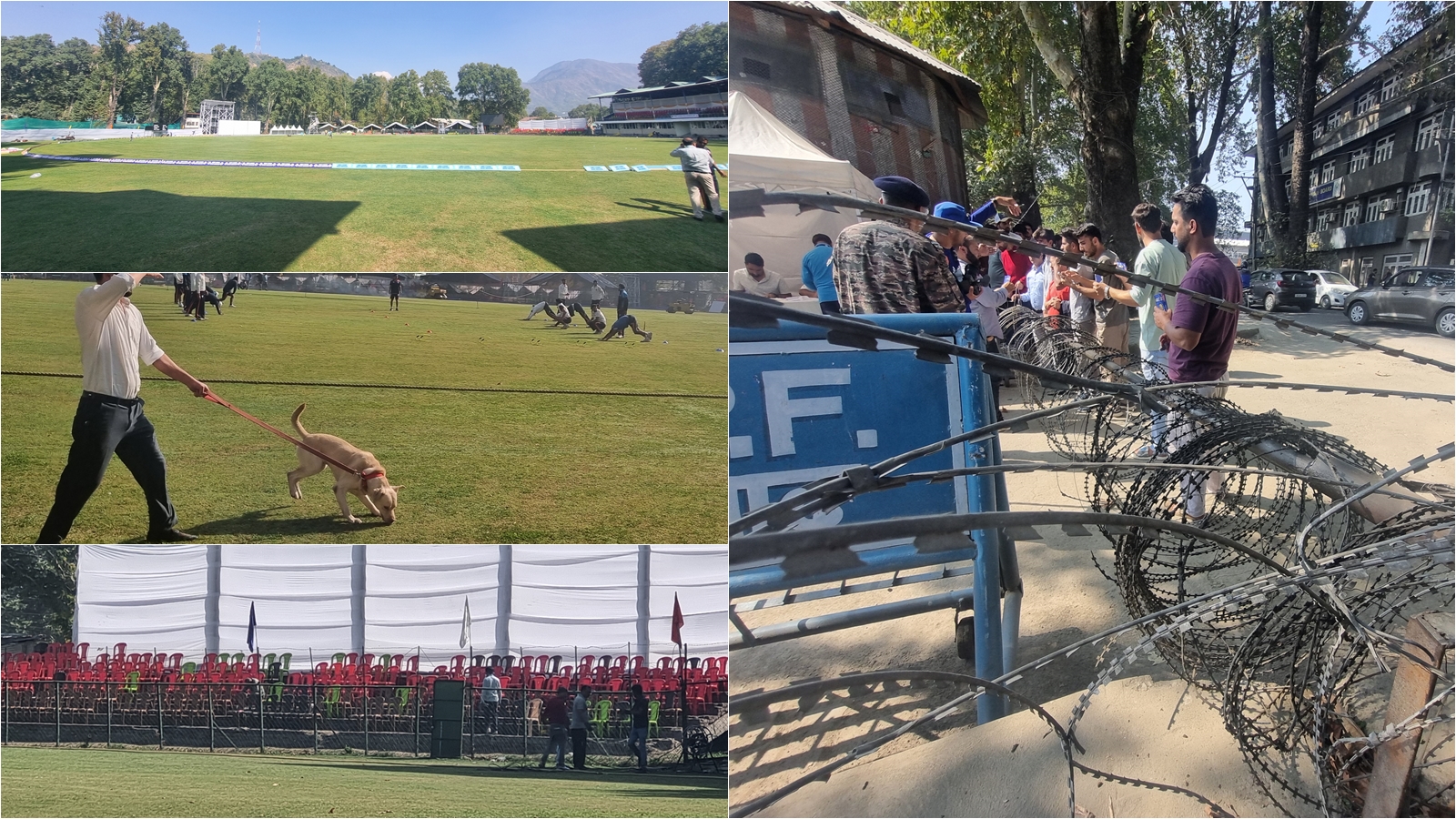
Had cricket a scent of its own, it could be smelt here, in Srinagar.
A carpet of emerald green unfurls across the Sher-i-Kashmir stadium. Lift your eyes from the outfield, and the valley takes over, mountains rising in shades of brunswick and grey. On the ridge above, the Shankaracharya Temple stands like a sentinel. A breeze wanders into the ground, bearing the cold of the Dal Lake.
Widen the lens, however, and a second picture asserts itself. Coils of barbed wire hem the ground on all sides. Braving those are fans jostling for a pass. Enthusiasm alone does not guarantee entry; every seat has to be earned with a display of the Aadhaar card’s physical copy.
Patrolling, with canine diligence, is a triad of sniffer dogs of different breeds: a German shepherd, a labrador, and a beagle.
“This is the first time in the last four decades, since 1986 (ODI between India and Australia), that a match of this magnitude is being played in Srinagar,” says Majid Dar, head of cricket operations at the Jammu & Kashmir Cricket Association.
The ground is readying itself for history: the Irani Cup, to be contested between defending red-ball champions Jammu & Kashmir and Rest of India. “We have worked day in day out to get things ready on time. The capacity of the ground is 700, but excitement among fans for this match is huge. We have built makeshift stands to accommodate more people. We will be issuing 5,000 passes, and I am expecting a full house. The security arrangement is top-notch,” Dar says.
The stadium has known international cricket only fleetingly, both fixtures etched in controversy. The Irani Cup is not one, but it carries the aura of one, buoyed by the presence of national team players Rishabh Pant and Manav Suthar.
*** Not once has the city’s appetite for cricket dipped.
Samiullah Beigh, joint second-highest wicket-taker for the state in the Ranji Trophy, finds it a struggle to contain his emotions as he reminisces about the ground. “I vividly remember the match against Goa in 2013 at this venue. We were chasing a target of 262. When people realised that we were inching closer to a win, they came to the ground in massive numbers. Around 10,000 people showed up. I remember the Goa captain asking me what the chants meant, as he assumed they were cursing Goa. I told him, it’s not about Goa, it’s about us,” Beigh says.
On that day, it was about “them.” And, in particular, “him”: Beigh, for whom batting was never the calling card, scored a resilient half-century as a 114-run eighth-wicket stand earned Jammu & Kashmir the win.
Former speedster Abid Nabi, the Jhelum Express, has 156 wickets to his name for Jammu & Kashmir. None, though, holds a place as special in his memory as the five he picked up in a local match, on this very stadium.
“My favourite memory here is not from a Ranji Trophy match, but a competition called the Mirza Nooruddin Cricket Tournament. I made my debut in the semi-final, took five wickets and scored 48 runs. This game earned me the moniker of Jhelum Express.”
It took Jammu & Kashmir 23 years, and 99 attempts, to record their maiden victory in a Ranji Trophy match, a four-wicket win over Services in December 1982. Playing a crucial role was wicketkeeper-batter Parvez Qaiser, whose association with the ground predates his association with the state team.
“My relationship with the Sher-i-Kashmir stadium began much before I had even started playing cricket,” he says. “I used to bunk classes in school and go to the ground to watch matches. Once Bishan Singh Bedi had come with the Delhi team, and I was very excited to watch him live. Naturally, I bunked school. When I returned, I got a thrashing from my master in school. But moments later, the same guy asked, ‘Bedi ne kitne wicket liye?'”
The stadium being readied for Thursday bears scant resemblance to the one Qaiser had known. “In our days, it was just a ground. It had no fencing, no stands, no pavilion. No permanent bathroom either, only a makeshift one. There was no water supply, fans drank the same water that was used on the pitch. And even then, it was the second home of many Kashmiris,” he says.
Nabi echoes similar sentiments. “Infrastructure has improved leaps and bounds. In my time, there were hardly any facilities. We had to run ourselves to the ground for every little thing, from spikes to bats. What has never changed, though, is the passion Jammu & Kashmir has for cricket. The sport runs in our blood.”
Against Pant’s team, Paras Dogra’s men will take the field as defending champions.
“We had a function after the 2024/25 season, where we reached the quarter-final,” Qaiser says. “There, I said, next time we have this event, we will be the champions. Not many people believed me then, but look at us now. Jammu & Kashmir have arrived.”
That, they have. And, they might be here to stay.
Shuvaditya Bose is a Deputy Copy Editor at the sports desk of The Indian Express. ... Read More
Stay updated with the latest sports news across Cricket, Football, Chess, and more. Catch all the action with real-time live cricket score updates and in-depth coverage of ongoing matches.
