Beta Padhao, Beti Bachao: Delhi students demand more than safety
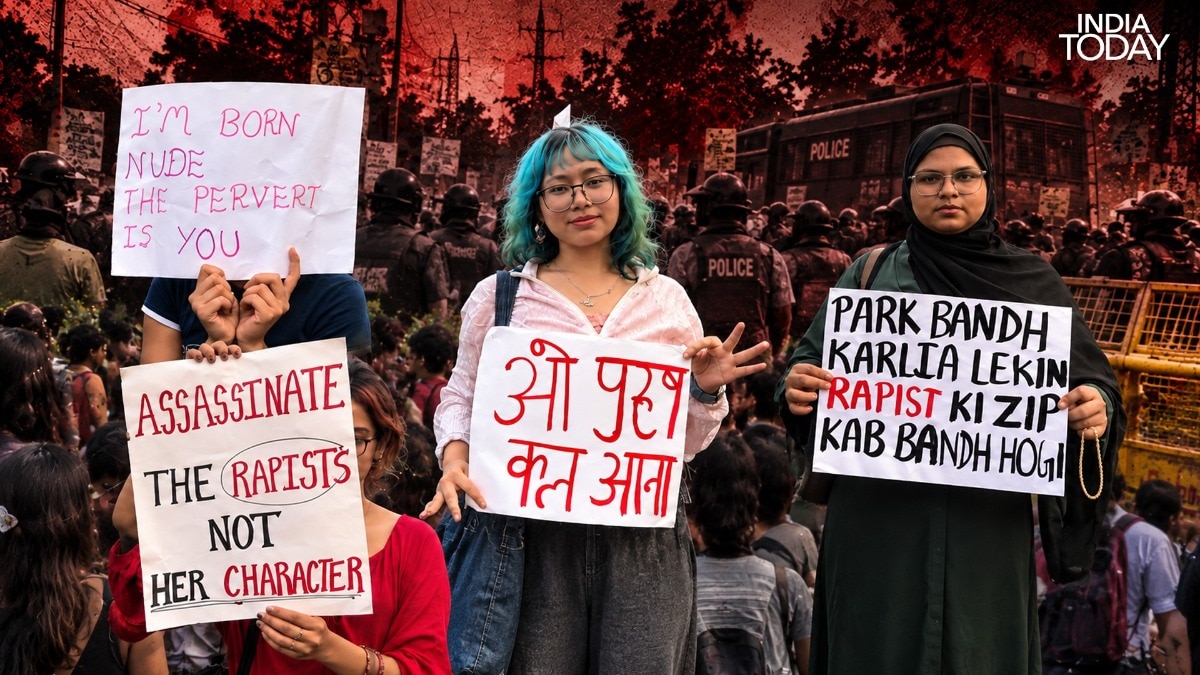
One placard after another, the anger of young women gathered outside the Delhi Secretariat on Wednesday came with its own vocabulary.
Some shouted slogans. Some stood silently, holding handwritten signs. Others spoke about the everyday things that rarely make it into crime statistics - the man following them to the Metro, the unwanted stare outside college, the vulgar comment on the street, the warning from parents to come home before dark.
Students from Delhi University, JNU and other colleges had gathered with demands that, on paper, sound remarkably basic: safety, dignity and the freedom to move through the city without constantly calculating the risks.
But standing amid barricades and heavy police deployment, the protest seemed to be asking a larger question: Why does staying safe so often mean changing the way women live?
Should she dress differently? Leave college before it gets dark? Avoid a park? Stop meeting male friends? Come home early?
For the women at the Delhi Secretariat, the answer was clear: the burden of preventing violence cannot keep falling on the person who may become its victim.
‘Can we imagine this in a country where girls are called goddesses?’
Leave aside the number of rape cases in the National Capital. If one were to count the smaller, daily humiliations — the staring, stalking, vulgar comments and harassment — a mountain would rise from them.
NCRB’s 2023 data recorded 13,366 cases of crimes against women in Delhi, which saw a spike in the past two years as well. The metropolitan-city dataset recorded 1,088 rape cases in the same year.
Delhi Police’s own 2023 figure for rape cases was considerably higher, at 2,141. The difference itself is a reminder that crime statistics can vary depending on the dataset and reporting system being used.
But statistics, for all their cold authority, cannot quite capture the peculiar exhaustion of having to calculate one’s safety every time one leaves home.
“You see anywhere, we are asked to wear in a certain manner, then they ask us not to go here and there, then ask us to come back home on time and also say ignore as much as you can. I mean, can we imagine all this in a country where girls are considered goddesses and where the rivers too are after the feminine energy?” says Aarvi, a student of one of Delhi University’s prominent colleges, who asked that the name of her college not be revealed. A large number of police personnel and other security forces were deployed near the Central Secretariat area. A PROTEST SURROUNDED BY FORCE
The protesters submitted their demands to the Chief Minister’s office amid heavy security and additional police deployment. Barricades stood between the students and the government building. Water-cannon vehicles and central forces were visible as authorities prepared for a large gathering.
One policeman, when asked about the demonstration, said, “The protest will end soon and they will return to their homes. The demands have been submitted already.”
For many of the youngsters gathered outside the Secretariat, it was their first protest.
They had been inspired by the events of September 28, when students from several Delhi University colleges marched following a series of sexual-violence cases reported in the Capital and NCR.
Among the incidents that had sharpened the anger was the alleged gang rape of a 17-year-old girl at Aastha Kunj Park in Kalkaji. Delhi Police said three men allegedly posing as police personnel were arrested in connection with the case. The girl had gone to the park with a male friend.
“See the police force here. I mean, see the numbers they are here to stop us. If this much had been invested to stop crime in Delhi, then the need to take to the streets would never have been felt,” says Diksha, a JNU student who came to Delhi from Bihar.
“See the police force here. I mean, see the numbers they are here to stop us. If this much had been invested to stop crime in Delhi, then the need to take to the streets would never have been felt,” says Diksha, a JNU student who came to Delhi from Bihar.THE QUESTION OF MALE GAZE
Aradhya Awasthi, who was born and brought up in Delhi, believes the conversation around women’s safety has never properly become a conversation about women’s freedom.
“The environment for women’s safety was actually never turned into what we can call safe. Our Prime Minister talks about Beti Bachao, Beti Padhao, but is it enough? We proudly call Delhi our capital city, but is it worthy of it? Have the governments taken enough measures to fix the condition? No, nothing like that happened,” she says.
Two young women who had travelled from Chandigarh to join the demonstration spoke in much the same language.
Their argument was not merely about clothes, parks or the hour at which a woman returned home. It was about what they described as the mindset of the man standing before her.
Wearing anything, they said, does not make a woman characterless. The problem, they argued, lies not in what a woman wears but in what a man chooses to see in her.
From a three-year-old child to a 75-year-old woman, if women of every age can become victims of sexual violence, they argued, then telling women not to go to parks, not to dress in a certain fashion or not to walk alone cannot be the answer.
One cannot impose suspicion upon every man for the crime of another, they acknowledged. But neither, they said, can the responsibility for preventing a crime be transferred to women.
When governments respond to danger by restricting women’s movements, they argued, the question inevitably returns to the state itself.THE CAMPUS BATTLE FOR GIRLS
For many female students at Delhi University, the campus is not merely a place of lectures, examinations and friendships. It is also where they say they encounter harassment - vulgar gestures, unwanted staring, stalking and unsolicited remarks.
Some students claimed that men around campuses sometimes expose themselves or engage in obscene acts. Others said men arriving in expensive cars pass comments and make sexually suggestive remarks.
Parth, a student of Hansraj College, described to India Today what he said were restrictions on women’s clothing within his college. He said students had been told not to wear “short clothes” and claimed that girls could be stopped at the gates for wearing clothing deemed inappropriate.
The account raises a wider question: whether an institution meant to educate young adults should police women’s clothing in the name of safety.
At the same time, Hansraj College has previously faced scrutiny over a gaushala on its campus. The college administration had explained that cow dung and urine were being used as resources for laboratory research.
The protest was also joined by male students from different colleges, who came out in solidarity with their female counterparts.
“After fighting for studies, we also have to fight every day with men. Coming to college feels like a daunting task. One or the other man keeps making us feel unsafe, as if we have done something wrong. It is like they are raping us with their eyes,” says Kratika Pandey, a second-year Political Science student at Hindu College, who asked that her identity be kept anonymous.NORTH CAMPUS STREETS
The India Today team also went towards the North Campus colleges to observe the atmosphere outside them. One of the booths outside one of Delhi University’s top colleges could be seen without any police personnel, even after what Delhi witnessed a few days ago. (Image: Rishabh Chauhan)
The ordinary bustle of student life continued. Students hurried to classes, groups stood outside college gates and the usual noise of the campus carried on. Yet the visible presence of police around several college gates and nearby stretches did not appear as extensive as one might expect amid the recent concerns.
A dozen students were approached, but most declined to speak. Fear, or perhaps simply the unwillingness to become part of a public controversy, kept their voices behind closed doors.
One faculty member from Ramjas College, who had also studied there, agreed to speak on condition of anonymity. Her experience was different.
“It is very rare if any case of harassment or molestation comes up. We walk during the evening, even after 9 pm, and we never felt unsafe. Being an open campus, Delhi University has its own challenges that we cannot turn ourselves away from,” she said.THE PLACARDS, THE TESTIMONY NOW
More than a decade after the protests that followed the 2012 Delhi gang rape and murder, women are still arguing for something more elemental than policy: the right to occupy public space without being instructed how to dress, when to return home, where to sit or whom to meet.
There are questions of cameras, lighting, policing and accountability.
There are also questions that no camera can answer: Why must a woman be taught caution before a boy is taught consent? Why does the burden of prevention so often fall on the potential victim? And why is safety repeatedly translated into restrictions on women?
The placards outside the Secretariat carried the voices of that argument.
“Assassinate the rapist, not her character.”
“Of course I have blue hair and opinions.”
And perhaps the most revealing question was not written on a placard at all.
If a woman cannot walk freely, sit with a male friend, visit a park, choose her clothes or return home after dark without becoming the subject of moral judgement, then what exactly is freedom supposed to mean?
The girls who stood outside the Secretariat were not asking for permission to live.
They were asking why they needed it in the first place.- Ends
A news writer who finds stories in the everyday, turning the ordinary into captivating news. With an eye for detail, Rishabh makes current events both informative and enjoyable, always seeking fresh angles to bring the latest happenings to life. A history enthusiast, he also loves weaving historical perspectives into modern narratives.