Between devotion and spectacle, what is Durga Puja becoming in Bengal?
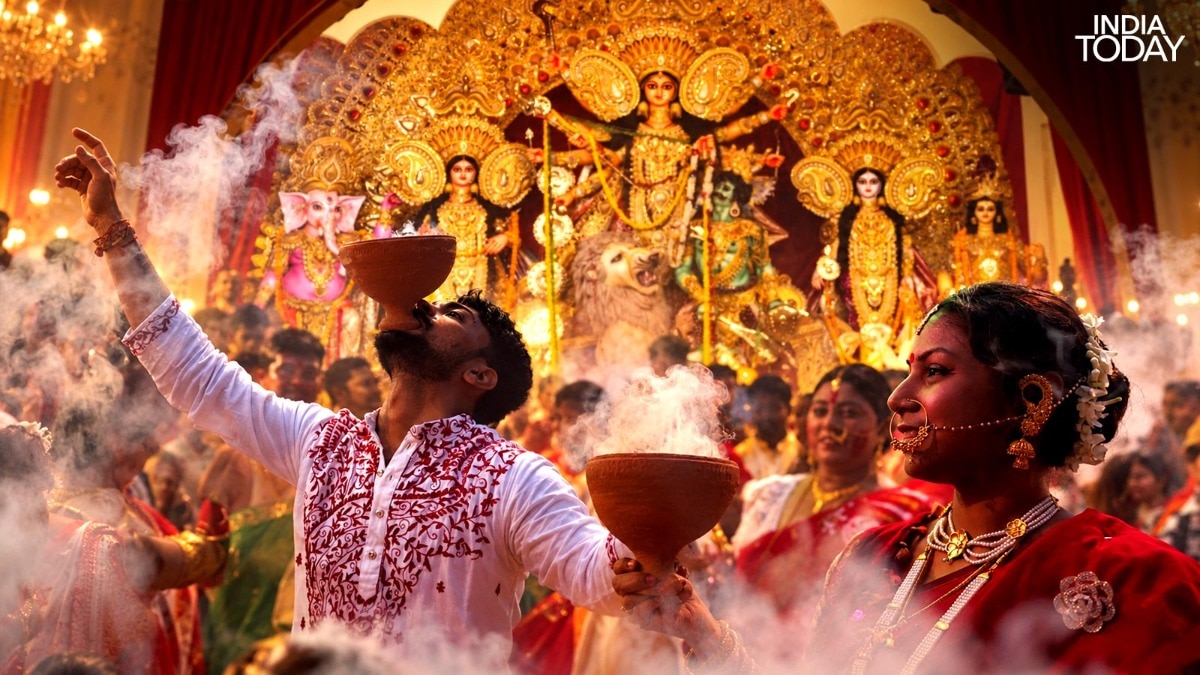
It was Bijoya Dashami, the day of Durga idol immersion. A four-year-old boy stood before a vacant pandal, grief etched across his face. Ma Durga had left for her matrimonial home after four days of hullabaloo, happiness and celebration. Dressed in new clothes and clutching a toy gun, the boy knew what that meant. His grief had little to do with religion. The roll-cap fireworks, new clothes, delicious food and freedom he had enjoyed over the past four days were all over. From the next morning, it would be back to the same old routine. Tweaking Charles Dickens a little, those four days were the best of times. What followed would be the worst.
For decades, Durga Puja has meant much the same thing for Bengalis in West Bengal. On Mahalaya, households would tune in to Mahisasuramardini, the iconic Akashvani Kolkata production featuring Birendra Krishna Bhadra’s recorded voice. Listening to it has become almost a ritual, marking the arrival of the festive season. The programme retells the story of Goddess Durga’s defeat of Mahishasura, interspersed with Bengali devotional songs.
A week later, new clothes would come out of wardrobes, while kitchens filled with aromas of delicacies reserved for those four days. Streets would light up, with theme-based pandals drawing bustling crowds eager for a glimpse of the Durga idol. Each idol, shaped by an artist’s imagination and craftsmanship, would become a talking point. A street in South Kolkata's Bhabanipore (Photo: Ishanee Dhar)
However, this year, that familiar picture is facing a challenge as a debate over the religiosity of Durga Puja and its grand celebrations takes centre stage.
The VHP urged Puja organisers to return to traditional practices and ensure that no non-vegetarian food is sold or consumed around pandals. Soon after, Dhirendra Krishna Shastri, popularly known as Baba Bageshwar, called those who eat non-vegetarian food during Durga Puja “pakhandi” (hypocrites).
Bengalis could perhaps have brushed aside such diktats, as they have done to similar concerns raised over the years about the carnivalisation of Puja and its waning religiosity. But when Chief Minister Suvendu Adhikari issued strict guidelines against themes or cultural practices that distort tradition or hurt religious sentiments, many found themselves at a crossroads. For Bengalis, Durga Puja has long been an inclusive celebration of art that transcends religious lines. Its experimentation and spectacle have helped the festival evolve into a major cultural event, earning Kolkata’s Durga Puja UNESCO recognition as intangible cultural heritage.
So, as calls for a return to tradition grow louder and controversy erupts just ahead of Puja, a question arises about how Bengalis, across the spectrum, are perceiving this renewed debate over tradition and modernity surrounding their favourite festival. Let us dive deep into that.BATTLE OVER WHAT DURGA IDOL SHOULD LOOK LIKE
“In many pandals, the Durga idols do not resemble the idols that the Sanatanis worship,” says Sajal Ghosh, BJP MLA from Baranagar and the main organiser of Kolkata’s 91-year-old Santosh Mitra Square Durga Puja.
With barely two weeks to go for the annual festival, Ghosh explains why he believes the idol should remain untouched by artistic experimentation.
“The idol is something we worship with devotion. It should not be a subject of experimentation and should strictly follow the traditional guidebook. We have seen instances where Durga idols were made impersonating Mamata Banerjee, with artists putting the names of her welfare schemes in Devi Durga’s ten hands. There have also been instances where ten children were placed in Devi’s ten hands, distorting the traditional form of the goddess. The idol is directly connected to people’s religious sentiments,” he said. An idol from Kolkata's Ekdalia Evergeen Durga Puja (Photo: Getty Images)
The irony is that Santosh Mitra Square Puja is itself famous for its themes, from Ram Mandir in 2024 to Vande Mataram this year. Ghosh draws a distinction between experimenting with the theme and altering the deity.
“I myself am a flagbearer of theme-based Pujas in Kolkata. No one has raised any objection to that. The sanctity of the Durga idol, however, needs to be protected. People can eat as much non-veg food as they want, but that should happen outside the pandal, not inside.”
RSS pracharak Jishnu Basu echoes the concern, arguing that artistic reinterpretation of the idol can hurt devotees’ religious sentiments.
“An idol is not merely made of clay. On the day of Maha Sasthi, Bengali Hindus invoke the divine presence of the deity in the idol. Thousands of people’s religious sentiments are attached to it. So, when the idol is distorted in the name of artistic expression, those sentiments are hurt. The artists or Leftists who are so keen on experimentation should try it at festivals of other communities or even at May Day programmes. Will they be able to do that? Why are the sentiments of Hindus always targeted?” Basu tells India Today Digital. A traditional Durga idol (Photo: Reuters)
Taking the argument beyond the idol itself, BJP spokesperson Rajarshi Lahiri says decades of what he calls cultural malpractices have eroded traditions associated with Durga Puja.
“Does today’s generation know who Ma Durga was? Bankimchandra Chattopadhyay hailed her as Bharat Janani (Mother India) in his song Vande Mataram. She was worshipped by Netaji Subhash Chandra Bose in jail, as well as by several other Bengali revolutionaries. This is what I mean by Bengali tradition. It was never about deciding mouthwatering menus for Puja or drinking expensive alcohol, as the present generation does,” Lahiri tells India Today Digital.advertisementWHEN ARTISTS REIMAGINE DURGAImagine this. The world is grappling with a devastating war. The air in the Middle East is heavy with gunpowder, bodies of children lie scattered, and blood stains spread across countries. Against this backdrop, Devi Durga appears in an unusual form. Pained by the horrors of war, she chooses not to carry weapons. Instead, she spreads a message of peace and love that transcends geographical boundaries.
The scene became a reality nearly 30 years ago, when visual artist Sanatan Dinda conceptualised an idol that drew the attention of pandal-hoppers.
“It was my first Durga Puja work in 1998. The world had just emerged from the devastating Gulf War, which claimed thousands of lives. I decided that my mother (Devi Durga), who was pained by the violence and terror, would not carry any weapons. So, I placed Lord Ganesha on her lap and made Mahishasura sit beneath her with folded hands, apologising to her,” Dinda said.
With calls against artistic experimentation growing louder, Dinda takes a balanced view. He believes artists should not do anything that excludes Devi Durga but argues that experimentation does not necessarily distort religious sentiment. Artistic experimentation with Durga idol (Photo: Getty Images)
“There are plenty of songs like ‘Jao Jao Giri Anite Gouri, Uma Boro Dukhe Royeche’ (Giri, Devi Durga’s father, please go and bring Uma, as she is in sadness), which address Devi Durga as our own daughter. So, where is it written that daughters need to be decorated only in a particular way? We can imagine her as we want. It needs to be remembered that a metal water pot is traditionally worshipped, and no one is changing that. However, the bigger idol is a work of art, and artists have every right to imagine it as they want,” Dinda said.
Durga Puja has evolved significantly over the decades, as have the artistic experiments around it. Kolkata’s Pujas underwent a major transition in the 1990s, when Asian Paints launched the ‘Shuddha Suchi, Sustha Ruchi’ campaign to promote high cultural and artistic standards. Theme-based Pujas have grown since then, giving artists greater room to experiment.
Reminiscing about those days, artist Bhabotosh Sutar tells India Today Digital, “Artists are devotees themselves. We worship what we make—the eyes, the hands, or the face of the goddess. Political parties need to be more respectful towards it.
“When it comes to the festival, one needs to remember that it is inclusive and does not discriminate against anyone based on caste or religion. Perhaps Bengal is the only place where Durga, originally Rajnondini (queen), leaves her status and comes down to the streets, where she is worshipped by common people. This is the festival that has earned us UNESCO World Heritage recognition. So, people should think twice before making statements that hurt its inclusivity,” Sutar adds. Durga idol, reimagined in the artists' eyes (Photo: Srishti Dutta Chwodhury)
The artistic discourse in Bengal has seen its share of debates. Some artists and critics have questioned the commercialisation of art in the name of Durga Puja, but also believe regulating artists would be problematic.
“If we look at the history of religious art, artists have always taken the liberty to shape their work as they wish,” art historian and critic Oindilla Maity Surai tells India Today Digital. “Today, artists are more equipped with technology; however, they also have a lot of burdens. They are already burdened by several demands from Puja organisers and committees. In this context, if people try to regulate their work, they will be agonised,” she adds.DURGA PUJA THROUGH THE LENS OF HISTORY
As exhibitionism draws flak from a section of people, it is worth looking at the history of Durga Puja. Historians and journalists have often argued that the competition and grandeur associated with today’s celebrations have been part of the festival for centuries.
Former Rajya Sabha MP and bureaucrat Jawhar Sircar, who has written extensively on Durga Puja, says the festival has always blended religiosity, art and culture with celebration.
“Conservatism is not part of Durga Puja. Sorry, it has never been. We reserve our orthodoxy for Ma Kali and observe the strictest rituals for her worship. But Durga represents the homecoming of our daughter. So, joy and openness to all have been part of our Durga Puja,” he says.
“During the Mughal period, when the peasant population was small, Hindu zamindars competed to attract more farmers to their estates. They organised grand Durga Pujas to draw villagers from afar, often adding ceremonies and carnivals to keep them longer. Therefore, carnivalisation has been a major part of Puja since the beginning,” he adds.
In her book Durga Puja: Celebrating the Goddess - Then and Now, author and journalist Sudeshna Banerjee traces the festival’s evolution to the zamindar households of Bengal. Raja Udaynarayan of Taherpur, in present-day Bangladesh, is credited with the first attempt to organise a grand Durga Puja in 1580. His grandson, Raja Kangsonarayan, realised that ambition in the early 17th century, reportedly spending Rs 8 lakh on the celebrations.
As the festival spread, other zamindars followed, using their Pujas to display wealth and power while bringing together friends, family and local communities.
Kolkata’s zamindar families took this exhibitionism further. Raja Nabakrishna Deb of Sovabazar hosted a lavish 12-day Puja soon after the Battle of Plassey, inviting senior British officials. The celebrations featured lavish food, alcohol, dancing and other entertainment. Shib Krishna Dawn of Jorasanko was known for covering the Durga idol in gold. A look at Kolkata's Sovabazar Rajbari
A popular North Kolkata folklore captures the grandeur of these Pujas: ‘Ma goyna poren Jorasankor Shibkrishna Dawn er barite, bhojon koren Kumortulir Abhayacharan Mitrer barite, aar raat jege naach dekhen Shobhabazar Rajbarite.’ (After coming to the mortal world, Ma Durga adorns herself with jewellery at Shib Krishna Dawn’s house in Jorasanko, feasts at Abhayacharan Mitra’s house in Kumartuli and stays up all night watching dance performances at Shobhabazar Rajbari).
“The competition among the elites, or the exhibitionism surrounding Durga Puja, goes back to the history of the Bonedi Bari celebrations. What we see among organisers today is nothing new. The earliest Durga Pujas became symbols of wealth and power, with the Hindu landed gentry using them to assert their position,” art historian Tapati Guha Thakurta tells India Today Digital.
Community Pujas, or sarbojonin, emerged in the early 20th century, when Bengal was at the height of the nationalist movement. Revolutionaries used the platform to mobilise people, while clubs such as Shimla Bayam Samiti, Kumartuli Sarbojonin, and Bagbazar Sarbojonin helped shape the movement. Subhas Chandra Bose also took an active part in some of these Pujas.
Artistic experimentation followed. Sculptor Gopeshwar Pal broke away from the traditional ekchala form, in which Durga and her family were placed within a single frame, and separated the five figures. The modern battle-ready Durga, shown slaying the buffalo demon, was influenced by his work. A sculptor is busy preparing a Durga idol (Photo: Reuters)
Over time, modern themes and political messaging entered the festival, turning idols and pandals into spaces for artistic expression. During the NRC-CAA protests, for instance, one pandal depicted Devi Durga as a refugee mother. The Naktola Udayan Sangha Puja imagined imagined Devi Durga as a refugee mother. It also made an artificial milestone that said Khulna, a place in Bangladesh (Photo: Srishti Dutta Chowdhury)
The Samaj Sebi Sangha in South Kolkata, which began its Durga Puja to restore communal harmony after the Calcutta Riots of 1946, reflected that history in its theme last year. The pandal depicted how it had provided shelter to Hindus and Muslims during the riots.
“The unique part of Puja is the public street art. A pandal is often established in a tiny lane, or on an empty area between two houses. The experimentation carried out by the team of artists springs from everyday spaces. The entire Durga pavilion becomes a live art installation, carefully choreographed by the artists. The experiments here should not be seen as ‘distortions’ but as celebrations of art and creativity,” Guha Thakurta concludes.DURGA PUJA FOR THE PEOPLE, OF THE PEOPLE, BY THE PEOPLE
Durga Puja may be a religious festival or a grand celebration of art and culture, but at its heart lies the participation of the people. Millions of Bengalis wait all year to immerse themselves in its rituals, celebrations and festivities.
With the debate around this year’s Puja intensifying, it becomes important to understand how people themselves view it. For some, it is about pandal-hopping; for others, an annual holiday or simply a break from routine. But the latest controversy has left many questioning whether that freedom is now under threat. Crowds flock to the Ekdalia Evergreen pandal (Photo: Getty Images)
“See, for me, Durga Puja is nothing but a time to relax. I can allow myself not to work during this particular time. No deadlines, and no one even nudges me about a new project. I can relax, read a book or watch movies,” Ranadeep Naskar, a freelancer and filmmaker, tells India Today Digital. “If this independence is being curbed by imposing diktats, then I find it problematic,” he adds.
Ritaban Misra, a media professional sitting nearly 1,300 kilometres from home, is similarly irritated by the debate.
“For me, Durga Pujo has always been much more than a religious affair. It is deeply rooted in Bengali culture, but its appeal goes far beyond religion. It is about food, art, music, adda, pandal-hopping and the feeling of coming together. Even people who aren’t particularly religious can find their own connection with Pujo, which is why I think it transcends the boundaries of faith.” Crowd in Kolkata's Hindustan Park Puja (Photo: Reuters)
Ishanee Dhar, a journalist, says that inclusivity is where the true spirit of Puja lies.
“We have a Muslim househelp at my home. She takes a mandatory four-day leave during Pujo. She buys new clothes for her kids and also fights with my parents if they do not give her a Pujo bonus. This is where the true spirit lies. I have seen my hardcore atheist friend crying in front of an empty pandal. Those tears had no religion, but reflected a feeling of community bonding. If anyone is challenging this inclusivity, then they are going against our culture.”
She sees the relationship with Durga as particularly intimate for Bengali women.
“Before immersion, Ma Durga leaves kanakanjali — a handful of rice and a coin — in the pallus of women. It is a ritual performed when a daughter leaves her parents’ home after marriage. I do not know whether King Janaka’s wife sheds tears before bidding farewell to her daughter and sending her back to Kailash. But women across Bengal do. They shed tears, embrace the idol and kiss the cheeks of the clay goddess. This is the mother-daughter affair or a form of sisterhood that runs through our veins. This is much deeper than the conservative ritualistic practices.” A woman offering her last prayers to Devi Durga before immersion (Photo: Getty Images)
The debate has also left some organisers anxious about this year’s celebrations, particularly over the vegetarian and non-vegetarian food controversy. Priyankar Das, an organiser and professor of sociology, says food stalls outside his Puja pandal have been asked to stay alert for possible trouble.
“Bengalis know how to take ownership of Durga Puja. Right after the RG Kar incident, Mamata Banerjee asked people to return to the festivities, leaving the protests aside. Bengalis rejected that. Now, if some other people are setting new guidelines, Bengalis would reject that as well. This is our Puja; we will celebrate it and not allow anyone to impose things on us,” Das tells India Today Digital.
Journalist-author Snigdhendu Bhattacharya believes the debate is politically motivated.
“This is RSS’s experimentation. They are aware of the liberal culture of Bengali festivals, and that is the reason they want to change it. Today, they are prohibiting experiments with the idol’s appearance. However, worshippers have always imagined her in different ways, which is evident in the huge diversity of Durga idols in traditional family pujas across the state,” Bhattacharya tells India Today Digital.
Somewhere amid these arguments, that four-year-old boy, now on the verge of turning 30, finds himself at a crossroads. The festival he grew up with has become entangled in arguments that exhaust him. Sitting 1,300 kilometres from home, he wonders whether those “best of times” are now over, and whether the days ahead may only be the worst of times.- Ends
Akash Chatterjee has joined India Today as a senior sub-editor in the news desk. Originally from West Bengal, Akash is fluent in English and Bengali, and has professional expertise in Hindi. Starting from the Bengali media, Akash has served multiple brands like Times Internet, Outlook Publishing India Private Limited, FirstSportz, and The New Indian Express before joining India Today. He has covered diverse beats like business, start-ups, US football, and features.
A graduate and master's degree holder in Political Science with International Relations from Jadavpur University, Akash is enthusiastic about state politics, election coverage, electoral analyses, and long-form articles explaining political turmoils. Other than politics, Akash is interested in tasting culinary items from various Indian states.