Beyond tariffs: A wider agenda for China-US relations
By continuing to browse our site you agree to our use of cookies, revised Privacy Policy and Terms of Use. You can change your cookie settings through your browser.
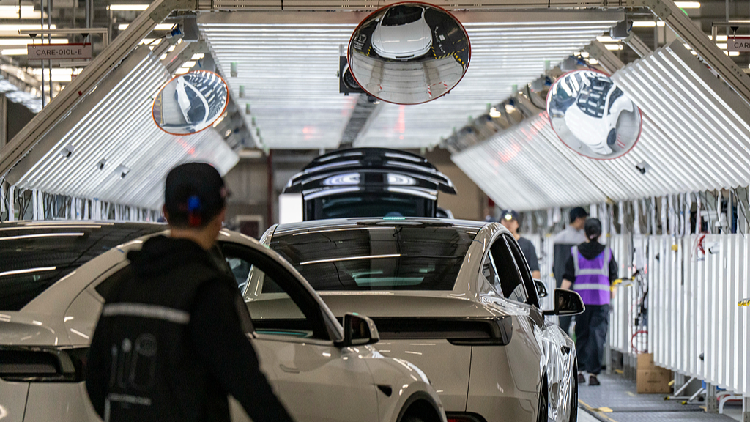
Tesla Inc. Model Y electric vehicles on a production line at the company's Gigafactory plant during a media tour in Shanghai, China, April 14, 2026. /VCG
Editor's Note: Sun Taiyi is an associate professor of political science at Christopher Newport University in the United States. He is also the executive editor of the Global Forum of Chinese Political Scientists' main publication, Global China. The article reflects the author's opinions and not necessarily those of CGTN.
The latest China-US economic and trade consultations in New York are noteworthy not because they produced a sweeping settlement, but because they suggest that the two sides are becoming more willing to separate problems that must remain contested from areas where practical cooperation is still possible.
The timing adds to their significance. President Xi Jinping's visit to the United States from September 23 to 25 comes just several months after President Donald Trump's visit to Beijing in May. Such high-level exchanges create a political deadline: negotiating teams have incentives to narrow disagreements beforehand, identify deliverable outcomes, and prevent new disputes from overwhelming the summit agenda. The New York consultations can therefore be viewed as part of a broader effort to place bilateral relations on a steadier footing.
The two sides held candid, in-depth, and constructive exchanges on economic and trade issues in New York, including implementation of previous understandings. They also discussed artificial intelligence. The widening agenda is significant because it shows that bilateral economic engagement is gradually moving beyond tariffs alone.
One important direction is creating more room for ordinary commerce. China and the United States remain deeply connected economically, yet an increasing share of trade has become entangled with national-security concerns. A more sustainable approach requires distinguishing technologies with genuine security implications from products whose trade creates little strategic risk.
The emerging "Board of Trade" could help make that distinction more concrete. US officials have discussed using it to reduce barriers on selected non-strategic goods. If this approach develops further, competition over semiconductors and other sensitive technologies would not automatically require restrictions on every consumer good, medical product, agricultural commodity, or intermediate input.
This matters beyond China and the United States. Lower barriers in suitable sectors could reduce costs for American consumers and companies while improving commercial predictability for Chinese producers and investors. Businesses elsewhere also have an interest in fewer abrupt policy changes between two economies whose decisions reverberate throughout global supply chains.
Artificial intelligence presents an even more interesting possibility.
China and the United States will remain strong competitors in AI. Computing power, advanced models, semiconductors, and industrial applications could profoundly influence future productivity and national capabilities. There is little reason to expect either country to abandon that competition.
Yet AI also presents dangers that cannot be contained by national borders. Major cyber incidents involving AI, misuse by non-state actors, or unexpected failures affecting critical infrastructure could create serious consequences for both societies.
This gives Beijing and Washington a reason to establish communication even while technological competition continues. US Treasury Secretary Scott Bessent said after the New York meeting that the two sides had agreed to formalize an AI dialogue, explore an "incident line" for significant AI safety events, and continue discussions in Shenzhen in approximately two months.
That is an important distinction. Cooperation on AI does not require China and the United States to agree on who should lead the technology. It requires them to recognize that some technological risks are shared even when technological ambitions are not.
The same preference for avoiding unnecessary escalation is visible in trade. The present tariff pause runs through November 10, and its extension was discussed in New York, although no final decision was announced. The exact duration will matter, but an equally important development is that disputes are now routinely returning to a negotiating mechanism rather than moving immediately into another round of tariffs and countermeasures.
That mechanism has accumulated experience. Beginning with the Geneva talks in 2025, the two sides established an ongoing consultation framework, reduced some additional tariffs, and suspended certain countermeasures while continuing negotiations. New York represents another step in that process.
None of this means that fundamental disagreements have disappeared. Semiconductors, critical minerals, market access, and other difficult questions remain. But disagreement in one field need not determine the entire relationship.
For China and the United States, the more achievable objective is therefore not an unrealistic return to comprehensive partnership. It is to enlarge areas where interests overlap, prevent strategic competition from unnecessarily absorbing ordinary economic exchange, and preserve channels capable of handling the next dispute when it arrives.
In a relationship of such global consequence, managing differences effectively can itself be a meaningful form of progress.