Big Hilsa twist: Sought-after fish changes direction, India now exporter - The Indian Express
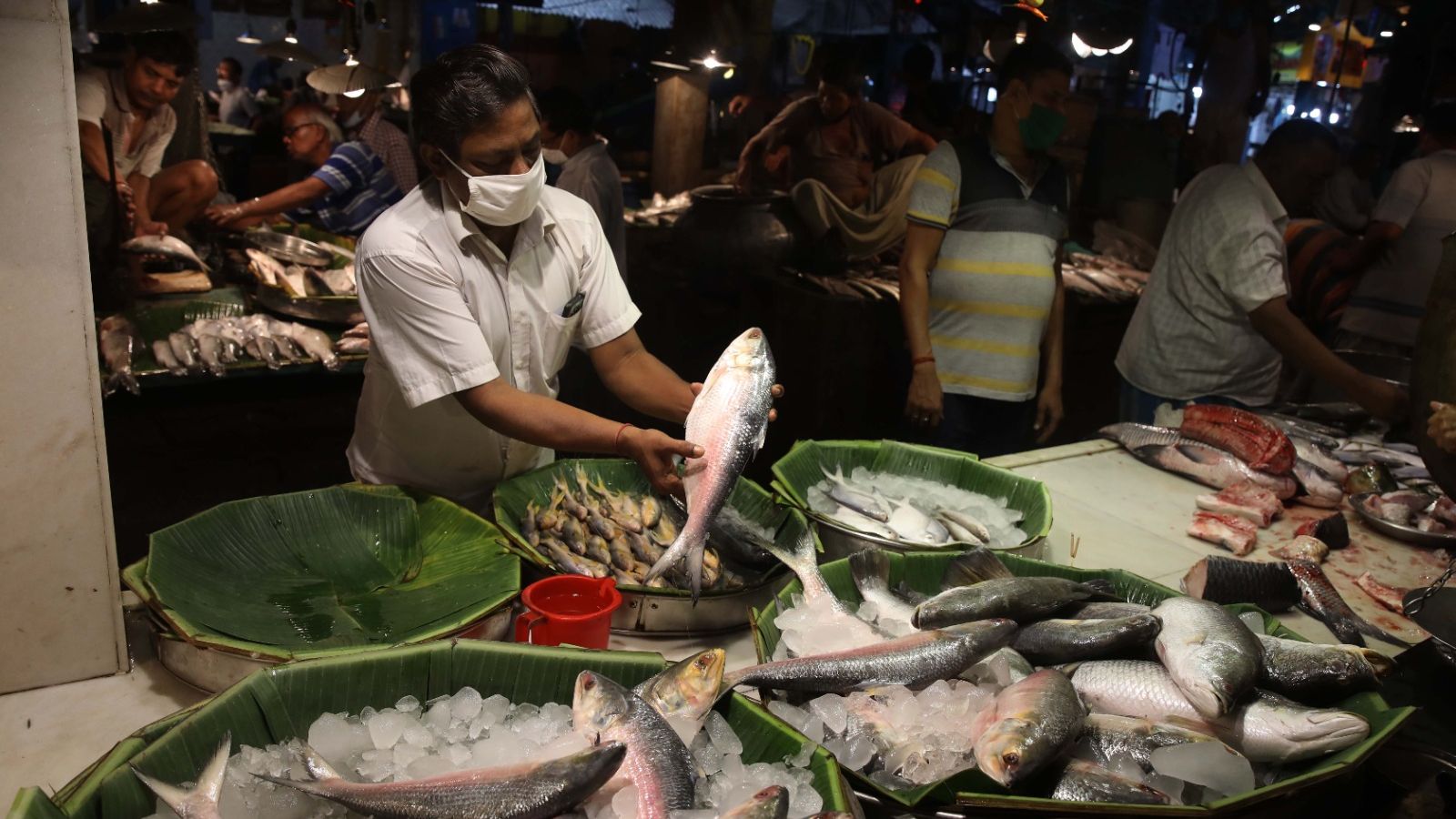
In a role reversal of sorts, India is exporting Hilsa fish to Bangladesh, bucking the trend of the neighbour supplying the sought-after variety of fish that has the highest place of pride on Bengal’s dining tables.
Around 500 tonnes of Hilsa, known as Ilish in Bengali, have been sent to Bangladesh in the past two months through the Petrapole land port on the international border in West Bengal. Traders expect an additional 150 to 200 tonnes of Hilsa to be exported to Bangladesh in the coming weeks.
Traditionally, Hilsa is brought in from Bangladesh when its government allows its import, generally during the Durga Puja festive season. Currently, Bangladesh has paused Hilsa exports to India.
“This is the first time Hilsa from our country is being exported to Bangladesh. It is a welcome development. Most of the catch is from Gujarat,” said Syed Anwar Maqsood, secretary of the Fish Importers Association in Bengal and the Howrah wholesale fish market.
Speaking to The Indian Express over the phone from Petrapole, Kartik Chakraborty, secretary of Petrapole Clearing Agents Staff Welfare Association, said, “Earlier, we eagerly waited for Hilsa from the Padma river in Bangladesh. Later, its import was restricted. Now we are happy that fish from India is going to Bangladesh and people there like it.”
According to fish traders and exporters, the development reflects changing patterns of production, availability and consumer demand in the two neighbouring countries.
A substantial portion of the Hilsa consignment is from Gujarat, particularly the Bharuch region, and some supplies have moved through the Howrah fish market in Bengal.
The traders said Hilsa with high roe content is attracting considerable demand in Chattogram, Sylhet and other districts of Bangladesh. Roe refers to the fully ripe egg mass in female hilsa fish, also used to prepare delicacies. The roe is also being processed for re-export from Bangladesh. Some fish are also being used to prepare dried and salted fish delicacies.
“The fish exported has high roe content. The roe is extracted, packaged and then re-exported, and the hilsa is salted, dried and sold in Bangladesh,” said Maqsood.
“The export of Indian Hilsa to Bangladesh is not merely a trade phenomenon; it is a strong market signal reflecting the exceptional consumer preference, economic value and regional demand for this iconic fish. It highlights Hilsa’s potential as a high-value fishery resource capable of contributing to fishermen’s livelihoods, food security, domestic consumption and regional trade. For West Bengal, this is an opportunity to develop a knowledge-driven, sustainable and value-added Hilsa economy through science-based stock enhancement, responsible fisheries management, post-harvest value addition and integrated market linkages,” said Pradip Dey, director of Central Inland Fisheries Research Institute.
For West Bengal, which has a strong cultural association with Hilsa and an established fish marketing network centred around Kolkata and Howrah, the development presents opportunities to strengthen production, aggregation, cold-chain logistics, value addition, processing, branding and export-oriented fisheries enterprises.
Earlier, a team from the Fish Importers Association visited Dhaka in August and met Ataur Rehman Khan, the Commerce Secretary of Bangladesh, and urged him to lift the ban on the export of Hilsa to India.
“The Association also wrote letters to the Bangladesh Prime Minister and others for lifting the ban. Since July 2012, Hilsa imports from Bangladesh were restricted. In 2019, the government of Bangladesh started permitting imports only during Durga Puja festivities with a window of a month. This does not work out,” said Maqsood.
“The Bangladesh government gives permission for a certain quantity. But since the window is small, the imported quantity is very low. For instance, in September 2024, the quantity permitted was 2420 metric tonnes, but the actual import was 577 metric tonnes. In September 2025, 1,200 tonnes were permitted, but only 150 metric tonnes were imported,” said Maqsood.
Ravik Bhattacharya is a highly experienced and award-winning journalist currently serving as the Chief of Bureau of The Indian Express, Kolkata. With over 20 years of experience in the media industry, Ravik possesses deep expertise across a wide range of critical subjects and geographical areas. Experience & Authority Current Role: Chief of Bureau, The Indian Express, Kolkata. Expertise: Extensive reporting across West Bengal, Odisha, Assam, and the Andaman Nicobar Islands. Ravik specializes in politics, crime, major incidents and issues, and investigative stories, demonstrating a robust command of complex and sensitive subjects. Experience: His long and distinguished career includes key reporting roles at several prestigious publications, including The Asian Age, The Statesman, The Telegraph, and The Hindustan Times. Ravik's current role marks his second stint with The Indian Express, having previously served as a Principal Correspondent in the Kolkata bureau from 2005 to 2010. Major Award: Ravik's authority and quality of work are substantiated by his winning of the prestigious Ramnath Goenka Excellence in Journalism Award in 2007 for Political Reporting. Education: His strong academic foundation includes a Bachelor's degree with English Honours from Scottish Church College under Calcutta University, and a PG Diploma in Mass Communication from Jadavpur University. Ravik Bhattacharya's extensive tenure, specialized beat coverage, and notable award confirm his status as a trusted and authoritative voice in Indian journalism, particularly for stories emanating from Eastern India. ... Read More