Bihar beyond katta: Culture, Chhath and The Vvaan mark its mainstream cinema moment
For years, Hindi cinema had a very specific way of seeing Bihar. There was the gun, the gangster, the corrupt politician, the cop, the dusty road and, somewhere in the background, a crime story waiting to unfold. Bihar could be dangerous, lawless, political or impoverished on screen. But rarely was it treated as more than a backdrop.
Now, something is changing. Bihar is beginning to enter mainstream Hindi cinema not merely as a setting, but as a world of its own, with its festivals, folklore, music, language, faith and everyday life becoming part of the story.
The Vvaan: Force of the Forest is a telling example of that shift.
Directed by Deepak Kumar Mishra, the film puts Chhath at the centre of its world rather than using the festival as a decorative backdrop. For Mishra, writer-producer Arunabh Kumar and the team, the connection was deeply personal. Mishra says the story came from Arunabh's own experience of growing up in Bihar, where Chhath was part of his childhood and cultural memory. That was also why the makers were particular about getting the festival right - its rituals, atmosphere and emotion - rather than recreating a generic version of it for the screen.
"The story is written by Arunabh Kumar, who is also one of the producers, and this is his lived experience from his childhood in Bihar," Mishra told India Today Digital. "Both of us wanted the audience to feel that they were witnessing something that belongs to their lives as it does to Arunabh," he added.
Mishra was quick to acknowledge Ektaa Kapoor and Balaji Motion Pictures for encouraging the team to bring this Bihar-rooted story to theatres. "We are very thankful to Ektaa Kapoor and Balaji Motion Pictures who encouraged us to bring this story to the big screen," Mishra said.
Why is that support important? Because The Vvaan doesn't just tell audiences that Chhath is being celebrated in Bihar. It tries to make them feel what that celebration means. It wants the audience to be a part of that experience. It wants someone sitting in Kerala to experience Chhath for the first time through that visual medium.
Mishra had seen Chhath being celebrated in his own hometown and wanted that familiarity to translate on screen. The director described how he shot for the most viral Chhath song from the film.
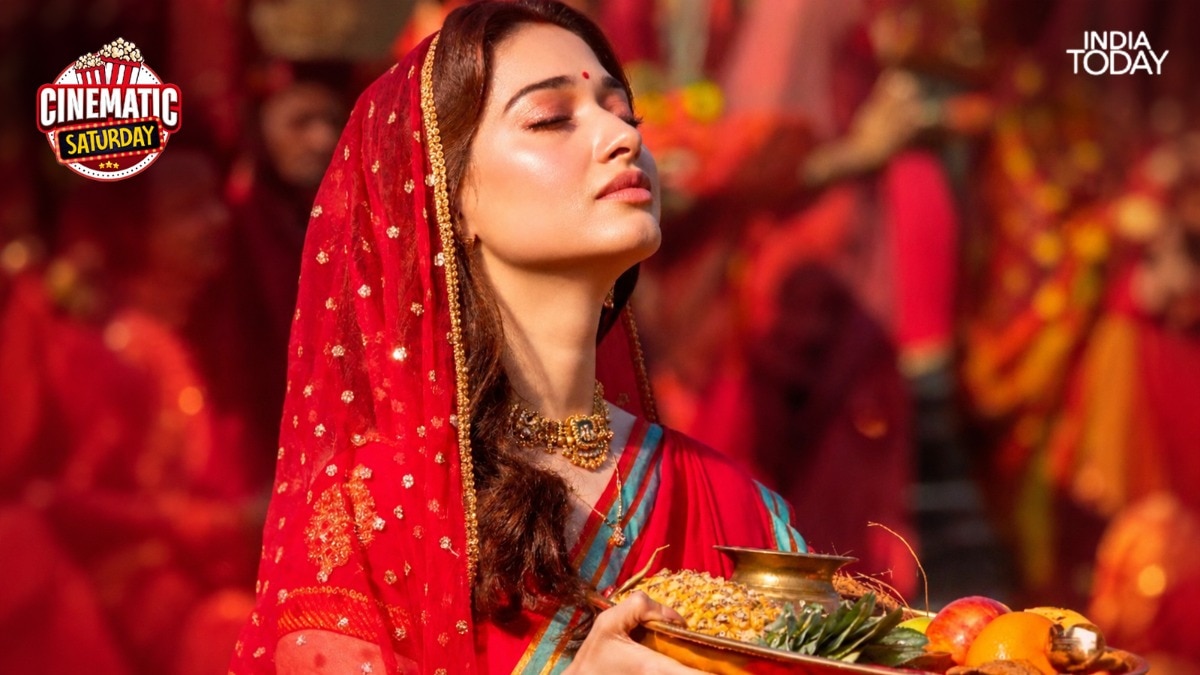
More than 100 women were dressed in traditional red sarees for the sequence, while the production paid attention to details such as the fruits offered in the soop, the rituals and the rounds performed during the festival. The Chhath sequence also runs parallel to the film's central conflict, with the struggle to save the Vandevi forest unfolding as women wait to offer the evening and morning arghya.
"The closer we could stay to the culture of Bihar and Eastern UP, and the more spiritual we could make the environment, the more we felt we were connecting with the true emotion of Chhath," Mishra said.
This is different from how the mainstream cinema has treated Bihar's culture so far. The intention is not to keep the culture on the periphery. There are efforts to get those details right.
Audiences have not just watched the Chhath portions of The Vvaan; they have turned screenings into celebrations of their own. There is thekua being distributed inside theatres while viewers turn up bare-foot to offer respect. Mishra says the most gratifying part has been seeing people respond not only to the film but to its cultural details - taking something from the world created for the screen and making it their own.
And that is the larger story here. Bihar is beginning to appear on-screen in ways that don't require a gun, a gangster or a crime plot to justify its presence. Ayushmann Khurrana and Sharvari during a Chhath scene in their upcoming film Yeh Prem Mol Liya advertisementWhat took the industry so long to represent Bihar's culture?Actor Chandan Roy, who grew up in Mahnar in Bihar's Vaishali district and became one of the most recognisable faces of TVF's Panchayat, has watched that shift from both sides - as someone from Bihar and as an actor working in mainstream entertainment. He believes the change has been driven significantly by audiences.
"The audience has forced these mainstream makers to change," Roy said while speaking to India Today Digital, arguing that access to world cinema has fundamentally altered what viewers expect. Earlier, audiences had fewer choices. Now, even people in small towns and villages can watch films from across the world and compare them with what mainstream Hindi cinema is producing.
For Roy, that exposure has made it increasingly difficult for filmmakers to rely on familiar formulas.
He recalled a time when the same basic story could be recycled with different actors, a few songs added and presented as entertainment. The internet, he said, changed that. Audiences began to realise that stories they had long been told were original were often borrowed from elsewhere.
"So now they have no choice," Roy said of mainstream filmmakers, adding, "They have to change."
He believes the South Indian film industries offer an important example of what happens when cinema remains connected to its roots. Their stories, he argues, often feel more original precisely because they remain rooted in their own cultures.
That is now beginning to happen in Hindi cinema too. And Bihar has plenty to offer.
"Where there is struggle, there are stories," Roy said. "But the unfortunate thing is that for the makers here, Bihar used to be a soft target. If you have to show a bullet, a gun, a katta (country-made pistol), show Bihar, show crime. But is that all there is to Bihar?" he added.The setting has changed
It isn't. For years, filmmakers mined Bihar's political and social landscape primarily for crime stories. Films such as Gangaajal and Apaharan became associated with a particular cinematic image of the state. Roy's argument is not that these realities don't exist. It is that Hindi cinema stopped looking after it found them.
"Bihar is still completely unexplored," he said, adding, "There are thousands and thousands of stories in every house."
There is another reason for that, he believes: distance.
Roy pointed out that writers and filmmakers who come to Mumbai in their early twenties can spend 15 or 20 years living in the city before getting the opportunity to make a film. By then, their everyday experience of the places they came from has inevitably changed.
"If someone has been in Mumbai for the last 20 years, struggling and working here, and then he sits in Mumbai and tells a story about his village, it may not be very organic," he said.
The new generation of filmmakers and storytellers coming from Bihar, Uttar Pradesh, Jharkhand and other parts of the country, he believes, is different. They have grown up with access to world cinema and are more conscious of what they want to show, and what they don't.
That authenticity is particularly important when cinema deals with culture. Roy is clear that simply inserting a Bhojpuri song or bringing in a regional actor isn't enough. If filmmakers are going to portray a festival, language or community, they need to do it honestly.
"If you are showing Chhath, please show it very authentically and organically," he said.
His reasoning is simple. A person sitting in Tamil Nadu who has never experienced Chhath may form their entire understanding of the festival from what they see on screen. "That is a very big responsibility," Roy said. "Whatever you show them, that becomes their understanding of Chhath," he highlighted.Bihar is recognised for its audience share
The Vvaan appears to have understood that responsibility. And the fact that its Chhath song has become such a talking point is significant because it shows that cultural specificity does not necessarily make a mainstream film niche. In the right context, it can become the very thing that makes the film connect.
The change is visible outside the film too. When Allu Arjun brought the trailer launch of Pushpa 2: The Rule to Patna's Gandhi Maidan in 2024, it was a striking image of the Hindi heartland's growing importance to pan-India cinema. A Telugu superstar and one of India's biggest films were not just expecting the Patna audience to travel to the film. The film travelled to them. Allu Arjun during the trailer launch of Pushpa: The Rule in Bihar (Photo: PTI)
The same widening of the mainstream space can be seen in the growing presence of Bhojpuri actors. Ravi Kishan has moved across Bhojpuri cinema, Hindi films, streaming and reality television, while Dinesh Lal Yadav, popularly known as Nirahua, is now a major part of mainstream Hindi projects such as Vibe. Bhojpuri stars have also become increasingly visible on reality television, where their regional popularity has translated into a larger national presence. Bhojpuri stars Aamrapali Dubey (L) and Dinesh Lal Yadav (R) with Salman Khan during Bigg Boss 20 premiere
For Roy, however, the most important change is not that Bihar is suddenly fashionable. It is that filmmakers are finally beginning to understand that audiences want to see themselves.Rooted stories, real people, raw settings
He experienced that response himself with Panchayat. Its characters work because they feel recognisable, not because they are presented as exotic villagers from an unfamiliar part of India.
"Panchayat became a hit because it was our story," Roy said, adding, "If you close your eyes and think about your village, you will find Vikas there, you will find Prahlad there, you will find Rinki there. Everyone will be there."
That may explain why the current Bihar moment feels different from earlier attempts at regional representation. It isn't simply about putting Bihar on screen, but about allowing Bihar to speak in its own language, celebrate its own festivals, inhabit its own contradictions and tell stories that aren't always about crime. Chandan Roy as Vikas Shukla (L) with Jitendra Kumar as Sachiv Ji (R) in a still from Panchayat
Mishra, the director of The Vvaan, believes audiences are increasingly receptive to stories rooted in a particular place and culture, as long as the world is presented honestly and the characters feel real. His experience at TVF, through shows such as Panchayat and Gram Chikitsalay, has reinforced that belief.
For Chandan, the possibilities are even bigger. He grew up in Mahnar, near the Ganga, performed in village theatre as a child, moved to Patna, worked in journalism and eventually saved enough money to leave for Mumbai. He arrived with little more than the conviction that he had to act. Years of playing cops, criminals and even a dead body eventually led him to Panchayat.
His own journey is almost a metaphor for the larger shift he sees happening in cinema: someone from Bihar no longer has to leave his identity at the door before entering the mainstream. Bihar has spent decades being used by Hindi cinema as a place where stories about crime could happen.
Now, finally, it is becoming a place where stories can just exist. And there are thousands of them waiting.- EndsRead more | Biharis turn The Vvaan shows into Chhath celebration, offer thekua inside theatres
Vineeta Kumar is a journalist and TEDx speaker with over 12 years of experience decoding cinema, streaming, and pop culture with emotional precision. Her writing often peels back the celebrity gloss and spectacle to explore the deeper gender, social, and emotional truths. Whether it's a viral Bollywood moment or a quiet scene in a forgotten film on Netflix, she brings a sharp, empathetic eye that invites readers to think, feel, and often see things differently.
Previously the Entertainment & Lifestyle Head at Zee Media, Vineeta has contributed to The Indian Express, Catch News, and India TV News, among others. Her stories are about balance of cultural critique and lyrical honesty, often asking tough questions, but never without heart.
A Delhi girl through and through, she finds comfort in regency-era romances and the heartbreak of World War II literature. If she’s not writing, she’s likely rewatching Bridgerton, re-reading a Jane Austen masterpiece or imagining what unsaid stories lie behind a red-carpet smile.
She writes to report, but also to reflect on what we celebrate, what we ignore, and why it all matters.