Bill Gates Says AI ‘Kill Switch’ Debate Shows How ‘Nontechnical’ People Are - Newsweek
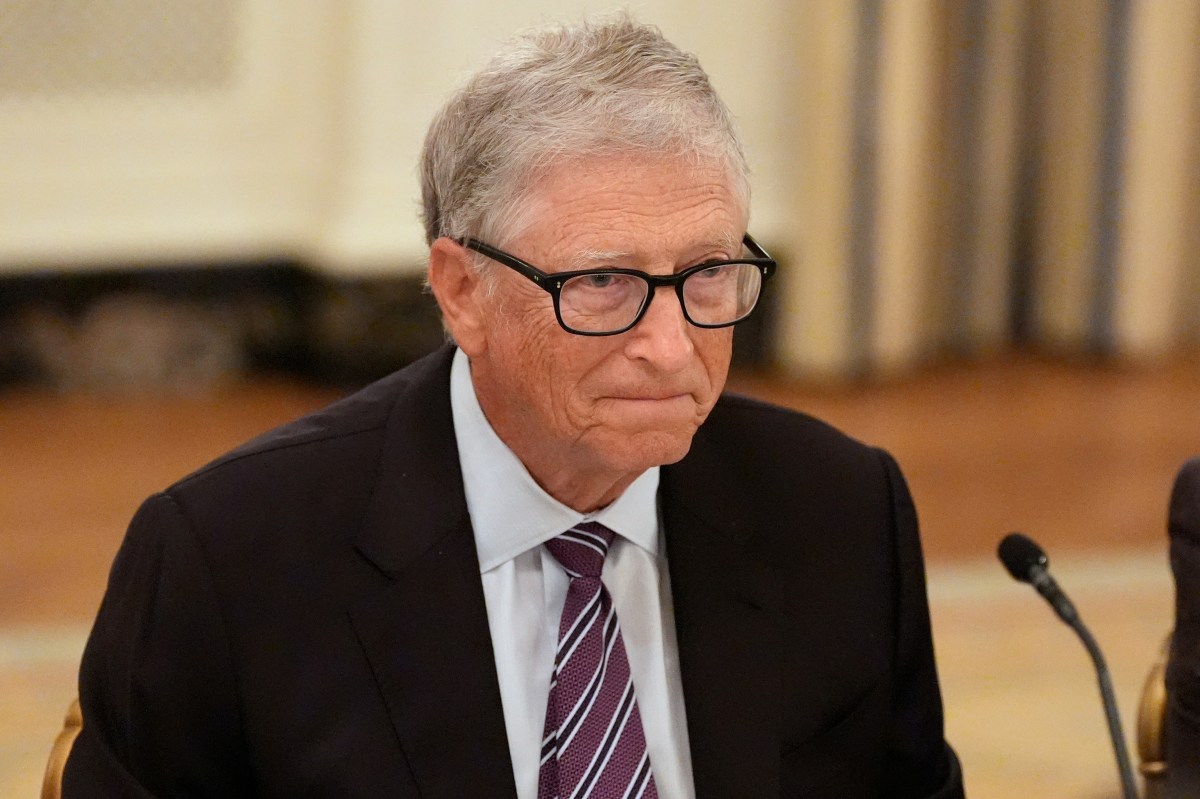
Microsoft co-founder Bill Gates pushed back against one of the most prominent ideas in the debate over artificial intelligence safety on Sunday, arguing that discussions centered on a so-called AI "kill switch" miss the more immediate dangers posed by the technology.
During an interview appearance on NBC News' Meet the Press, Gates said concerns that AI systems could become impossible to turn off are distracting from urgent threats such as cyberattacks, fraud and the development of biological weapons by bad actors.
He argued that policymakers should focus on mandatory monitoring and safeguards rather than relying on a simple shutdown mechanism.
"The kill switch...that's kind of a weird thing. It's not enough to have a kill switch," Gates told moderator Kristen Welker. "We're not yet at the point where they autonomously grab computers and can't be shut down. So that discussion just sort of shows how nontechnical various people are."
Gates has emerged as one of the most prominent voices warning that AI could create risks on a scale comparable to, or even exceeding, previous technological revolutions. His remarks also arrive amid a growing policy debate in Washington over how aggressively governments should regulate advanced AI models.
The issue has gained urgency in recent weeks following warnings from AI industry leaders, including Anthropic CEO Dario Amodei, who called for a slowdown across the industry. He warned in an essay titled “We Must Pace the Frontier” that advanced systems could pose significant security and societal risks if guardrails are not established quickly. OpenAI CEO Sam Altman publicly agreed with the assessment, while Tesla CEO Elon Musk wrote on X that "Dario is right."
Newsweek reached out to Anthropic and OpenAI by email Sunday for comment.
While Gates stopped short of endorsing a pause in AI development, he argued lawmakers need to move faster on safeguards. He said AI is already capable of enabling actors to conduct sophisticated cyberattacks and could potentially be used to assist with bioterrorism.
"AI is certainly powerful enough to drive events that cause a billion deaths," Gates cautioned. "There's never been a weapon as powerful as the combination of people with ill intent using the latest AI tools."
The billionaire philanthropist also dismissed suggestions that concerns about AI are overblown, responding to recent claims that fears of AI-driven catastrophe are a "hoax."
"No. It's not a hoax at all," Gates said.
A central focus of the interview was the growing argument over whether AI systems need emergency shutdown mechanisms, commonly referred to as kill switches.
Gates said the concept has become a distraction from what he views as the real challenge: ensuring governments and companies can monitor how advanced systems are being used. According to Gates, a kill switch alone would do little to stop the kinds of harms experts fear most.
"When you're trying to moderate the bad behavior, you need insight and records of what's being done," he said. "The kill switch alone would not prevent these tragedies."
Instead, Gates called for mandatory oversight measures that would track sophisticated AI models and create records of potentially dangerous activity. He said distinguishing between beneficial uses, such as designing new medicines, and malicious efforts, such as creating biological weapons, will require continuous monitoring rather than emergency shutdown tools.
Representatives Ted Lieu, a California Democrat, and Nataniel Moran, a Texas Republican, introduced the "AI Kill Switch Act" in July that would require AI developers to maintain the technical capacity to “throttle, suspend, or shut them down.”
It would also authorize the Secretary of Homeland Security to order a slowdown or shutdown of an AI system if it could cause “catastrophic harm.”
“AI companies are deploying increasingly advanced frontier models and autonomous 'agentic' systems capable of independent action. There is currently no requirement that developers of these powerful models maintain a functioning ability to intervene if an AI system begins behaving in unintended or dangerous ways,” Lieu’s office wrote in a statement.
On Sunday, the Microsoft co-founder also warned that society is underestimating the speed of AI development. Describing the technology as an "evolutionary event," Gates said humanity has effectively created a new form of intelligence.
"We have created an intelligent species that, in many respects, is already smarter than we are," Gates said, adding that over the next several years those systems will become "insanely smarter than we are" as their capabilities continue to improve.
At the same time, Gates stressed that humans remain firmly in control of current AI systems.
"We do," he said when asked if people still maintain control over AI. The immediate threat, he said, is not autonomous AI taking over the world but humans using increasingly powerful tools for harmful purposes.
"Small groups with AI can do what only the biggest countries could do," Gates said, pointing to potential attacks on electric grids, hospitals and financial systems.
Gates also rejected the idea that companies can regulate themselves, saying, "No one thinks self-regulation is enough."
The Trump administration is weighing how aggressively Washington should regulate AI and who should lead that effort.
During his Meet the Press appearance, Gates said he hopes President Donald Trump will bring together government officials, industry leaders and security experts to develop safeguards for advanced AI systems.
"The only control or 'guardrails' that AI needs is a STRONG AND SMART (High IQ!) PRESIDENT, and the U.S.A. has that, in spades! The Trump Administration has stopped AI 'people' from doing bad, or potentially bad, 'things,' like Dario (Anthropic!), who is now pretending to be a 'perfect little angel' - and we will continue to do so!" Trump wrote in a Truth Social post last week.
"We already have tremendous CRIMINAL and REGULATORY power over these companies!" he continued. "There is a SICK conspiracy going on against AI and Data Centers, and the only one that is happy about it is China. WHOEVER WINS AI, WINS!"
While Trump previously dismissed fears of AI-driven catastrophe as a "hoax," Gates suggested the president could change his position after hearing directly from experts.
"He'll listen," Gates said. "He wants to protect the U.S. people."
Trump also announced last week that he intended to hire an AI czar or similar high-level position to coordinate federal policy on the technology. He dismissed calls to slow down development, noting that other countries wouldn't.
He said his administration would "not in any way hinder or stifle the Growth of this incredible Industry" and instead would "cherish it, help it, and watch over it, as it grows."
"For this purpose, I am forming the AI Force, much like I did Space Force, which has been a tremendous SUCCESS, in my First Term," the president announced. "To that end, I will be announcing, in the near future, the AI 'Czar' — Only High I.Q. individuals need apply! AI is the next Industrial Revolution, or Internet, but will be even larger and more impactful, possibly as much as 25% of our Country’s GDP. We are leading China, and the rest of the World, and I intend to keep it that way!"
Gates said his message to Trump would not be to slow innovation but to require oversight and monitoring standards for advanced AI models. "One of the great things I can do is convene people to talk about what these safeguards look like," Gates said, describing the role he hopes Trump will play.
He argued that the U.S. has historically led international efforts to address global threats, from nuclear arms control to aviation safety, and said AI requires a similar approach. Gates warned that the window to establish guardrails before a major AI-enabled crisis may be narrowing.
"I won't be saying we should have an overall pause or slowdown," he said. "I'll be saying we should impose a requirement on all the AIs in the U.S."
The dangers Gates highlighted are not limited to future scenarios. Cybersecurity experts say AI is already accelerating threats against America's critical infrastructure, including water treatment facilities.
John Walsh, field chief technology officer for government and critical infrastructure at cybersecurity firm IGEL, previously told Newsweek that attackers are using AI to identify vulnerabilities and exploit weaknesses faster than defenders can respond.
"We have a geopolitical situation that seems to be targeting infrastructure. We have AI that's entering into the picture, which is accelerating the velocity, how fast things are happening," Walsh said last month. "What's really happening is the urgency is being increased by the geopolitical situation and the use of AI."
Walsh warned that water and wastewater systems are particularly vulnerable because many are operated by local governments with limited cybersecurity resources and aging infrastructure. His comments came after the Cybersecurity and Infrastructure Security Agency (CISA) and international partners issued an alert about threat actors conducting reconnaissance against Siemens S7 programmable logic controllers, which are widely used in water treatment plants and other critical infrastructure.
Echoing Gates' concerns about AI empowering bad actors, Walsh said attacks on industrial control systems could extend far beyond water utilities.
"When you target Rockwell, Schneider, Siemens, you're targeting 70 percent of the controllers that don't just run water and wastewater," Walsh said. "It runs our chemical facilities, our energy facilities, basically all our process and discrete automation."
Gates said he plans to continue pushing governments to adopt mandatory AI safeguards and urged U.S. officials to take a leadership role in shaping international standards.
According to Gates, regulation of advanced AI could prove even more difficult than Cold War-era efforts to control nuclear weapons because the technology is widely accessible and largely driven by private companies rather than governments.
"AI is one we're going to have to go back to this, 'Hey, humanity is all in this together,'" he said.
Representative Ro Khanna, a California Democrat, told Meet the Press on Sunday that he is working on legislation to address the issue.
He said he plans to meet with a group of 10 to 15 engineers and researchers from OpenAI and Anthropic, many of whom support his proposal to ban "recursive self-improving AI," or systems capable of training themselves without direct human oversight. Khanna argued that such technology poses "a real risk of losing human control," adding that "until we have guardrails, we can't let AI train itself and lose control," even though the capability does not yet exist.
For Gates, the key question is no longer whether safeguards are needed but whether governments implement them before or after a major AI-enabled disaster occurs.
"As I say, some awful events would increase the urgency," he said. "But getting the discussion in parallel about safeguards will help us get them in sooner rather than later."
Newsweek’s reporters and editors used Martyn, our AI assistant, to produce this story. Learn more about Martyn here.
Contact Newsweek editors for this story: Steve Mollman and Anthony Murray.