BRICS' rise masks a China story, says economist Surjit Bhalla
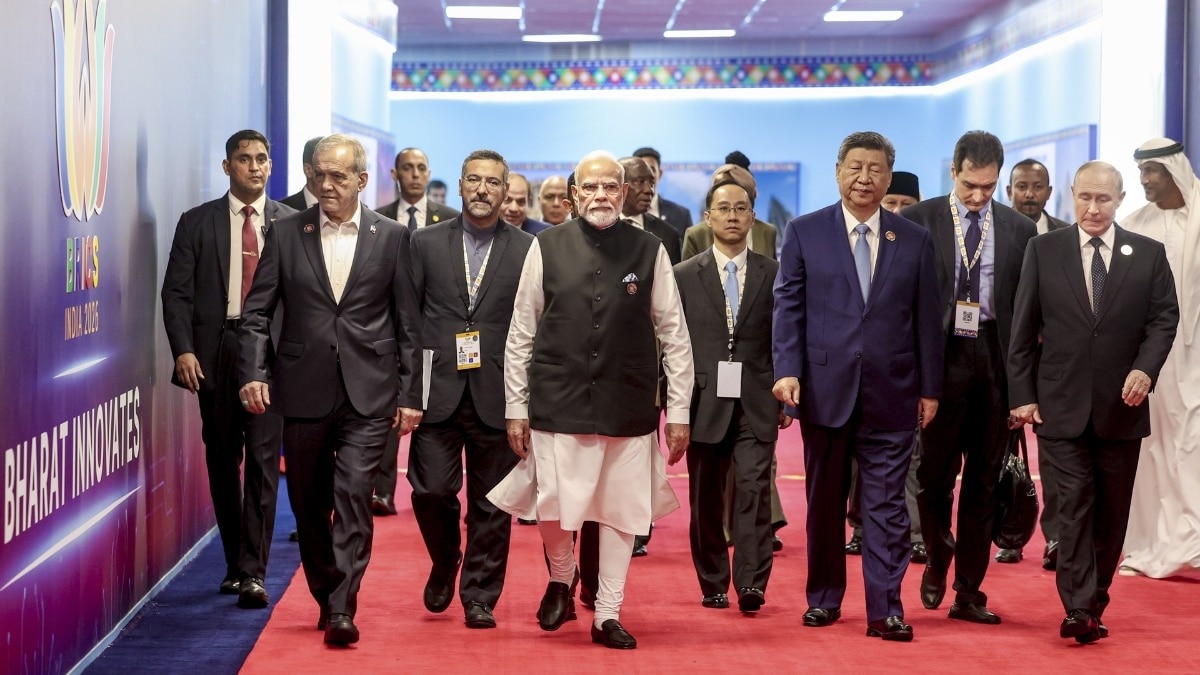
BRICS is often presented as a rising force in the global economy, bringing together some of the world's largest emerging economies and accounting for a growing share of global income and trade.
But economist Surjit Bhalla argues that the picture looks very different when China is taken out of the equation.
In a Substack post titled “BRICS: A Club of One”, Bhalla examined the bloc's economic performance using data on income and trade. His central argument is that BRICS' rise has largely been driven by China, while the other members have made little progress in increasing their collective share of the global economy and trade.
BRICS' share of world income increased from 21.9% in 2011 to 28.9% in 2025.
At first glance, that appears to support the argument that BRICS has become a much more important economic bloc.
But Bhalla says the picture changes sharply when China is excluded.
The other 10 BRICS members accounted for 11.9% of world income in 2011 and 11.5% in 2025.
China, meanwhile, increased its share of world income from 10% to 17.4% during the same period.
Bhalla calculates that China accounted for 72% of the entire increase in BRICS' income share between 2011 and 2025.
He also points out that the bloc's share of the world's population barely changed, from 50.9% in 2011 to 50.5% in 2025. In other words, BRICS represents roughly half of the world's population but less than three-tenths of global income.
The concentration becomes even clearer when looking inside the bloc.
China accounted for 45.6% of BRICS income in 2011. By 2025, its share had risen to 60.2%.
Among the five original BRICS members — Brazil, Russia, India, China and South Africa — China's share of income increased from 54.1% to 68.9% over the period.
Bhalla notes that China's share of the bloc's population actually fell during this period, from 38.4% to 35.7%.
His point is that BRICS has become increasingly dominated by China economically, even though China's share of the bloc's population has declined.TRADE TELLS A SIMILAR STORY
Bhalla then turns to global goods exports.
BRICS' share of world goods exports increased from 23% in 2011 to 25% in 2023.
But once China is removed, the share falls from 12.4% to 10.1%.
Bhalla calculates that China accounted for 94% of the increase in BRICS goods exports between 2011 and 2023.
He goes further by removing both China and the four BRICS oil exporters — Russia, Saudi Arabia, the UAE and Iran.
The remaining six countries — Brazil, India, Indonesia, South Africa, Egypt and Ethiopia — accounted for 5.1% of global goods exports in 2011 and 5.1% in 2023.
For Bhalla, this is the clearest evidence that the bloc's broader trade story is not one of sustained growth across its members.NOT ALL BRICS MEMBERS HAVE BEEN RISING China and Ethiopia nearly tripled their dollar incomes between 2011 and 2025, while India's income per person roughly doubled.
But three members were poorer in dollar terms in 2025 than in 2011, according to his calculations.
Brazil's income per person was down 6%, South Africa's was down 20%, and Iran's was down 36%.
Bhalla notes that South Africa, one of the original members, recorded negative growth in per-capita dollar income across the period.
He does not claim that BRICS membership caused these countries to underperform.
In fact, he explicitly says there is no evidence in the data establishing such a causal relationship.
BRICS has no common market, tariff preference, transfer mechanism or binding economic commitment, he notes. Therefore, the economic performance of its members cannot simply be attributed to their membership of the grouping.
Instead, his question is whether the bloc is actually delivering the economic benefits that its supporters associate with its growing global footprint.advertisementBRICS IS NOT OUTPERFORMING THE REST OF THE WORLDBhalla compares BRICS members with 125 countries that had populations above three million and data available for both 2011 and 2025.
The median BRICS member ranked 66th, with annual per-capita income growth of 2.7%.
That was also the median growth rate among countries outside BRICS.
Only five of the 11 members outperformed the global median, according to his analysis.
Bhalla points instead to countries such as Bangladesh, Vietnam, Cambodia, Nepal and Georgia among the fastest-growing economies. He argues that many of these countries have benefited from trade access, investment and domestic reforms, rather than membership of a geopolitical grouping.INDIA IS DOING BETTER, BUT IT CAN DO MORE
Bhalla's assessment of India is more positive.
He calls India the second-best performer among the five long-standing BRICS members and ranks it 26th globally on his measure.
India's share of world income increased from 2.5% in 2011 to 3.5% in 2025, while per-capita income rose from 13.4% of the global average to 18.7%.
But he says India's performance in global goods exports is less impressive.
India's share of world goods exports rose only slightly, from 1.71% in 2011 to 1.88% in 2023.
Bhalla contrasts this with Vietnam, whose share rose from 0.52% to 1.50% over the same period.
Vietnam's goods exports increased from $93 billion to $345 billion, while India's rose from $307 billion to $432 billion, according to the figures cited by Bhalla.
Bhalla's broader argument is that India should not confuse BRICS' growing global profile with India's own economic progress.
He argues that India's economic future will depend more on increasing trade, attracting investment and pursuing domestic reforms than on its membership of a multilateral grouping.
At the same time, he does not argue that India should abandon BRICS or diplomacy with its members. His earlier argument, which he revisits in the Substack post, is that India can maintain relations with all countries while also building closer political and economic ties with the US and Europe.
His criticism is particularly focused on China's growing weight within BRICS. He notes that China accounts for roughly two-thirds of the bloc's income and 60% of its exports, while also highlighting India's trade deficit with China and the difference in Chinese and US direct investment in India.
Bhalla does leave room for his assessment to change.
He says he would reconsider his position if BRICS demonstrated measurable economic gains — for example, if intra-BRICS trade grew faster than members' trade with the rest of the world, if lending by the New Development Bank materially increased investment, or if the bloc's share of global income increased even after China's contribution was excluded.
He says none of those conditions has been met so far.
That leads to his central conclusion: BRICS' economic rise is overwhelmingly a China story.
In Bhalla's formulation, the bloc is “one rising power, four members going sideways, three going backwards, and six who arrived in 2024 and cannot yet be judged.” India, he says, is the best performer among the rest — but that distinction is smaller than the broader BRICS narrative might suggest.- EndsPublished By: Sonu VivekPublished On: Sep 14, 2026 09:37 IST