Brothers from another mother: Kuno’s rare cheetah coalition spans India, Botswana - The Indian Express
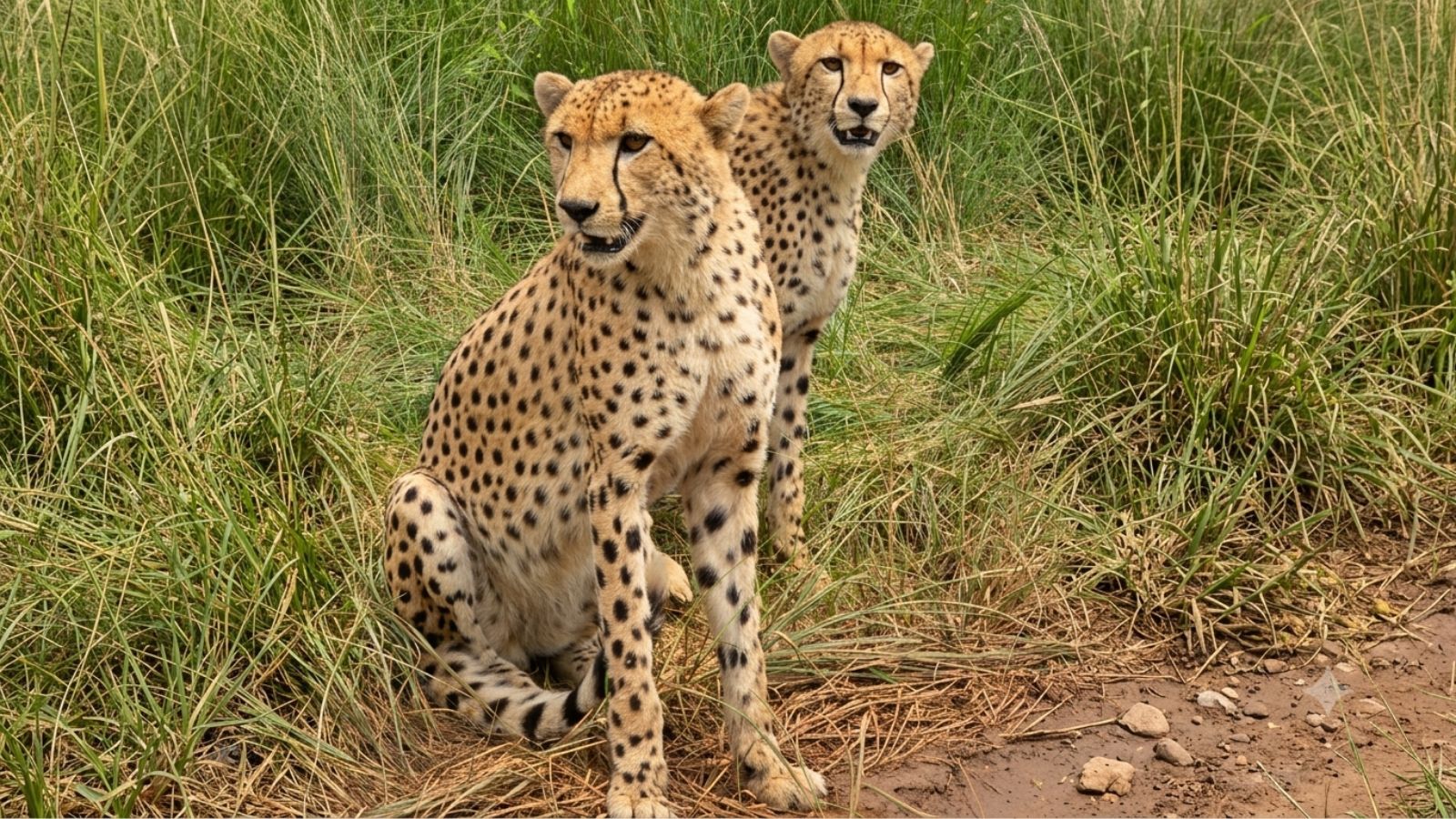
Two male cheetahs stalk the wilderness of Kuno National Park, watching each other’s back, sharing kills and establishing their territory. Separated by genetics and a whole continent, one could say they are brothers from another mother.
Exactly four years after the ambitious cheetah project was launched in India, wildlife officials at Kuno have begun celebrating this unusual male coalition, usually made up of siblings.
At Kuno, KNG23 was born in March this year to a cheetah named Nirva. CCB4 arrived from Botswana on February 28 this year.
“This is a very rare phenomenon,” said Uttam Kumar Sharma, director of Kuno National Park. “What is particularly interesting is that these are two unrelated male cheetahs, with an age difference of around six to seven months, and yet they have accepted each other and formed a coalition.”
The relationship began in circumstances that had little to do with any deliberate attempt to pair the animals.
Around March, KNG23, then about 16 months old, was separated from its mother and siblings after sustaining an injury that required isolation. CCB4, meanwhile, arrived from Botswana without its sisters. The two young males were housed on opposite sides of a fence and continued to show interest in one another.
KNG23 was later released into the wild with its mother, brother and sister on May 30. The family remained together for several weeks. By late July, however, KNG23 was injured again. By then, its sisters had dispersed into the wild on their own.
And so, KNG23 and CCB4 found themselves near each other once more. This time, the field team removed the fence between them.
Their first encounter was over food. According to Kuno’s officials, the animals shared a kill without aggression, and neither tried to drive the other away. The team did not immediately interpret that encounter as evidence of a coalition. Sharing a meal by itself was not enough.
KNG23 started following CCB4 and sitting nearby. The two began calling to each other when they were out of sight. They moved together, hunted together and shared kills. They were also observed grooming each other and, on at least one occasion, supporting each other when a rival coalition challenged them.
“These were no longer simply two cheetahs tolerating each other. They were beginning to behave like a team. A coalition was taking shape,” said a wildlife official.
For Sharma, the significance lies in what the animals may be demonstrating about the flexibility of cheetah social behaviour.
“Male cheetahs do form coalitions, but generally, when they grow older, they become less accepting of another unrelated male,” he said. “If they form a coalition when they are very young, it can continue, but as they mature, it becomes more difficult for two different males to stay together. That is why this particular case is unusual.”
The test, therefore, will not be whether the two animals can remain together in an enclosure. It will be what happens as they mature and begin confronting the pressures of life in the wild: competing males, access to territory, food and eventually females.
The park already has other examples of male coalitions forming among the growing cheetah population. Kuno has a five-male coalition: three older males and two younger. The two male cubs born to Jwala have formed a coalition, while two of Asha’s three male cubs have remained together and one has separated.
“There are several advantages to males remaining in a coalition,” Sharma said. “They are able to protect each other better, and hunting also becomes easier when there are two animals together.”
A coalition can also alter the balance when males encounter rivals.
“A coalition also gives them protection against rivals,” he said. “A lone cheetah may be intimidated when confronted by more than one rival, whereas two males together can confront rivals more effectively. So there are clear advantages to remaining together.”
But KNG23 and CCB4 have not yet faced those pressures.
“These two males have not yet encountered a leopard or another major predator,” Sharma said. “They are currently in a large enclosure and have not been released into the wild.”
“One of them had earlier been outside with its mother,” Sharma said. “It was injured in a fight and was brought back to the enclosure with the cubs, and that is when this coalition developed.”
“Once they are released and we observe them outside, we will be able to see how they perform in the wild and how they respond to conflicts and other challenges,” Sharma said.
That question sits within a broader transition at Kuno. Four years after the first cheetahs were brought from Africa to India, the project is no longer concerned only with whether individual imported animals survive. India-born cheetahs are now growing up, dispersing and beginning to establish territories of their own.
“If you look at the cheetah project over these four years, it has progressed step by step,” Sharma said. “The first year was about introducing the cheetahs and ensuring their survival. The second year was about births and ensuring that the cubs survived – establishing breeding and then improving cub survival.”
“The third year was mainly about the cubs growing up and releasing them into the wild, including mothers with their cubs. Now, in the fourth year, our main focus is for the cheetahs to gradually begin establishing themselves.”
That establishment is already showing in the animals’ movements.
“Wherever the cheetahs are going, we want to allow them to use more area,” Sharma said. “We should not restrict their movement in the forest unless it is necessary. Gradually, they are beginning to establish their territories.”
The male coalitions are part of that process.
“The male coalitions, including Asha’s and Jwala’s males, are beginning to establish their territories,” Sharma said. “They have started occupying particular areas of Kuno and are moving around within them. They are beginning to establish their own territories, which is a positive sign,” Sharma said.
Meanwhile, the females are moving through and across those territories.
“The females are also moving across one another’s territories. They are criss-crossing these areas,” Sharma said. “Slowly, we are beginning to see the natural ecology of the cheetah emerging.”
Kuno officials said the current project population is 52 – 49 at Kuno and three at Gandhi Sagar – including 32 born in India. Seventeen of Kuno’s 49 are currently living in the wild, with the remainder in soft-release enclosures.
The numbers matter, but so does what the animals do with the landscape they have been given.
“The cheetahs are beginning to settle,” Sharma said. “What we are seeing now is that some of the natural ecological behaviour that we would expect from cheetahs is gradually becoming visible in Kuno.”
For the project, that is ultimately the harder milestone to reach: not simply producing cheetahs in India, but producing cheetahs that can reproduce and survive without the protections that accompanied their arrival.
“Going forward, our main objective will be for mating to take place in the wild, for cubs to be born in the wild and for those cubs to survive in the wild,” Sharma said.
Anand Mohan J is an award-winning Senior Correspondent for The Indian Express, currently leading the bureau’s coverage of Madhya Pradesh. With a career spanning over eight years, he has established himself as a trusted voice at the intersection of law, internal security, and public policy. Based in Bhopal, Anand is widely recognized for his authoritative reporting on Maoist insurgency in Central India. In late 2025, he provided exclusive, ground-level coverage of the historic surrender of the final Maoist cadres in Madhya Pradesh, detailing the backchannel negotiations and the "vacuum of command" that led to the state being declared Maoist-free. Expertise and Reporting Beats Anand’s investigative work is characterized by a "Journalism of Courage" approach, holding institutions accountable through deep-dive analysis of several key sectors: National Security & Counter-Insurgency: He is a primary chronicler of the decline of Naxalism in the Central Indian corridor, documenting the tactical shifts of security forces and the rehabilitation of surrendered cadres. Judiciary & Legal Accountability: Drawing on over four years of experience covering Delhi’s trial courts and the Madhya Pradesh High Court, Anand deconstructs complex legal rulings. He has exposed critical institutional lapses, including custodial safety violations and the misuse of the National Security Act (NSA). Wildlife Conservation (Project Cheetah): Anand is a leading reporter on Project Cheetah at Kuno National Park. He has provided extensive coverage of the biological and administrative hurdles of rewilding Namibian and South African cheetahs, as well as high-profile cases of wildlife trafficking. Public Health & Social Safety: His recent investigative work has uncovered systemic negligence in public services, such as contaminated blood transfusions causing HIV infections in thalassemia patients and the human cost of the fertilizer crisis affecting rural farmers. Professional Background Tenure: Joined The Indian Express in 2017. Locations: Transitioned from the high-pressure Delhi City beat (covering courts, police, and labor issues) to his current role as a regional lead in Madhya Pradesh. Notable Investigations: * Exposed the "digital arrest" scams targeting entrepreneurs. Investigated the Bandhavgarh elephant deaths and the impact of kodo millet fungus on local wildlife. Documented the transition of power and welfare schemes (like Ladli Behna) in Madhya Pradesh governance. Digital & Professional Presence Author Profile: Anand Mohan J at Indian Express Twitter handle: @mohanreports ... Read More