
Canadians can see only scattered pieces of a national strategy. Carney needs to explain how they fit together - Toronto Star
The Liberals’ 2025 election platform pledged “a new, full foreign policy' and a national security review. Neither has been tabled.
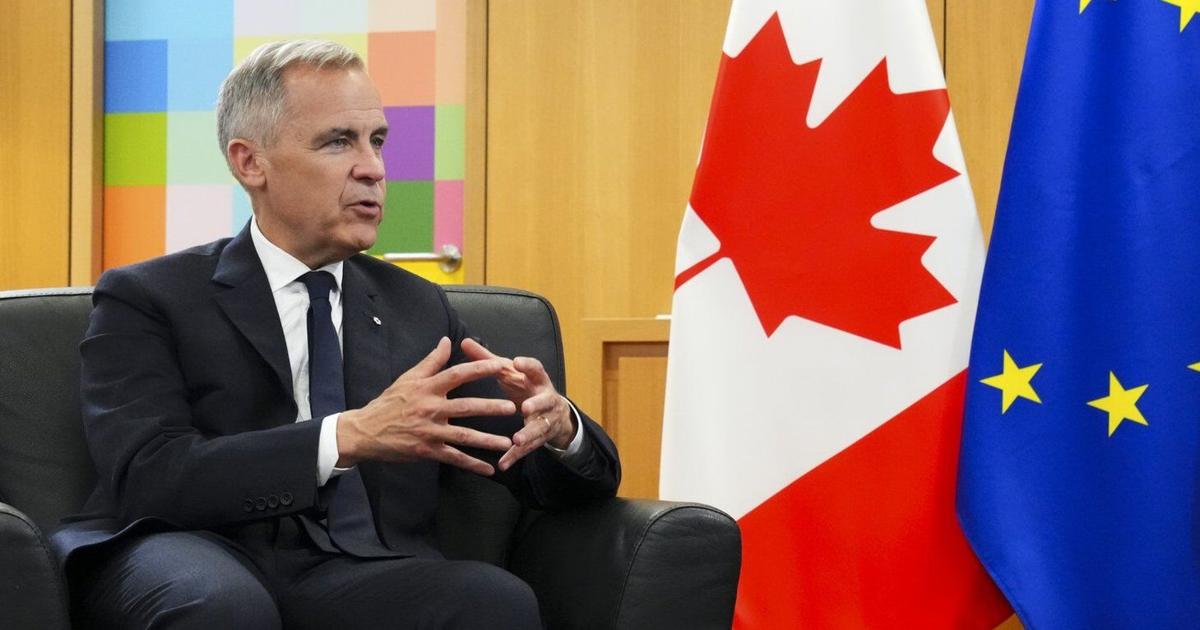
Prime Minister Mark Carney takes part in a meeting with European Council President Antonio Costa and European Commission President Ursula von der Leyen, in Brussels, Belgium, on June 23, 2025.
Lloyd Axworthy is a former longtime MP who served as Canadian foreign minister from 1996 to 2000.
Eighteen months into Mark Carney’s government, Canadians can see elements of a foreign and defence policy scattered like puzzle pieces across a table — but no one has shown us the box with the picture illustrating what the pieces assemble into.
On Sept. 17, Carney will add another piece to the pile: an address to the European Parliament in Strasbourg. This follows his absence from the United Nations General Assembly’s marquee address, which the prime minister has now skipped two years running. Why Europe and not the UN? And why is the Canadian Parliament being bypassed?
It is the consequence of a promise not kept. The Liberals’ 2025 election platform pledged “a new, full foreign policy,” as well as a companion national security review. Neither has been tabled. Instead, Carney is governing by announcements made in foreign capitals.
The prime minister has pursued a defence-based economic shift, including a commitment to making Canada an arms exporter. And now the government is pursuing deeper integration with Brussels. A fall summit, intended to build “much stronger and deeper economic and security alliance,” is approaching.
Why is a country that spent a year diversifying itself away from overdependence on one power now building a major new architecture of integration with another partner — one that moves by consensus, on its own timetable and for its own reasons, and has different and contentious political systems? What has become of the suggestion that Canada work with coalitions of middle powers?
As the jigsaw board clearly signals, security risks that do not fit neatly into the “defence economy” or “trade diversification” are being pushed aside.
Canada’s climate change strategy is moribund, even as the UN prepares to confront the reality that climate overshoot is becoming unavoidable. Nuclear proliferation barely registers. In the months since the Non-Proliferation Treaty review conference collapsed without reaching consensus for a third time, Canada has been largely absent from efforts to rebuild safeguards. AI threats have gone ignored.
The gaps between the puzzle pieces, meanwhile, form a revealing pattern.
U.S. President Donald Trump’s “Donroe Doctrine” claims the Western Hemisphere as part of America’s sphere of influence, yet Canada would rather sit on the fence than work with the Latin American and Caribbean states facing the same pressures we are.
Africa fares worse. Carney has said the continent is “not among his government’s early priorities.” We’ve pulled most of our peacekeepers out of the continent, a decision South Africa’s envoy to Ottawa criticized as being out of step with Canada’s middle-power ambitions.
On the Middle East, while Canada has recognized a Palestinian state, the underlying posture is one of diplomatic paralysis: a government caught between principle and alliance, that moves only when political pressure forces it to.
More troubling is the absence of anything resembling a Canadian peace agenda — the oldest test of a middle power, and the one at which we are failing most quietly.
Ottawa is shutting down overseas peacekeeping operations. Limiting violence and protecting civilians used to be something Canada vigorously pursued. Now it is something Canada is abandoning.
Nor has Ottawa found its voice on the erosion of the international justice system, the institution that gives any peace agenda teeth. When the United States sanctioned a Canadian judge on the International Criminal Court in August 2025 — part of U.S. Secretary of State Marco Rubio’s campaign to “dismantle” the court — Canada’s response was described as a “conspicuous silence” in the face of the Trump administration’s efforts to make the world safer for war criminals.
And no one in government seems willing to ask the difficult questions that our deepening military integration with Washington raises, from the expansion of NORAD to Trump’s proposed “Golden Dome” missile shield, or to address the broader problem of Canadian technology and equipment disappearing into systems over which we have no control.
Which leads us to the real question behind all this: Is this a jigsaw puzzle, or is it really a Mercator projection map?
The Mercator projection exaggerates the size of whatever sits near the poles and shrinks everything nearer the equator. Substitute Brussels and Washington for the poles, and the pattern of this government’s attention begins to look remarkably similar.
Europe and the transatlantic relationship loom enormous. The Western Hemisphere, Africa, the Middle East and the whole architecture of peace, justice and civilian protection have been pushed toward the edges.
Not because anyone decided they mattered less, but because no one has been required to decide what matters most.
This is why the government needs to table a full foreign, defence and peace policy that identifies the threats Canada is preparing for, that explains why particular regions and alliances are being prioritized and that shows how the risks of climate change, nuclear proliferation, AI, poverty and a weakened international justice system all fit into the same national strategy.
Canadians deserve to know what picture this government is trying to put together — and what it is willing to sacrifice to get there.
Error! Sorry, there was an error processing your request.
There was a problem with the recaptcha. Please try again.
You may unsubscribe at any time. By signing up, you agree to our terms of use and privacy policy. This site is protected by reCAPTCHA and the Google privacy policy and terms of service apply.
Lloyd Axworthy is a former longtime MP who served as Canadian foreign minister from 1996 to 2000.
Opinion articles are based on the author’s interpretations and judgments of facts, data and events. More details


