CDF Munir urges Iran to persuade Houthis not to target Saudi energy facilities: officials
Direct Source Verification:
This story is aggregated from The Express Tribune (tribune.com.pk). Full reporting rights and copyright belong to the primary publisher.
Also discusses ways to revive stalled direct talks with the US to end the months-long war with Iran
Chief of Defence Forces and Chief of Army Staff Field Marshal Asim Munir has urged Iran to persuade Yemen's Houthi group not to target Saudi Arabia's energy facilities, Pakistani government officials told Anadolu on Thursday.
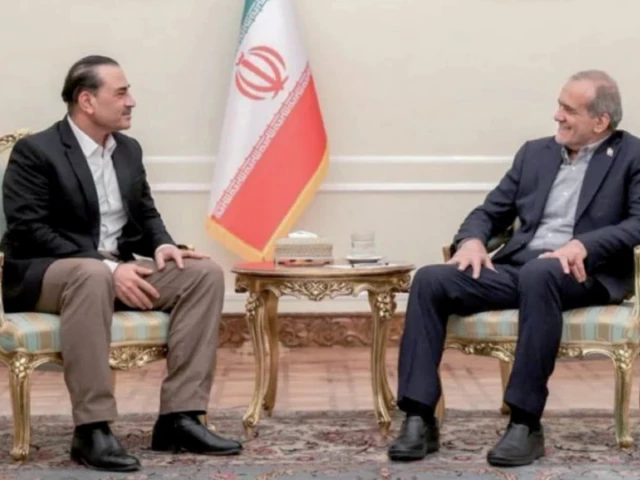
In Islamabad's latest attempt to bring a negotiated settlement to the raging Middle East conflict, CDF Munir spoke to Iran's top diplomat Abbas Araghchi over the phone, urging Tehran to "use its influence" on Houthis to halt their strikes on Saudi oil and economic infrastructure, the sources added.
The two spoke during Araghchi's visit to China on Wednesday, Iranian state media confirmed.
"The army chief discussed the overall regional situation, with special focus on Houthis' attacks and revival of stalled direct talks between the US and Iran," a source familiar with the developments said.
Islamabad has already warned that the recent escalations would further complicate the already complex regional scenario.
Describing Araghchi's response as "hopeful," the sources did not provide further details.
Iranian Foreign Ministry spokesman Esmaeil Baqaei recently stated that Tehran does not interfere in Yemeni affairs and described the Houthis as independent actors "pursuing their own interests".
The latest conversation comes a day after a drone was intercepted near the holy city of Makkah in Saudi Arabia, which invited ire from the international community, including Muslim countries. Houthis denied they launched the drone.
Pakistan and Saudi Arabia last year inked a bilateral defence pact, which subsequently led to the signing of a trilateral Makkah defence agreement last month involving Türkiye.
Yemen has been gripped by war since the Houthis seized the capital Sanaa in 2014, prompting a Saudi-led Arab coalition to intervene in 2015 in support of the internationally recognised Yemeni government.
The group has been engaged in renewed fighting with government forces since July, when it declared a maritime blockade on Riyadh, and has recently claimed advances along the Red Sea coast and the Bab el-Mandeb Strait. The Houthis have also targeted the oil infrastructure of Saudi Arabia, which has further raised oil prices in the international market.
Committed to defence pacts, says Islamabad
Separately, the Foreign Office (FO) reiterated its commitment to “implementing” the bilateral defence agreement with Saudi Arabia, as well as the trilateral Makkah pact.
“However, when, how, where and what force will be used against what objectives, in which modes and matters ... — operational confidentiality requires us to be discreet at this stage,” FO spokesman Sajjad Haider Khan told reporters in Islamabad.
Read More: Iran urges caution over Makkah drone claim
He was responding to a question on whether “any mechanism had been devised as to how Pakistan will ensure that recent Houthi attacks in Saudi Arabia are thwarted".
"Pakistan has for a long time ... shared the perspective that we would like to have peace and stability because this is not only in the interest of Pakistan and Iran, but also the entire region and beyond," said Khan.
The situation in Bab al-Mandeb, he said, is “exceptionally serious", urging Houthis to “stop their activities”.
“In this regard, our discussions basically revolve around bringing peace and stability through dialogue and diplomacy and not through coercive measures,” he added.
Revival of stalled talks
Sources said that CDF Munir and Iran's top diplomat also discussed ways to revive stalled direct talks with the US to end their months-long war.
Aragchi, for his part, said Iran was ready to return to negotiations as the US halts hostilities in the Strait of Hormuz and "abides by the Islamabad memorandum", the sources further said.
China was also assisting Pakistan's efforts to revive the US-Iran talks and stop the conflict from spilling over, they added.
"Beijing is equally worried about the raging hostilities because it's getting its oil bill heavier," a source said, without offering further details about China's assistance.
In his meeting with Araghchi in Beijing on Wednesday, Chinese Foreign Minister Wang Yi encouraged Iran and the US to remain rational, exercise restraint, return to the Islamabad Memorandum of Understanding, and "engage in substantive consultations".
China "does not want to see regional tensions to spill over further into Yemen and the Red Sea", Wang added.
Chinese President Xi Jinping is expected to meet his US counterpart Donald Trump in Washington, DC, next week, where the two sides are likely to discuss ways to resolve the lingering Middle East conflict, in addition to other pending issues between the world's two largest economies.
Pakistan has remained the main mediator between Iran and the US throughout the war that began on February 28, and has maintained close contact with both sides.
The US and Iran signed the Islamabad Memorandum of Understanding on June 17 and launched negotiations towards a final agreement. However, the talks later stalled over disagreements on security guarantees and freedom of navigation through the Strait of Hormuz, one of the world's most strategic routes for global energy supplies and trade.
Between July 8 and July 24, the US and Iran exchanged military strikes, with Washington launching attacks on targets inside Iran, and Tehran responding by striking US military facilities and equipment in several Arab countries, including Jordan, Bahrain, and Kuwait.
After securing a ceasefire on April 8, Pakistan hosted the highest-level direct talks between the US and Iran since they broke diplomatic ties in 1979. The talks, held in Islamabad on April 11-12, ended inconclusively.
Since the war began on Feb. 28, more than 3,500 people, both civilians and soldiers, have been killed in Iran.
Tehran has hit US bases and assets in the Middle East, and the Pentagon has confirmed over a dozen fatalities, as well as dozens of injuries to its personnel.
Original Source
https://tribune.com.pk/story/2629870/cdf-munir-urges-iran-to-persuade-houthis-not-to-target-saudi-energy-facilities-officials