
China and India can turn a new beginning into a new chapter
By continuing to browse our site you agree to our use of cookies, revised Privacy Policy and Terms of Use. You can change your cookie settings through your browser.
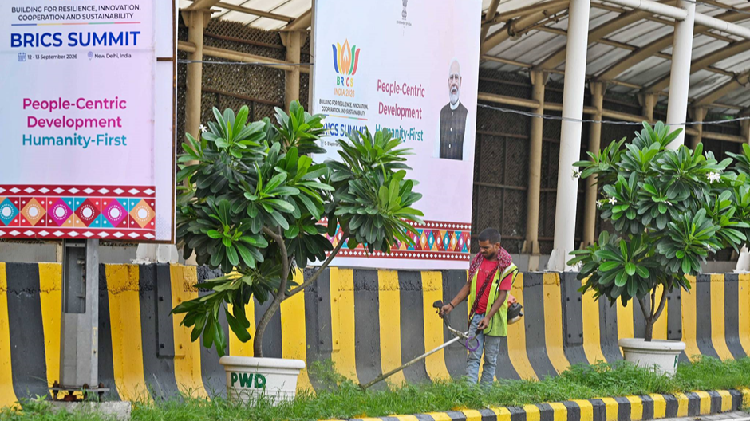
Beautification in progress ahead of the 18th BRICS Summit near the Bharat Mandapam, the venue of the event, in New Delhi, India, September 6, 2026. /CFP
Editor's note: Xu Ying is a Beijing-based international affairs commentator for CGTN. The article reflects the author's opinions and not necessarily the views of CGTN.
The meeting between Chinese President Xi Jinping and Indian Prime Minister Narendra Modi in New Delhi on September 12, on the sidelines of the 18th BRICS Summit, carries significance well beyond bilateral ties.
It is the third consecutive year that the leaders of the world's two most populous countries have met face to face, following Kazan, Russia, in 2024 and Tianjin in China in 2025. The trajectory from "a new start" to "a new elevation" suggests that China-India relations are moving away from prolonged tensions toward greater stability, cooperation and strategic maturity.
At the heart of the meeting was a simple proposition: China and India should be partners, not rivals; each other's development should be seen as an opportunity, not a threat.
The economic relationship provides a compelling reason to choose cooperation over confrontation.
Despite political difficulties, China-India trade continued to expand, reaching a record level in the 2025-2026 fiscal year. India's manufacturing sector remains connected with Chinese supply chains, from pharmaceuticals and electronics to machinery, batteries and renewable-energy components.
India's ambition to become a global manufacturing hub and China's strength in industrial supply chains need not be mutually exclusive. Greater trade, investment and technological cooperation can help both strengthen their industrial capacities, provided legitimate concerns are addressed through dialogue rather than politicized restrictions.
Recent signs of economic pragmatism are encouraging. The easing of restrictions on some Chinese investment, greater flexibility in trade measures and the decision to restore direct flights point toward a more practical approach. Such steps should be expanded in a calibrated manner.
People-to-people ties deserve equal attention. A relationship involving more than 2.8 billion people cannot be sustained by government dialogue alone. Students, entrepreneurs, researchers, tourists, journalists and ordinary citizens need opportunities to interact with one another directly. Pilgrimage and cultural exchanges will also help consolidate the balance of communication.
The New Delhi meeting is also significant because China-India relations can no longer be viewed solely through a bilateral lens.
Both countries are major members of the Global South and important participants in BRICS, the Shanghai Cooperation Organization, the G20 and the United Nations. Their cooperation therefore affects global governance and the voice of developing countries in international affairs.
India's BRICS presidency this year and China's presidency next year provide a valuable opportunity.
An expanded BRICS is an important platform for the Global South to strengthen cooperation, promote development and make global governance more representative. If China and India turn improved bilateral ties into practical BRICS cooperation, they can make the organization more effective while showing that differences need not prevent common action.
This cooperation matters even more today.
Neither China nor India benefits from a world divided into competing blocs.
Police presence at Pragati Maidan ahead of the 18th BRICS Summit in New Delhi, India, September 6, 2026. /CFP
For India, strategic autonomy has long been an important foreign policy principle. For China, peaceful development and mutually beneficial cooperation remain central to its approach to international relations. These traditions offer considerable space for convergence.
Strategic mistrust will not disappear after a few successful meetings. Differences over the boundary, trade imbalances, investment and regional security will continue. Domestic political pressures can also complicate the relationship. Nor should either side expect the other to compromise on core interests.
The answer is not to pretend differences do not exist, but to manage them responsibly.
That requires more strategic communication, institutionalized dialogue and fewer worst-case assumptions. Both sides should respect each other's development paths and resist allowing third-party factors to dictate their bilateral relationship.
The world does not need China and India to agree on everything. It needs them to learn how to disagree without confrontation and cooperate without demanding uniformity.
That may be the most important lesson of the New Delhi meeting.
The evolution from Kazan to Tianjin and now New Delhi demonstrates the value of sustained leader-level strategic guidance. It also shows that diplomacy works when political will is translated into mechanisms, and mechanisms into outcomes.
China and India should strengthen border management, expand economic cooperation and people-to-people exchanges, and coordinate more closely in multilateral institutions. They should turn the emerging consensus that they are partners rather than rivals into a durable principle of bilateral relations.
A stable China-India relationship would contribute to Asian stability, strengthen South-South cooperation, give greater momentum to BRICS and provide the Global South with a more influential voice in shaping the international order.
The 21st century is often described as the Asian century. Whether that promise can be fulfilled depends in no small measure on whether Asia's two largest developing countries can coexist peacefully, develop together and contribute jointly to global prosperity.
The dragon and the elephant do not have to move in identical ways. They simply need enough wisdom to move forward without blocking each other's path.
The New Delhi meeting offers a promising opportunity to do just that – turning a new beginning into a new chapter in China-India relations, and bilateral cooperation into a greater contribution to a more peaceful, prosperous and multipolar world.
(If you want to contribute and have specific expertise, please contact us at opinions@cgtn.com. Follow @thouse_opinions on X to discover the latest commentaries in the CGTN Opinion Section.)

