China-ASEAN Expo opens with focus on CAFTA 3.0, AI, and Pinglu Canal
By continuing to browse our site you agree to our use of cookies, revised Privacy Policy and Terms of Use. You can change your cookie settings through your browser.
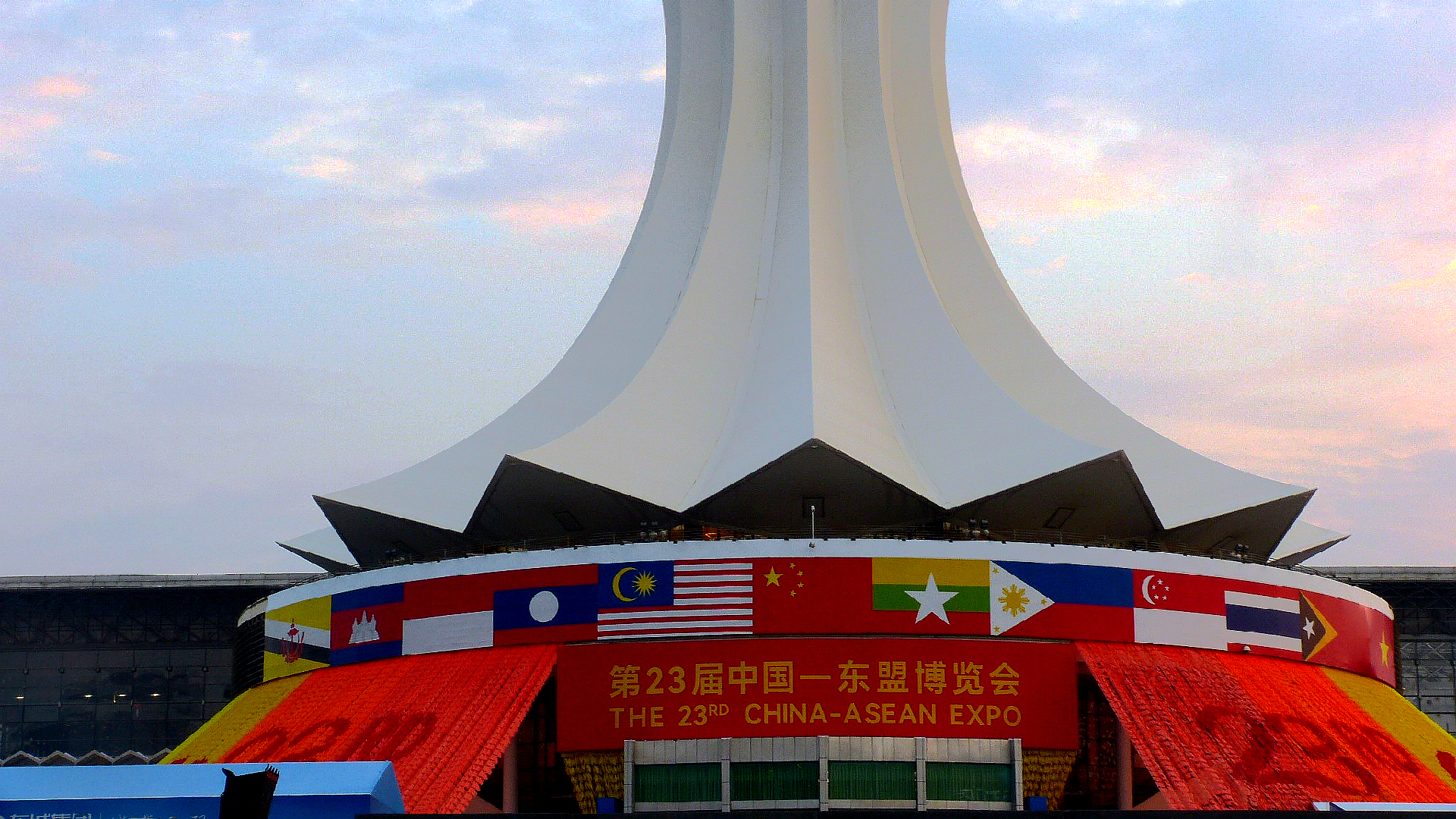
The venue of the 23rd CAEXPO in Nanning, south China's Guangxi Zhuang Autonomous Region, September 15, 2026. /VCG
The 23rd China-ASEAN Expo (CAEXPO) opened on Thursday in Nanning, capital of south China's Guangxi Zhuang Autonomous Region, bringing new business opportunities under the China-ASEAN Free Trade Area (CAFTA) 3.0 framework into focus.
Running from September 17 to 21, the expo has attracted more than 3,400 companies from over 70 countries and regions. The exhibition area covers about 170,000 square meters, with participating enterprises up 5.3% from the previous edition. Timor-Leste is taking part for the first time as a full ASEAN member and co-host, bringing all 11 ASEAN member states together in Nanning.
AI and the newly opened Pinglu Canal are also key focuses of this year's expo, with dedicated exhibition areas showcasing their potential to drive regional cooperation.
The latest CGTN survey shows that 90.9% of global respondents believe the continued hosting of CAEXPO demonstrates China's commitment to high-standard opening up. Meanwhile, 89.5% see the expo as an important platform for business exchanges, industrial matchmaking and sharing regional development opportunities.
An exhibitor introduces Timor-Leste's local agricultural specialties to a visitor during the 23rd China-ASEAN Expo in Nanning, September 17, 2026. /VCG
China-ASEAN Free Trade Area 3.0 opens new areas for cooperation
The expo comes as China and ASEAN begin implementing the upgraded CAFTA 3.0 framework, which aims to facilitate trade, strengthen supply chains and expand cooperation into emerging sectors.
Science and technology authorities and high-tech institutions from countries including Cambodia, Indonesia, Malaysia and Thailand have sent delegations to the expo.
China has made significant advances in areas such as AI, electric vehicles and renewable energy, said Destarata Mustafa, counselor for political affairs at the Indonesian Embassy in Beijing. "We hope to expand cooperation with China in these fields."
More than 50 trade and investment promotion activities are being held during the expo, focusing on trade and investment facilitation, regional economic integration, and cross-border industrial and supply chain cooperation.
In the CGTN survey, 84.5% of respondents said deeper China-ASEAN free trade cooperation will inject greater momentum into openness, cooperation and stable growth in the global economy.
A view of the exhibition hall at the Nanning International Convention and Exhibition Center during the opening day of the 23rd China-ASEAN Expo, September 17, 2026. /VCG
AI is taking a prominent role at this year's expo, with dedicated exhibition areas at the Nanning International Convention and Exhibition Center and the newly established Nanning AI Compound.
The AI exhibition area at the Nanning International Convention and Exhibition Center showcases AI products and technologies covering consumer applications, smart homes, intelligent terminals, robots and embodied intelligence, alongside AI technologies from ASEAN countries.
At the 10,000-square-meter Nanning AI Compound, more than 150 AI companies, including Huawei, iFlytek and Unitree Robotics, are presenting applications across 11 themed sections, focusing on industrial and everyday use.
The venue will also feature an AI-themed market, service robots, robot competitions and performances.
The new exhibition area is also designed to facilitate more targeted cooperation through an intelligent matchmaking system. More than 8,000 pairs of potential cooperation partners have been pre-matched, while nearly 2,000 additional matchmaking sessions are scheduled during the expo. The system has collected around 60 cooperation demand projects from ASEAN countries and matched them with nearly 40 Chinese projects to help companies pursue potential partnerships.
The emphasis on practical applications reflects growing efforts to connect China's AI capabilities with the specific industrial and consumer needs of ASEAN markets.
Smart demonstration vessels navigating in formation toward Pinglu Canal in Qinzhou Port, Qinzhou City, Guangxi, September 16, 2026. /VCG
The newly opened Pinglu Canal has become another highlight of the expo, with a dedicated exhibition area showcasing the 134.2-kilometer waterway and its potential to strengthen regional connectivity.
Connecting the Xijiang River shipping network with the Beibu Gulf, the canal allows vessels of up to 5,000 tonnes to reach the sea directly, creating a more efficient route from China's southwestern hinterland to international markets.
The canal is expected to shorten shipping distances between southwest China and Southeast Asia by more than 560 kilometers, reduce logistics costs by 18% to 30% and save about 5.2 billion yuan (about $775 million) annually.
It also strengthens the New International Land-Sea Trade Corridor linking western China with Southeast Asia through railways, roads, waterways and ports.
According to the CGTN survey, 87.6% of respondents said multimodal transport, including river-sea and rail-water transport, when efficiently connected with cross-border industrial and supply chain cooperation, will further facilitate regional trade and investment.
The new connectivity comes as China-ASEAN trade continues to expand. In the first seven months of 2026, trade between the two sides reached $744.41 billion, up 24.7% year on year and accounting for 21.8% of China's total foreign trade.