China completes 16th Arctic expedition with new findings
By continuing to browse our site you agree to our use of cookies, revised Privacy Policy and Terms of Use. You can change your cookie settings through your browser.
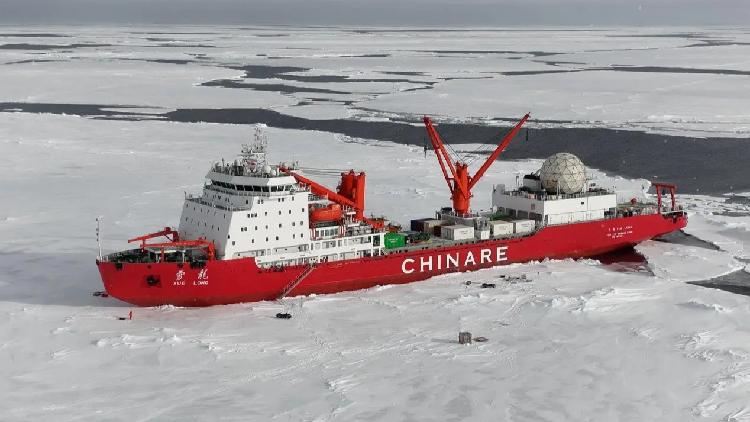
China's icebreakers Xuelong and Xuelong 2 returned to Shanghai on Tuesday after carrying out the country's 16th Arctic expedition, which yielded multiple scientific advances.
Over three months, the two vessels conducted comprehensive marine environmental surveys in the Chukchi Plateau, Canada Basin and the central Arctic Ocean, making significant progress in multidisciplinary surveys along the ice edge and coordinated air-ice-ocean observations.
The expedition found an intensified inflow of subsurface warm water from the Pacific into the Canada Basin. Scientists also discovered a new large hydrothermal plume area in the deep sea along the Gakkel Ridge.
In the high-latitude ice-covered areas of the Arctic, researchers found a relatively large number of juvenile polar cod, offering new insights into the Arctic ecosystem.
The expedition also made a breakthrough in geophysical surveys along the Gakkel Ridge. Researchers obtained a complete record of the electrical structure of the lithosphere spanning a timescale of 25 million years. They found that the boundary at the bottom of the lithosphere extends nearly horizontally at a depth of about 60 kilometers, challenging the traditional plate-cooling model's prediction of progressive plate thickening.
Wang Jinhui, head of China's 16th Arctic expedition team, said the scale and total workload of the expedition both reached record highs.
The expedition achieved fruitful results in new scientific discoveries, theoretical breakthroughs, technology testing and equipment applications, providing strong support for a deeper understanding of and effective response to climate change, as well as promoting sustainable development in the Arctic.