Commentary: BRICS found consensus in New Delhi but that also showed its limits - CNA
The watered-down language in the joint declaration showed less a resolution of differences than the narrowing ground on which consensus can be found, says RSIS’ Nazia Hussain.
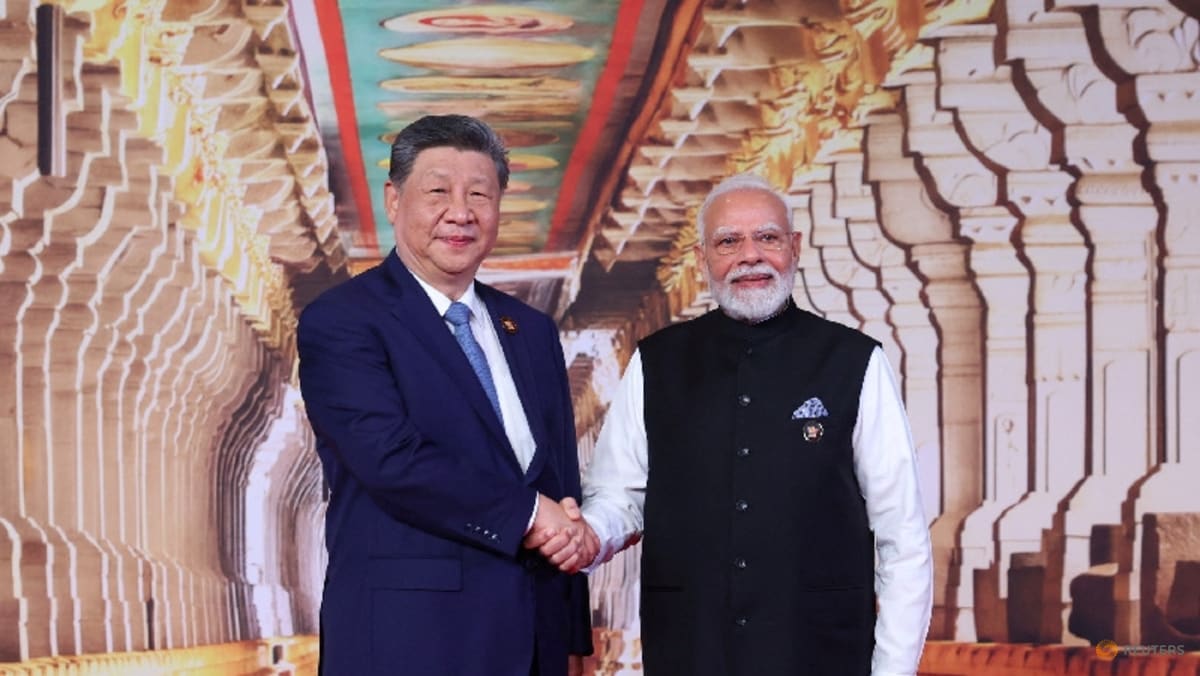
India’s Prime Minister Narendra Modi shakes hands with Chinese President Xi Jinping at Bharat Mandapam, the venue of BRICS Summit in New Delhi, India, September 12, 2026. India's Press Information Bureau/Handout via REUTERS
This audio is generated by an AI tool.
Nazia Hussain 21 Sep 2026 06:00AM Bookmark Bookmark Share WhatsApp Telegram Facebook Twitter Email LinkedIn Set CNA as your preferred source on Google Add CNA as a trusted source to help Google better understand and surface our content in search results. Read a summary of this article on FAST. Get bite-sized news via a newcards interface. Give it a try. Click here to return to FAST Tap here to return to FAST FAST SINGAPORE: A 20-second handshake between Indian Prime Minister Narendra Modi and Chinese President Xi Jinping, as well as a 140-paragraph joint declaration – those were the headline-grabbing outcomes from the recent BRICS summit that showed both the value and challenges of keeping a disparate grouping together.
The two-day summit, which marked the 20th anniversary of the grouping, and the first held with 11 members and 10 partner countries, concluded in New Delhi on Sep 13 against the backdrop of a war in the Middle East that has drawn in several member states on opposing sides.
BRICS – comprising Brazil, China, Egypt, Ethiopia, India, Indonesia, Iran, Russia, Saudi Arabia, South Africa and the United Arab Emirates – entered the summit with its divisions clearly exposed. Iran and the UAE have been on opposing sides of the wider conflict, while Iran-aligned Houthi forces have carried out attacks against Saudi Arabia. A deeper divide runs between India and China over an unresolved Himalayan border dispute and a wider contest over BRICS, with each seeking to position itself as the leading voice of the Global South.
These divisions had already cost the bloc an agreed text in May when foreign ministers could not reconcile their positions on the Iran war. Negotiations before the recent summit ran for four days and lasted into the early hours of Sep 12, with the difficulty concentrated in the paragraph on West Asia, or the Middle East.
CNA Games Guess Word Crack the word, one row at a time Buzzword Create words using the given letters Mini Sudoku Tiny puzzle, mighty brain teaser Mini Crossword Small grid, big challenge Word Search Spot as many words as you can Show More Show Less Consensus was eventually forged, with BRICS leaders calling for “maximum restraint” in the Middle East without saying who should exercise it. This allowed all 11 member states to sign on, while keeping their national positions intact.
A text that all member states could sign on the issue dividing them most sharply should not be dismissed, but the watered-down language showed less a resolution of differences than a potential concern – the narrowing ground on which consensus can be found.