Cosatu turns 40: Struggling for ideological integrity in a changing landscape - IOL
As Cosatu turns 40, the upcoming congress could either be a moment of revival or a final capitulation to the political elite.
Having celebrated its 40th year of existence last year, it is fair to assume not only that the Congress of the South African Trade Unions (COSATU) has now come of age but also that it has reached a mature stage.
However, just like in nature and in the evolution of capitalism, inherent in the stage of maturation is the dialectic of moribundness. A moribund thing or organism is characterised by a terminal state of degeneration in which there is a fatal struggle between the hitherto vibrant essence which is now increasingly succumbing to the virulent outgrowth of its pseudo self. Indeed, based on the recent developments in the post-COVID-19 pandemic period, more so after COSATU’s 14th National Congress in 2022, the inherited practice of organisational and class independence that was historically forged as part of the assimilation of the proletarian ideology of Marxism-Leninism within the federation has now been substituted by ideological subordination and political servitude.
Regrettably, this signifies the fact that for some time the conjunctural atmosphere of the suffocating Neoliberalism has been definitively disruptive of the inter-generational transmission of Marxism-Leninism within COSATU. This has created ideological lacuna and strategic confusion as the fledgeling cadres assuming the leadership responsibility that is heavily loaded with expectations of sustaining its revolutionary ideological traditions that require broader shoulders, whilst providing guidance on the strategic tasks facing this workers’ movement in the pursuit of class struggle.
Unfortunately, ahead of the 15th National Congress that is taking place this month, it is increasingly becoming manifest that the federation is degenerating to the bottom of the historical arch of its existence in which from its founding there was the rise of radical proletarian ideology and militant agency, which was followed by an interlude whilst COSATU still remaining unmistakably identifiable with an unwavering commitment to Marxism-Leninism as an ideological outlook and the long-term struggle for socialism.
Regrettably, those glorious and heady years of the popular assimilation of Marxism-Leninism which forged the political traditions of class-orientation, shop-floor militancy and worker control are fading behind us, as the current top hierarchy of the federation has abandoned class independence. We now have ideologically dodgy leadership occupying the centre and that is also typically dominant in some affiliates - seeking to subordinate this workers’ movement to the same elite political stratum that has turned the African National Congress (ANC) into a party of Neoliberalism. The ANC that has become its pseudo-self and strategically at sea, having long abandoned the shared strategic lodestar in the Freedom Charter, in favour of a grotesque vision of the National Democratic Society (NDS).
The federation’s top hierarchy is now characterised by deep unevenness in terms of class consciousness and indeed there is even an unhidden presence of some self-conscious ideological flip-floppers that are thoroughly opposed to the workers’ political and class independence in favour of subordination to the pro-capitalist and Neoliberal leadership that dominates the ANC.
As NEHAWU we do appreciate that this is partly a function of the current ebb in the momentum of the struggle marked by the dialectical intersection of the unfavourable objective conditions and weak subjective working-class agency in which the Neoliberal trajectory has enhanced the shift of the balance of class forces in favour of capital and its political acolytes, some of whom are found in the ANC. Without a concerted ideological intervention over time, at best the trade union landscape would continue to produce a cadreship that is caught up in the clutches of trade union consciousness, reformism and therefore political subservience.
It is a brutal historical irony that as it adopted the constitution at its launching congress in 1985 which “firmly commit” the federation to a “united democratic South Africa, free of oppression and economic exploitation” a couple of metal and cultural workers in Mi S’dumo Hlatshwayo and Alfred Temba Qabula had composed a poem for the launching congress entitled “Tears of a Creator”. It was from this poem that these workers read out some sorrowful words about the history of the trade union movement in South Africa, in which it has been the leaders that led to their demise, notwithstanding the contemporaneous political contexts. In this regard, they went as far back as the formative years of the trade union movement which was accordingly “derailed by Kadalie” and other such turncoat leaders.
They impassionedly recited a cautionary tale and poetically raising to bold relief the inherent dangers of trade union consciousness. To underline the gist of their message, they read out prophetically chilling words about the gloomy fate for a trade union movement that is left in the hands of class collaborationist leaders through whom it is bound to fade away and eventually disappear. To back up their cautionary tale, they challenge the sceptics of their thesis with rhetorical questions that “if that [their thesis] was devoid of the truth” then:
“Where is the ICU of the 1920s to be found?
Where is the FNETU of the 30’s to be found?
Where is the CNETU of the 40’s to be found?”
The poetic duo went on to lament what had befallen the workers and their trade union movement from one generation to the other up to the reemergence and founding of COSATU, with a sage warning about such leaders when they read out that: “They emerged, they poisoned and then faded!” Comrades Hlatshwayo and Qabula closed their cautionary tale by a friendly reminder and admonishment, that “COSATU today be wise!”
Indeed, never before has this cautionary tale been more relevant than today. From the founding congress the ideological orientation of COSATU was already clear, even though a more elaborate framework was still to be worked out at the 2nd National Congress in 1987, at the time when the National Education Health and Allied Workers’ Union (NEHAWU) had just been founded as a nucleus geared at building a giant industrial union in the public sector. Thus, from its launching congress, through its adoption of the constitution and resolutions COSATU was built on an ideological platform that committed it, amongst others, to work and fight for:
The ‘restructuring of the economy which will allow the creation of wealth to be democratically controlled and fairly shared.’
To ‘draw people into a programme for the restructuring of society in order to make sure that the wealth of our society is democratically controlled and shared by its people.’
In themselves, these two strategic objectives constituted a clear anti-capitalist ideological commitment and the political practice of class-orientation and thus they were the ideological roots upon which COSATU’s proletarian ideology was sprouted and flourished.
So, it is incontrovertible that from the moment of its founding COSATU had nailed its colours to the mast as a red trade union movement that is ideologically pivoted to Marxism-Leninism and organisationally to shop-floor militancy and worker control. In this regard, the federation remained relatively consistent throughout its history culminated at the watershed 14th National Congress in 2022, at which the delegates not only reaffirmed the ideological inspiration of Marxism-Leninism but also sought to put this into practice by politically identifying the federation with their own side of the working class in overwhelmingly passing a resolution to campaign in support of the South African Communist Party (SACP) through the constitutionally highest democratic means of a secret ballot.
This was engendered by the fact that he political character and socioeconomic content of the democratic transition and the related institutional structures that it created since 1994 have perpetuated and even aggravated the inequalities of the inherited settler-colonial society. The imposed Neoliberal macroeconomic policy template has over more than three decades compounded this reality in deepening and widening the scale of poverty, hunger and unemployment which are highly concentrated in the spaces that were historically designated for black people.
In the absence of the political will and urgency to transform this socioeconomic reality and its corresponding oppressive Apartheid geography the masses of our people are still dispossessed of their land and forced to eke out survivalist livelihoods as they trapped in the generally unproductive rural areas, forsaken shack-lands, townships and decaying inner-cities. Hence, as NEHAWU we have concluded that the class content amongst the contradictions defining the inherited settler-colonial society has now become the principal feature in the political terrain, which calls upon the organised working class forces to unite and rally other popular forces to assert their class independence and put their own interests at the centre of their political activities.
Indeed, across the board the parliamentary parties behave as if the horrendous existence of the shunted masses of our poor people in the isolated spatial and economic margins is normal, despite the vast potential inherent in the country’s endowment with resources to change their lives. Even the lay people who are disillusioned and disengaged from these political parties are discerning the fact that the class question is now the central determinant that defines the political landscape – whether for the maintenance of the status quo or for radical its transformation, as these parties merely relate to the masses of the poor as their ignoramuses that are only useful as pawns for elections.
In other words, it is self-delusional for a trade union movement born of the ideology and political practice of radical transformation such as COSATU to now behave as if in the present conjuncture of the Government of National Unity (GNU) there could still be the political will to drive the National Democratic Revolution (NDR), even the perverted version whose end-state is supposed to be the realisation of the NDS.
With the aggravation of the socioeconomic contradictions amidst the persistent features of our settler-colonial society and the suffocating Neoliberal atmosphere it is the central task of a radical and class-oriented trade union movement to be decidedly and unmistakably on the side of the broad masses of the downtrodden poor human beings in this society. It must forge alliances with the working class formations that have no vested interests in the status quo. It must owe no one, class or organisation any kind of allegiance, other than the collective commitment with those that have consistently demonstrated their loyalty to the down-trodden masses.
Therefore, it is a tragedy that an organised formations of the working class such as COSATU could now be caught up being incapable of decidedly occupying its leading role on the side of the suffering masses of our people. Instead, it is engaged in shameful and poorly disguised political deceptions whilst seeking to render the workers into ideological subordination and political subservience to an agenda that is against their own class interests and that has been primarily serving the interests of the elite and randlords and butchering the working class over the past 32 years.
Despite the watershed political resolution of the 14th National Congress directing COSATU to strengthen the socialist-axis with the SACP through an integrated joint programme and in line with this to campaign in support of the party in elections, the turncoat leaders are already speaking in tongues, making no sense. The last time the delegates at a COSATU congress resolved to support the ANC was in 2018 at the 13th National Congress and even so on condition of the ANC acceding to the call for the reconfiguration of the Alliance. Yet, since the 14th National Congress there has been a concerted attempt by the top hierarchy in COSATU to veto that resolution of the federation’s highest decision making organ, by pretending that it does not exist and thus asking the affiliates to consult on the resolution of the SACP’s 15th National Congress rather than focusing on how to implement their own resolution. This is divisive.
Being ashamed of their subservience to the core Neoliberal leadership of the ANC, fearful of the fact that the delegates could reaffirm their own resolution from the previous if the matter was to be taken back to their control, they now seek to manage the political outcome of the 15th National Congress by coming out with a bizarre idea of supporting both the ANC and SACP. As to how this would be practically done when these formations are contesting elections independently and on distinct manifestos it is unclear, let alone the fact that the ANC has clearly proven over more than three decades that Neoliberalism is now in its DNA. There could be no better epitome of political zig-zagging, taking into account the mandate given to the same leadership by the 14th National Congress.
Worst still, the organised working class contingent in COSATU members, whose federation comes from the ideological tradition of Marxism-Leninism, are now reduced to children. They are told that “when the parents fight, it is the kids who suffer”. For the record, as far as we are concern there is no fight between the ANC and SACP. COSATU is an independent workers’ movement and its members are not anybody’s kids! There is no better epitome of ideological degeneration.
We can only foresee the ongoing political zig-zagging ending in tears, but unfortunately it would be the tears for our ancestors who the creators of this giant red trade union movement and only those of us who are yearning to carry forward their legacy of ideological commitment to Marxism-Leninism and the corresponding political commitment to socialism, with the SACP as the vanguard of the South African working class! Nonetheless, belated as it may be, we reiterate the council and cautionary tale of Comrades Hlatshwayo and Qabula, that “COSATU today be wise!”
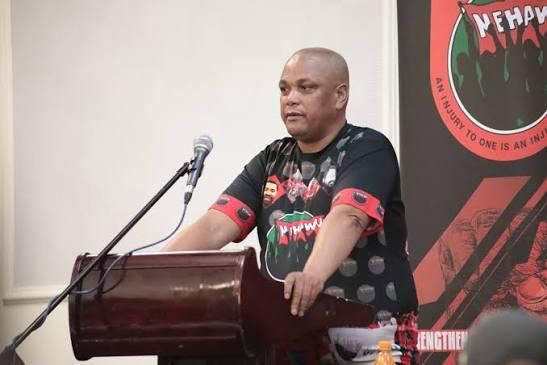
Zola Saphetha, NEHAWU General Secretary who currently as a CEC Member of COSATU and also Central Committee Member of the South African Communist Party. He also serves as the General Secretary of the Trade Union International Public Service & Allied which makes him a Presidential Council Member of the World Federation of Trade Unions.
/file/dailymaverick/wp-content/uploads/2021/07/des-phoenixdeaths.jpg)