Crushed dreams: The 5 small-town boys who loved Delhi until it took their lives - The Indian Express
TO BE a 17-year-old in Delhi. For Pavan Yadav, that meant visits to gaming arcades, eyeing a supercar in a mall, tucking into Dolma Aunty’s momos that tasted so much better than the ones in his small-town Auraiya in Uttar Pradesh, and burrowing deep into his new Murakami book that he wouldn’t let his sisters touch.
“At home, he used to be so picky about food, but in Delhi, he had something good to say even about the mess food. He loved the city,” says Aparna, 25, the eldest of his four siblings.
But like many teenage loves, this wasn’t meant to be. The quiet boy from Auraiya, with a head full of curls and a love for all things tech, died on September 6 when the private hostel building they stayed in collapsed in Delhi, burying seven, five of them Delhi University (DU) students like him. Delhi had failed him, a little over a month after he had discovered the city.
“Even as a child, Delhi was the only city he wanted to visit. And once he moved there, he would talk about his friends, how they were exploring the city. He was living out his dream,” says Aparna, an economics teacher at a private school in Auraiya.
In July, Pavan followed his sister Priyanshi, 19, into Delhi University, enrolling for a BSc (Computer Science) at Motilal Nehru College.
The family worried for him. How would the shy boy find his space in a city where people spoke louder and harsher than needed?
“He wouldn’t talk a lot. Not even with his school teachers. He was mostly by himself. He would watch videos related to tech and fast cars,” says Priyanshi, a second-year BSc student at Daulat Ram College in DU’s North Campus.
When Pavan moved into Hostel Daze, a paying guest accommodation at Delhi’s Satya Niketan, the family was reassured that at least Priyanshi was around for him. “He would call on video from his room, show us the car stickers and anime posters on his walls,” recalls Aparna.
Satya Niketan is a cluster of paying guest facilities that cater to students in the university’s South Campus colleges. It’s relatively more open than the city’s other student hubs, including Kamla Nagar near North Campus, where Priyanshi lived. What they didn’t know was that like many of the other buildings in Satya Niketan, Hostel Daze stood on unsteady ground. Built to be a two-floor structure, it was illegally extended to five floors, and construction was on in the basement to make more rooms.
That Sunday noon, September 6, Priyanshi was in her hostel room, scrolling through Instagram when she came across a video of the building collapse at Satya Niketan.
“I didn’t know what to do. I was trembling. I called the operator of the building, but he didn’t answer. I called Pavan, but his phone was switched off. I rushed to Satya Niketan by 4 pm. I told the rescue personnel that my brother was inside, but they wouldn’t let me in,” says Priyanshi.
She then rushed to AIIMS. By then, some people had been rescued from the debris. Two bodies were found, neither of them Pavan’s.
Priyanshi then rushed back to Satya Niketan, showing Pavan’s photo to those who assembled at the site. Aparna says, “A Blinkit ambulance driver then told Priyanshi that he had taken Pavan to AIIMS. So she rushed back to the hospital. There, after much pleading, a nurse confirmed that Pavan’s body was in the mortuary.”
In the days since then, Pavan’s father Vishambhar Nath, a retired doctor, and mother Meera Devi have gone silent. They now plan to file an official complaint against the government and Hostel Daze for their son’s death.
The family last got together for Raksha Bandhan, after which Priyanshi and Pavan had travelled back to Delhi together. This time, she will have to make that journey alone.
In Akshat Singh’s house in Katni, Madhya Pradesh, is a world he left behind. A wooden table sits pushed against the wall. On it, a shelf with stacks of NCERT books, BCom Business Studies textbooks, a copy of the Constitution, Arundhati Roy’s The God of Small Things, Jostein Gaarder’s Sophie’s World and Secret by Rhonda Bryne. On a lower shelf, two swords rest side by side, one still in its brown sheath. Above them, a row of toys — a T-Rex, and Iron Man and Captain America figurines.
Akshat’s father Manta Singh speaks of his first born as someone far wiser than his 19 years — the class topper who played chess like a dream, the one the family turned to for advice, the son who never needed to be told what to do.
While being enrolled at Delhi’s PGDAV College, where he was a second-year BCom student, Akshat prepared for the UPSC exams. “You need to be 21 to sit for the exam. But he started preparing a year ago. “Usko aasan raasta pasand nahi tha (He never took the easy way out),” recalls Manta Singh, an architect who runs his own business.
Akshat’s self-imposed dedication, says the father, led him to often isolate himself while studying. “When his friends came to see him, he would ask his mother to tell them he wasn’t home. He was already writing Mains-level answers, that too very fast — 250 to 280 words in five minutes, sometimes,” says his father.
In Class 10, Akshat scored 90%. In Class 11, he took up kho-kho, fencing and later, chess, which took him all the way to state-level championships in Bhopal.
Then, sometime in his first year of graduation, he decided he wanted to be a civil servant. “He read a lot of philosophy, took life so seriously, I used to tell him to relax a little,” says Manta Singh, his voice low. “But he was clear that he wanted to become a Chief Secretary some day.”
Since his first year of college, Akshat had been living in Delhi’s Hostel Daze, managing a monthly budget of around Rs 20,000. “When he joined the hostel last year, I dropped him off after paying the rent and brokerage. He handled everything else,” says Manta Singh.
“I didn’t want a lot from him. I just wanted him to fall in love, enjoy his life, go on trips, be with his friends.”
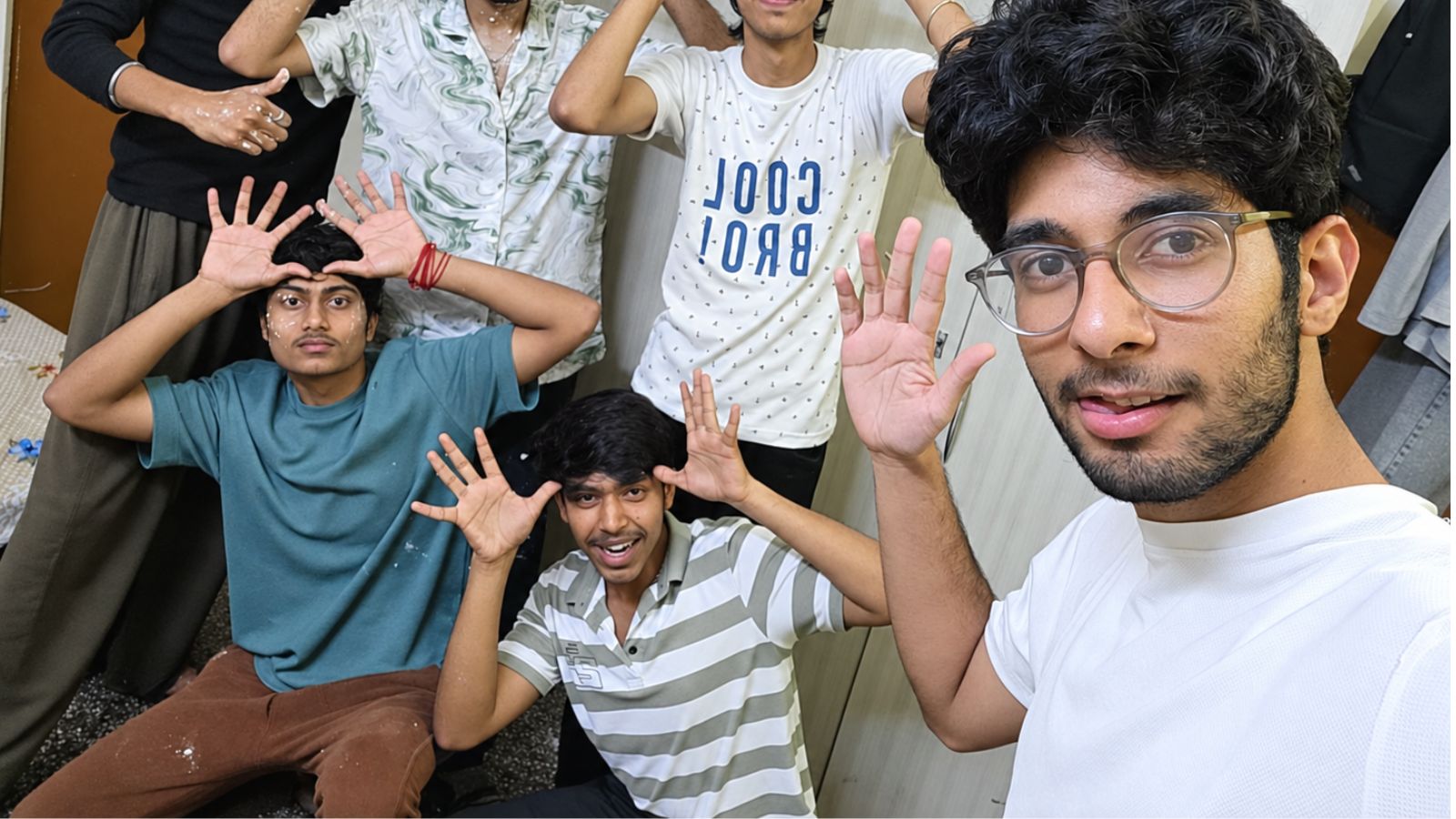
Singh would be happy to know his son did let his hair down sometimes. A photograph that his friend Navneet shared with The Indian Express shows Akshat at Navneet’s birthday party, splotches of cake on his face and his T-shirt. He isn’t smiling, but strikes a goofy pose.
Arpit Jaj, 19, is in the photograph too, wearing a striped T-shirt. Akshit and Arpit were part of a group of six, says Navneet. Akshat, Arpit, Sarthak, Krishna, Shrestha and Navneet — all in different DU colleges but shared the same hostel and hung out together.
On the day of the collapse, Navneet had gone to Meerut with his family, and Shrestha and Sarthak were visiting a relative. Krishna had moved out to another flat in Satya Niketan only two months earlier. Arpit and Akshat were trapped, and later declared dead.
If Akshat was quiet, Arpit, a second-year BCom student at DU’s Atma Ram Sanatan Dharma College, was outgoing, extroverted, the life of every gathering.
“Arpit and I shared a room at the hostel. Everyone used to hang out in our room, and Arpit would entertain them. We would talk for hours, play games, and put on music,” says Navneet.
Arpit’s friends say the boy from Dewas, Madhya Pradesh, walked through every door that DU opened, making sure he never missed a music society event, debate, or dance fest. Every Saturday night, he organised a small get-together in his room. His evenings ended with a walk through Satya Niketan’s lanes.
But he always found time to call his mother Pushpa — “at least five times a day”, says Arpit’s father Bhupendra Jaj, a taxi driver in Dewas. “He was very close to her, shared everything. He would call her soon after waking up, then again while on his way to college, once after coming back, and then before sleeping.”
He says Pushpa now simply sits staring at her phone. The last time Arpit called her was around noon on September 6, two hours before the building collapsed.
Arpit, who was preparing for his Cost and Management Accountancy exam, had already cleared the foundation level. He loved anime and rap songs, topics he could talk about for hours with anyone willing to listen.
“Most of us were school toppers,” Navneet says of the group of six. “We came to DU to study, to make a mark in life. Now only four of us remain.” He hasn’t found the courage to go back to Satya Niketan, to the lanes they once called home.
A year ago, Abhishek Kumar put his foot down — he would study in Delhi University, nowhere else. “His sister studies in Jhansi, his elder brother is in Kota. Abhishek had got into Banaras Hindu University as well, but he wanted to study in DU and prepare for MBA. Delhi has good MBA coaching institutes, he would keep saying,” recalls his father Santosh, a machine operator in a factory in Jhansi, Uttar Pradesh.
His “dream city” disappointed him soon enough. “He would sometimes tell me about the small rooms in the hostel, the bad food. But I would always console him, saying no place was perfect,” says Santosh.
Santosh would remind his youngest child of his larger goal. “I would tell him that he had been one of the best students in school, that he was working towards what he wanted. Learn to adjust, I told him. And then, this…” he says, breaking down.
For Yuvraj Soni — “Honey” to his family — staying away from home was difficult. So when he left Chhattisgarh’s Durg after securing a seat in DU’s Motilal Nehru College, the 19-year-old found a way to keep his home close to him: daily video calls and a steady stream of photographs.
He could talk for hours, especially to his mother Kavita, 45, and sister Siddhi, 13.
“After he went to Delhi on July 27, 2025, he would get very emotional and say he did not want to live there. We encouraged him, saying it was just a matter of a few years,” says Kavita.
Growing up, Yuvraj gave them no reasons to complain: he cracked the CA foundation exam all by himself, and willingly stepped up for the family. “He would take care of our needs from Delhi, with banking work, paying bills or his sister’s project work. While home, he would play cricket or spend hours taking care of his plants on our terrace,” says the mother, holding back her tears.
He had moved into the hostel only on September 1, five days before it collapsed. He earlier stayed in a room in DU’s North campus, but it took him two hours to reach college. The hostel looked good: Rs 14,000 for a room on the fourth floor, with food served four times a day. His college was just 15 minutes away.
Soon, he was sending his family videos — of his room that looked “posh”, and the view from his balcony of students performing bhajan at a nearby Bholenath temple. He also sent photographs of his daily thali of dal, curry, vegetables and roti, all of which, he told his mother, “tasted good”.
On September 6, around 1.20 pm, Yuvraj was on the phone with his childhood friend Gunjan Sahu — who, like him, had made the journey from Durg to DU — when the call ended abruptly. That was the last time anyone had spoken to Yuvaraj.
Gunjan then contacted Kavita, before rushing to the tragedy site. Back in Durg, Kavita started making frantic calls. “It has never happened that he did not answer calls. I called 50 times that day,” she says.
Finally, around 5.30 pm, a policeman answered Yuvraj’s phone and told Kavita to rush to Delhi.
Days after the tragedy, it’s all quiet at the Soni household in Durg’s Panchsheel Nagar. “The day we lost Yuvraj was my daughter’s birthday. She says she will never celebrate her birthday,” says Kavita.
The medical store that Yuvraj’s father Kanhaiya ran from the ground floor of their house remains shut. “I will continue to fight till my son gets justice,” he says.