Dateline soars on Washington support for gold-rare earths restart
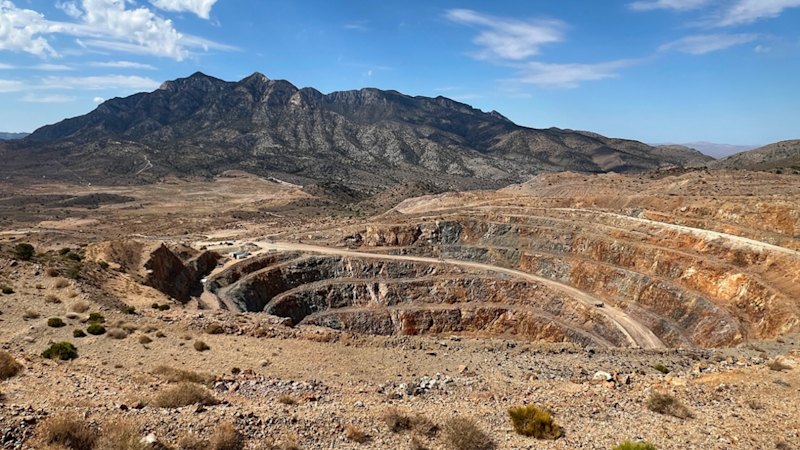
Dateline Resources has landed heavyweight US Government backing in its fight to restart operations at its Colosseum gold-rare earths project in California, with two powerful federal departments throwing their weight behind the company’s push to overturn a preliminary court injunction.
Judging by the market’s reaction today, this was just the tonic Dateline punters were looking for, with the stock rocketing a whopping 50 per cent to as high as 9.5 cents on turnover of 55 million shares in early trade.
Dateline Resources’ Colosseum gold mine in California.The US Department of Justice has filed its own motion seeking a stay of the injunction that halted operations at Colosseum last month, while the Department of War has weighed in with a sworn declaration arguing that exploration at the project is in the national security interests of the United States.
If granted, the stay would allow Dateline’s wholly owned subsidiary, Colosseum Rare Metals, to resume operations under its approved Plan of Operations while an appeal against the injunction works its way through the courts.
In its filings, the US Government has also requested the court allow Dateline to resume development work immediately while the stay order remains in place.
The latest move follows an August 10 preliminary injunction issued by the US District Court for the Central District of California in proceedings brought by the National Parks Conservation Association.
Dateline had already lodged its own application for a stay. The Federal Government has now joined the fray with a separate motion, arguing the District Court erred in finding that the “valid existing rights” savings clause under section 508 of the California Desert Protection Act did not protect an approved Plan of Operations.
Importantly for Dateline, the Government is arguing that keeping the injunction in place causes irreparable harm to US national security interests and the broader public interest.
Cadenazzi said continued exploration at sites such as Colosseum was critical given the importance of rare earth elements to national security and America’s reliance on foreign sources.
Mountain Pass, operated by mining behemoth MP Metals, is America’s only significant rare earths producer hosting a resource of 26.27 million tonnes at an impressive grade of 5.89 per cent total rare earth oxides (TREO).
The next key date is October 26, when both Dateline’s and the Government’s stay applications are scheduled to go before Judge Christina Snyder – the same judge who issued the original injunction. Both the company and the Federal Defendants formally filed notices of appeal on September 22.
Should the District Court knock back the applications, both parties can take their stay requests to the US Court of Appeals for the Ninth Circuit. The broader appeal will continue in the Ninth Circuit regardless of the stay decision. The National Parks Conservation Association has indicated it will oppose the applications.
The legal battle comes as Dateline looks to develop its 100 per cent-owned Colosseum project in California’s Walker Lane Trend. The company completed a bankable feasibility study on the project’s gold operation in May and has increasingly turned its attention to the site’s rare earths potential.
For the first time, Dateline has pulled all of Colosseum’s geophysical and geochemical data into one model, sharpening up three carbonatite-style rare earths targets. The standout is the 1.2km-long Clark Mountain Fault Zone, where electrical, radiometric, gravity and geochemical anomalies have stacked up in the same patch of ground.
A second undrilled target on the eastern side of the project hosts a strong ring-like gravity anomaly, while a third target at 2200N is undergoing further modelling. Importantly, Dateline says the combined geophysical signature bears striking similarities to the nearby Mountain Pass carbonatite system.
The geological case gained further weight when one hole at Clark Mountain delivered Colosseum’s first drill-based confirmation of anomalous rare earths, intersecting mineralisation about 40m deep on the edge of the priority target. Dateline says the rare earths signature and associated barium, strontium, calcium, phosphorus, thorium and uranium enrichment point towards a mantle-derived alkaline magmatic system comparable to Mountain Pass.
Subject to the outcome of legal proceedings, the company now has a 12-hole diamond program lined up across its two leading targets, with several holes set to plunge beyond 750m in search of the heart of the interpreted carbonatite systems.
Rare earths potential aside, the more developed gold story at Colosseum stacks up strongly. The previously published study presents what the company says is a technically simple restart of the historic mine with some hefty economics to match. At a base-case gold price of US$4200 (A$6000) an ounce, the numbers point to US$1.08 billion (A$1.54B) in undiscounted pre-tax free cashflow, a 49.5 per cent internal rate of return and a pre-tax net present value of US$785 million (A$1.12B).
Underpinning the numbers is a maiden ore reserve of 20.6 million tonnes grading 0.95 grams per tonne gold, with the ore set to run through a 2-million-tonne-per-annum carbon-in-leach plant delivering a healthy 91 per cent metallurgical recovery.
Dateline plans to do the heavy lifting early, with mining front-loaded into the first six years and average annual gold production running at about 75,000 ounces. Production is expected to hit its straps in year six at 102,000 ounces, while the operation is forecast to deliver 573,000 ounces across its 10.4-year mine life.
Adding further shine to the numbers is a low 3:1 strip ratio, keeping waste movement in check and helping underpin an all-in sustaining cost of US$1825 (A$2607) per ounce.
Elsewhere, Dateline has recently consolidated its Music Valley heavy rare earths project in California, where rock-chip sampling has already thrown up some eye-catching numbers. All 33 samples returned anomalous rare earths, headlined by a stunning 7.13 per cent TREO hit from the Southern target, adding further critical minerals weight to the company’s US portfolio.
The company also holds the Argos strontium project in California, reportedly the largest known strontium deposit in the United States.
Having the US Government step into the ring alongside Dateline significantly raises the stakes ahead of the October hearing. For the company, a successful stay would reopen the gate at Colosseum while the bigger legal contest continues – and put its rare earths hunt back in motion just 10km from America’s flagship Mountain Pass operation.
Is your ASX-listed company doing something interesting? Contact: mattbirney@bullsnbears.com.au
You have reached your maximum number of saved items.
Remove items from your saved list to add more.