David Olive: Why Saab’s Gripen has never looked better for Canada - Toronto Star
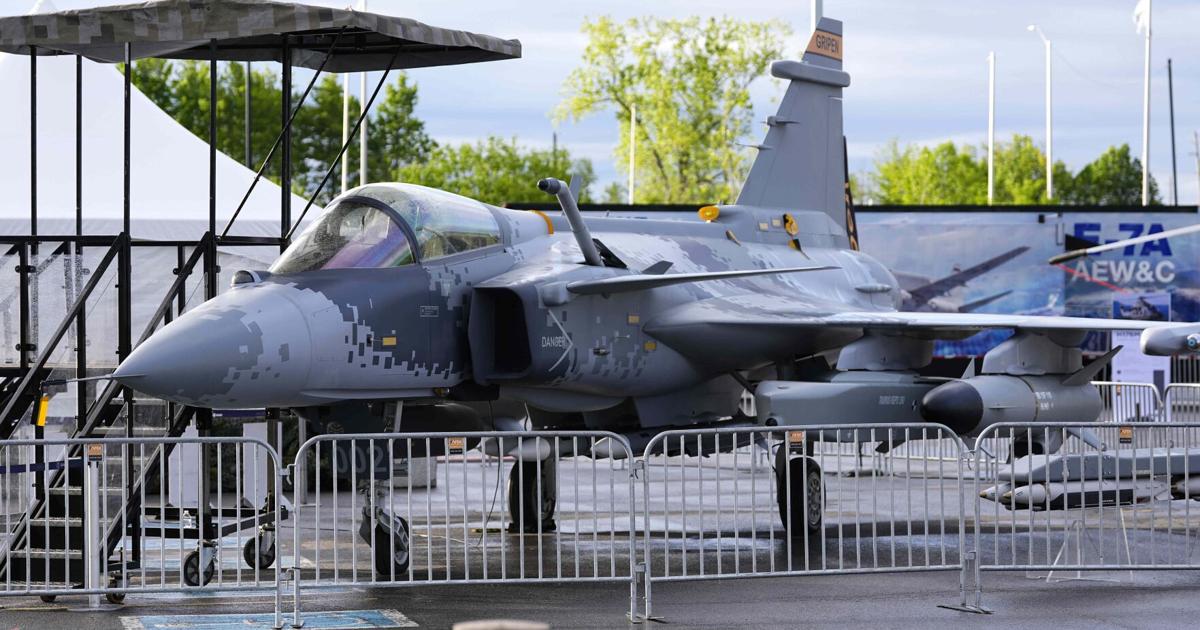
Trump's trade war has turbocharged the Gripen's chances of winning Canada's fighter jet contract.
A replica of a Saab Gripen multirole fighter aircraft is shown at the Canadian Association of Defence and Security Industries annual defence industry trade show in Ottawa in May.
David Olive is a Toronto-based business columnist for the Star.
The U.S. and Sweden are taking very different approaches to winning an enormous Canadian defence contract for a fleet of 21st-century warplanes to replace the RCAF’s aging CF-18 fighter jets.
The U.S. is trying to bully Canada into purchasing all the 88 U.S.-made F-35 fighter jets it ordered in the Trudeau years, with a total price estimated at $27.7 billion. Prime Minister Mark Carney put that order on hold last year after U.S. President Donald Trump’s first trade attacks on Canada’s economic sovereignty.
Ottawa is considering Saab AB’s competing Gripen jet fighter as an F-35 alternative.
Canada is contractually obliged to buy the first 16 F-35s, which leaves a balance of 72 planes needed by the RCAF.
In contrast to American hostility, Saab has spent the past year trying to strike a harmonious partnership with Canada that aligns with the Carney government’s agenda of using defence procurement to increase Canada’s industrial capacity.
If Ottawa chooses the Swedish option, Canada could have its first military aerospace industry since the Second World War, when Canadian factories turned out hundreds of Allied warplanes.
There is no chance of that with F-35 maker Lockheed Martin of Bethesda, Md. Saab has committed to building its Gripen jet fighters in Canada. Lockheed will continue to assemble its F-35s in Fort Worth, Texas.
Saab proposes a Canadian production line to assemble the Gripens, sourcing of components from up to 250 Canadian suppliers, a reported six new R&D centres across Canada, and Canadian access to the software on which the Gripens operate. Lockheed withholds that code from its customers though it is accessible to Trump’s Pentagon.
Lockheed has not matched Saab’s proposed benefits in part because of the RCAF’s strong preference for the F-35.
The F-35 has stealth capabilities the Gripen lacks, which makes it close to undetectable by enemy forces. And Canadian F-35s would be interoperable with the F-35s operated by the U.S. and Canada’s NATO allies and Australia.
The odds in the jet-fighter contest long favoured the F-35.
But that was before the attempted U.S. shakedown in the failed Canada-U.S. trade talks last month, in which the Americans’ unreasonable demands included Ottawa’s purchase of all the F-35s it originally ordered.
And that’s leaving out the Gordie Howe bridge debacle, “Lake America,” and Trump’s latest tariff attacks in August and again this week.
Lockheed didn’t anticipate the impact on its Canadian F-35 sales of a falling-out between Canada and the U.S.
Last spring, Carney declared that “The days of our military sending 70 cents of every dollar to the United States are over.” Canada has since turned increasingly to non-U.S. military suppliers.
Canada has begun negotiations with Saab to buy up to six GlobalEye early warning surveillance planes. These are radar and sensor systems built into Bombardier 6500 executive jets assembled in Toronto. The GlobalEye was in competition with two U.S. planes, the Boeing E-7 Wedgetail and the L3Harris Aeris X.
In June, Canada agreed to pay $2.5 billion to buy an innovative Australian Arctic Over-the-Horizon Radar system in a deal that includes expertise-sharing to strengthen Canada’s defence industrial base.
In July, Carney chose German shipbuilder ThyssenKrupp Marine Systems, in partnership with Norway, to supply Canada with 12 submarines in a deal reported to be worth up to $24 billion. “The project is about much more than acquiring submarines,” said Carney in announcing the contract. “It builds Canadian industrial capacity.”
In August, Carney committed to spend $11.3 billion in partnership with the Quebec shipbuilding industry to supply the Canadian Coast Guard with six new icebreakers. They will be built at the Chantier Davie shipyard in Lévis, Que., which is owned by the British maritime and industrial firm Inocea Group.
Also here at home, Canada is building 15 “River-class” destroyers at Canadian-owned Irving Shipbuilding in Halifax at an estimated cost of $77.3 billion over the next 25 years. And Canada is buying more than 65,000 new assault rifles from Kitchener, Ont.’s Colt Canada, a division of Prague-based Colt CZ Group SE.
Saab may have gained an edge with the May 13 appointment of Stephen Fuhr as Canada’s secretary of state for defence procurement. The former fighter jet pilot was among the very few RCAF officers to lobby for the Gripen over the F-35.
This space earlier made a case that the Gripen is well suited to a mixed fleet of Canadian fighter jets. The F-35 is designed to take the fight to the enemy. That’s ideal in meeting our NATO commitments. The Gripen, a faster aircraft than the F-35 and less prone to breaking down, is made for defending home skies.
Together, they would give Canada one of the world’s most versatile air forces and help us build a sovereign military aerospace industry in the bargain.
Opinion articles are based on the author’s interpretations and judgments of facts, data and events. More details
David Olive is a Toronto-based business columnist for the Star.