Day two in Dubai: The region makes its case for telling its own story
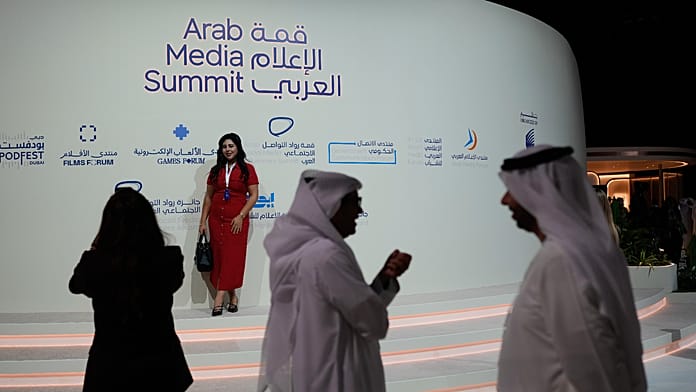
Day two of the Arab Media Summit belonged to the Euronews Forum, where ministers from the UAE, Azerbaijan and Georgia took the main stage for a session on building the national narrative.
The UAE Economy and Tourism Minister Abdulla bin Touq Al Marri was asked whether the Gulf had been rattled by recent events. His response was robust.
“We do not design economies on recovery. We design the economy for future storms, exactly. For the next crisis that we are ready for. And we will be prepared," Al Marri said.
“Resilience cannot be bought. Yes, the storm has hit. Yes, our banks stood still. Our government stood still. But resilience is built," he added.
"And resilience is the insurance of economies. And that's the kind of mindset and the policy we're putting into what we design today.”
Al Marri was also very clear about how governments should communicate during times of crisis: “When a crisis or when a storm hits the shores, communication shouldn't be louder. Communication should be constant.”
"Think it, say why, say how, then go and do it. That is Dubai," he concluded.
Alongside him, Assistant to the President of Azerbaijan Hikmet Hajiyev set out Baku's case on the peace process with Armenia, signed in a joint declaration with the United States in Washington in August 2025.
"We won in the war, but we are winning in the peace," he said. He also noted Azerbaijan's joining the Central Asian leaders' platform, taking the grouping from five members to six.
Georgia's Foreign Minister Maka Botchorishvili completed the panel.
Both Botchorishvili and Hajiyev said their countries have been targets of sustained disinformation campaigns.
Elsewhere in the summit, UAE Minister of State Noura Al Kaabi told a session on media and diplomacy that public diplomacy matters most when conventional political channels recede.
She welcomed the warming between Abu Dhabi and Damascus and Syrian President Ahmed al-Sharaa's visit to the UAE, and praised an initiative by Sheikha Fatima bint Mubarak to restore the Umayyad Mosque in Damascus.
On misinformation, Al Kaabi said the answer was engagement, speed and credibility, and that young people had a part to play in checking what they are shown before passing it on.
Chief marketing officer of the Emirates Group, Boutros Boutros, took a session on building a global airline. On AI and influencers, he was unsentimental about the tools.
"We are humans after all," he said. "Making the best use of technology calls for expertise, and this is the key, not the technology itself."
"Today, we can communicate in 20 to 30 languages with just one click of a button, but the most important factor is discovering the creative minds who can connect with people in unique ways," Boutros said.
Discussing strikes, geopolitics, technical faults and weather, he said an airline's job during a disruption is to limit damage to passengers and keep their trust.
"We always challenge ourselves to be the best. We can't always be the best in everything," Boutros said.
Information ministers from Egypt, Syria, Bahrain, Jordan and Lebanon have also attended the summit.
The rest of the programme included discussions on a wide range of topics including the international reach of Arab cinema, television made for TikTok, women in Arab drama, and whether anyone should trust medical advice from an influencer.
A panel examined the new Lebanese media law, while the Oscar-nominated documentary "From Inside Gaza" was screened.
The summit closes on Thursday at Dubai World Trade Centre.