Derek Burney went from Canada-U.S. free trade legend to corporate transformer, writes Rod McQueen, - Toronto Star
The man who helped clinch the Canada-U.S. Free Trade Agreement, writes Rod McQueen, brought the same demanding, impatient energy to the boardroom — and to public debate.
Derek Burney, who helped clinch the Canada-U.S. Free Trade Agreement in 1988, writes Rod McQueen, brought the same energy to the boardroom as flight simulator company CAE’s president.
Rod McQueen is a freelance contributing columnist for the Star’s Business section. McQueen spent a career talking to successful CEOs and power players. In an ongoing series, he reflects on the lessons he learned from those past interviews. McQueen is based in Toronto. Reach him via email: rmq@rogers.com
Simon Reisman and Gordon Ritchie were Canada’s official negotiators for the Canada-U.S. Free Trade Agreement, but Derek Burney’s talents were crucial to concluding negotiations. The perfect next step for Burney was to be Canada’s ambassador to the U.S., maintaining a close eye on implementation.
After he arrived in Washington, D.C., in January 1989, Burney tried to keep Americans focused on Canada. He nabbed Sen. George Mitchell at a dinner to talk about acid rain, collared White House Chief of Staff John Sununu in a congressional corridor, and buttonholed Lloyd Bentsen, chair of the Senate Finance Committee, on a hotel escalator.
“Three minutes with a guy like that is important,” Burney told me. “It isn’t as much what you engage in at that point, it’s the next time. You’re not approaching him as some question mark.”
Such boldness is essential in Washington with some 200 ambassadors, 50 think tanks, 500 political consultants, and 7,000 lobbyists all chasing the same decision-makers.
Burney also needed to defend himself. A Toronto Star article in the first year quoted an unnamed official in the prime minister’s office saying Burney was bored.
When the story appeared, Burney invited six Canadian journalists to the embassy. Few can do outrage like Burney. Soup was barely served when he rattled through a list of accomplishments as ambassador: hosted 92 meals and receptions, delivered 28 speeches, visited 10 of Canada’s 12 U.S. consular offices, called on 14 of the 16 members of the Bush cabinet, and met individually with more than 60 members of the House of Representatives and Senate. The list completed, he snapped: “It’s hard to be bored if you’re busy,” then paused, daring anyone to disagree.
But a man’s strength can be his weakness, too. At 6 feet and 220 pounds, Burney had the heft to defend Canada’s interests, but his brusqueness didn’t always suit the circumstances. He opened one speech I attended in Washington by mocking everyone’s favourite depiction of Canada and the U.S. as “the longest undefended border in the world” by describing it as “the longest undefended cliche in the world.”
During the question-and-answer session, a student noted that most Canadians lived within 100 miles of the U.S. border. Burney interrupted her, snorting: “See what I mean about clichés?” The young student gamely carried on with a query about seniors’ health care, but Burney had struck a sour note.
He hoped for an eventual private-sector role that would pay more than his $180,000 annual salary as ambassador, but claimed money wasn’t everything. “I’m more interested in what I’m doing rather than what I’m getting paid. The draw would be the challenge of trying to do something different and testing myself.”
After Washington, Burney got his wish and was named chairman and CEO of Bell Canada International from 1993 to 1999, followed by CAE Inc. as president and CEO until 2004.
Only a few senior civil servants made a similar leap: Ed Clark, Toronto-Dominion Bank; Paul Tellier, CN Rail; Robert Brown, Bombardier Inc.
I caught up with Burney at CAE and watched his demanding approach.
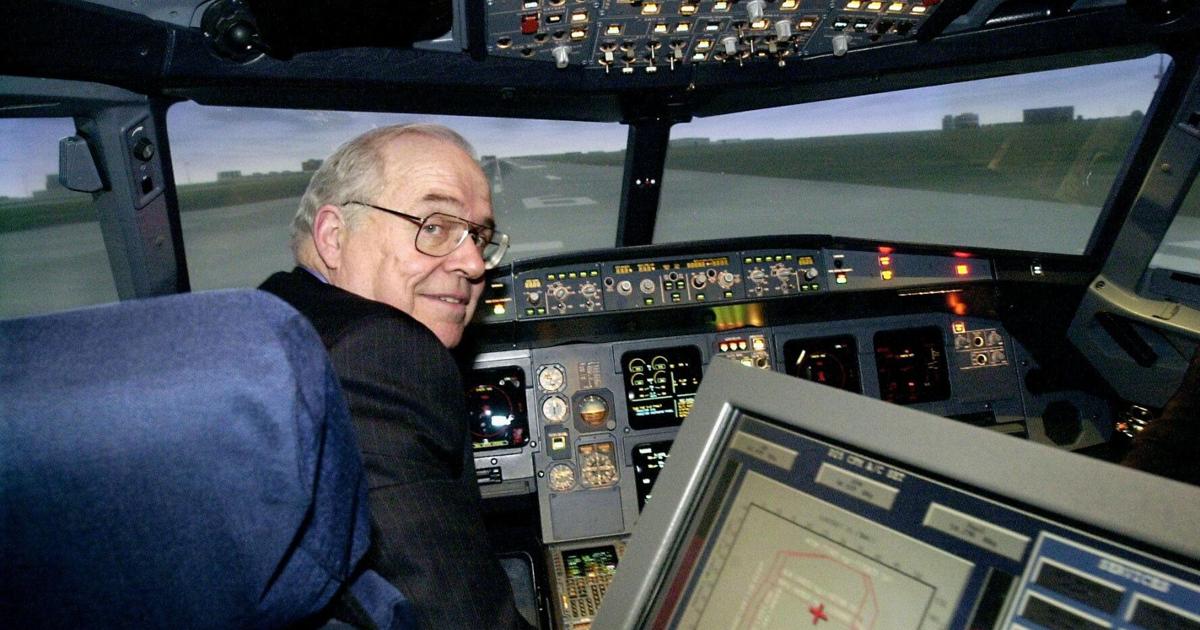
We both clambered into one of the CAE flight simulators. The operator began the demonstration with a scene from Indonesia. “Give me something a little more stimulating,” said Burney, asking for “foggy London.” Tower Bridge was soon in sight.
At CAE he combined four military units into one and seven forestry companies into two. The 21 profit centres became five, he sold several subsidiaries, and cut the number of people reporting to him from 32 to 11.
Burney admitted to me that he avoided using the word transform because at first he didn’t believe it was possible in a conservative operation. “I’m now talking about transforming the company. A year ago we were having trouble keeping people. Not anymore. We’ve got people coming back to us.”
While Burney had said salary didn’t matter, there was much more money in the corporate world. At CAE his annual compensation was $1.2-million plus stock options worth $5-million. But then again came the siren call of the public sector. When Stephen Harper was elected prime minister in 2006, Burney agreed to return to Ottawa where he’d served Brian Mulroney, to head Harper’s transition team.
Burney remained a no-nonsense antagonist.
He later challenged the Trudeau government’s cosy ties to China by writing in the National Post, “The litany of apologies and obsequiousness by Canada regarding China is one that only a lickspittle would salute. Standing up against a brazen bully can be difficult, especially when you are on your knees bowing.”
Such outspokenness is a rarity among public servants and business leaders alike.
Burney, now 86, spent his life putting himself out there, saying and doing things he never dreamed he would, all the while seeking the next challenge even further removed from anywhere he’d ever been.
Opinion articles are based on the author’s interpretations and judgments of facts, data and events. More details
Rod McQueen is a freelance contributing columnist for the Star’s Business section. McQueen spent a career talking to successful CEOs and power players. In an ongoing series, he reflects on the lessons he learned from those past interviews. McQueen is based in Toronto. Reach him via email: rmq@rogers.com
Related Coverage in Politics