Donald Trump’s Approval Ratings Loom Over Midterms With 45 Days to Go - Newsweek
With 45 days remaining until the midterm elections, Republicans face a question that could determine control of Congress: How much does President Donald Trump's unpopularity matter?
Midterm elections are often seen as referendums on the party occupying the White House. This year, Republicans are hoping that concerns about immigration, crime and national security will outweigh voter dissatisfaction with Trump. Democrats, meanwhile, are betting that frustration over inflation, gasoline prices and the president's handling of the Iran war will translate into victories up and down the ballot.
Control of both the House and Senate remains within reach for either party, raising the stakes of Trump's standing with voters as Election Day approaches.
Newsweek reached out to the White House for comment on Saturday.
Republicans point to Trump's 2024 victory despite years of unfavorable approval ratings. His supporters have repeatedly proven more loyal at the ballot box than many polling analysts expected.
But governing and winning a midterm election are different challenges.
A growing body of polling suggests Trump's ratings remain underwater nationally, even as Republicans seek to energize voters ahead of November.
Nathan Gonzales, editor and publisher of Inside Elections, said Trump's standing has created a challenging political environment for Republicans.
"Any midterm election with an unpopular president is potentially treacherous for his party," Gonzales told Newsweek on Saturday.
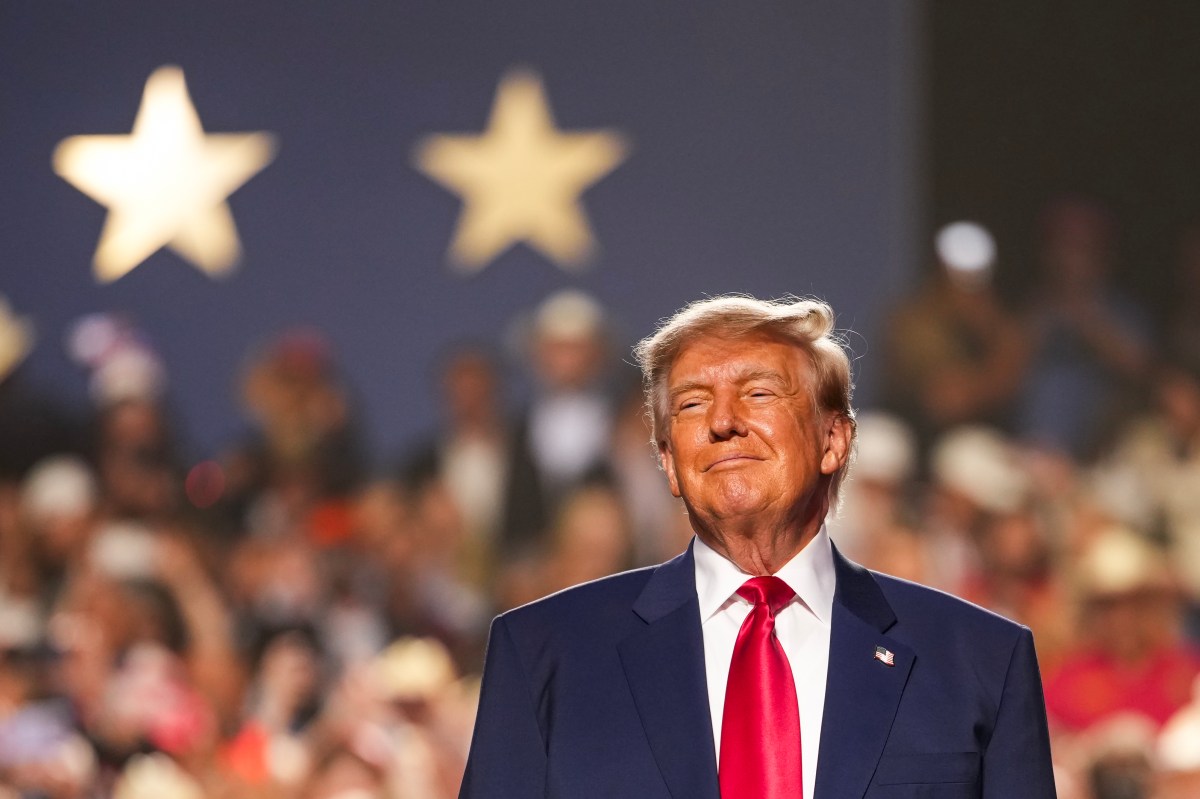
At the Republican National Committee's midterm convention in Dallas earlier this month, Trump urged supporters to act as though he himself were on the ballot this November, further tying Republican candidates to perceptions of his presidency.
"Pretend that I'm on the ballot. I'm on the ballot, just one more time," Trump told the crowd.
A Marquette Law School survey found 37 percent of adults approved of Trump's job performance and 63 percent disapproved, the weakest result of his second term in the poll. The same polling environment has contributed to broader concerns about Republican prospects in November.
The survey also found Democrats leading Republicans 54 percent to 41 percent on the congressional ballot among likely voters.
Other polls have produced somewhat different numbers while reaching a similar conclusion. A recent Fox News survey found Trump's job approval rating at 39 percent, while a Reuters/Ipsos poll put it at 35 percent.
Both were national surveys of voters, indicating Trump's challenges are not confined to a single battleground state or region.
Both surveys found a majority of voters disapproved of Trump's performance.
When Republicans entered 2026, many expected the election to focus on border security, immigration and public safety, issues where the party historically performs well.
Instead, much of the national conversation has centered on pocketbook concerns.
Polls have consistently shown inflation and the cost of living among voters' top concerns. The Marquette Law School survey found inflation and the cost of living were the country's top concerns, cited by 37 percent of respondents. Many Americans continue to report paying more for groceries and gasoline than they did earlier in the year, creating a difficult political environment for an administration struggling to convince voters that economic conditions are improving.
The Iran war has also emerged as a political complication.
A recent Fox News poll found a majority of voters believe U.S. military action against Iran was the wrong decision, while nearly three-quarters said the administration lacks a clear plan for ending the conflict. Even if foreign policy ranks below economic concerns, such findings suggest voters remain skeptical about one of Trump's most consequential decisions since returning to office.
Perhaps the greatest warning sign for Republicans isn't what core Trump supporters think. It's what appears to be happening with voters in the middle.
An August I&I/TIPP national survey found Trump's approval rating among independents fell from 29 percent to 26 percent while disapproval rose from 59 percent to 61 percent, highlighting concerns about a voting bloc that often helps decide close races.
The consequences are already visible.
Gonzales said Democrats do not necessarily need a wave election to make major gains. Instead, he argued that Republican weaknesses have opened opportunities in places that were not expected to be competitive earlier in the cycle.
Gonzales added that "the president's poor job approval rating has laid the foundation for Democrats to win in states where they normally don't have any business competing.”
North Carolina, one of the most important Senate battlegrounds in the country, has produced a string of surveys showing Democrat Roy Cooper ahead of Republican Michael Whatley. In Texas, Republicans are suddenly being forced to spend time defending races they likely expected would be less competitive.
None of this means Democrats are destined to win.
Republicans continue to hold advantages in many individual races. The party remains competitive on immigration and border security, issues that remain important to large segments of the electorate. Trump also retains a loyal political base capable of reshaping turnout dynamics in ways conventional polling sometimes struggles to capture.
Political scientists caution that disapproval of a president does not necessarily translate into votes for the opposing party.
"Voting for a Democratic alternative is a higher bar than stating lack of approval," Grant Reeher, a political science professor at Syracuse University, recently told Newsweek. "But it suggests more about potential turnout effects than vote choice. And in a midterm, that's really important."
Republicans argue that Trump's political strengths will outweigh concerns about his approval ratings.
"President Trump cut taxes, lowered prescription drug costs, and secured our border, and he energizes Republican voters like no one else," Natalie Baldassarre, the Republican National Committee's national press secretary, told Newsweek on Saturday.
Baldassarre said Republican candidates would campaign on what she described as Trump's achievements while drawing contrasts with Democratic policies.
The White House has also argued that polling does not reflect the full impact of Trump's agenda. In a previous statement to Newsweek, White House spokesperson Davis Ingle said: "No other president in history has accomplished more for the American people than President Trump, who is working tirelessly to create jobs, cool inflation, increase housing affordability, and more."
Ingle added that Trump's agenda was still taking effect and that the administration had already made "historic progress" both domestically and internationally.
Republicans also point to the party's advantages on immigration and border security, as well as Trump's ability to energize core supporters, as reasons they remain confident about November.
Presidential approval ratings can shape the political environment, but they do not determine election outcomes on their own. Candidate quality, turnout, fundraising and local issues will also play important roles in many of the races that decide control of Congress.
The most important indicator may not be whether Trump's approval rating rises or falls by a few points.
Instead, Republicans will be watching for signs that dissatisfied supporters remain motivated enough to vote.
A president can be unpopular and still help his party if supporters show up. But if concerns about the economy, inflation and foreign policy cause some Republicans to stay home, even marginal changes in turnout could have significant consequences in closely contested races.
Democrats, for their part, are hoping the election becomes exactly what midterms often become: a judgment on the party in power.
With 45 days remaining, the central question is no longer whether Trump will dominate the political conversation. He already does.
The question is whether voters will reward him for it.