Doublespeak in US sanctions law: No Russian oil for others, exception for its own uranium imports - The Indian Express
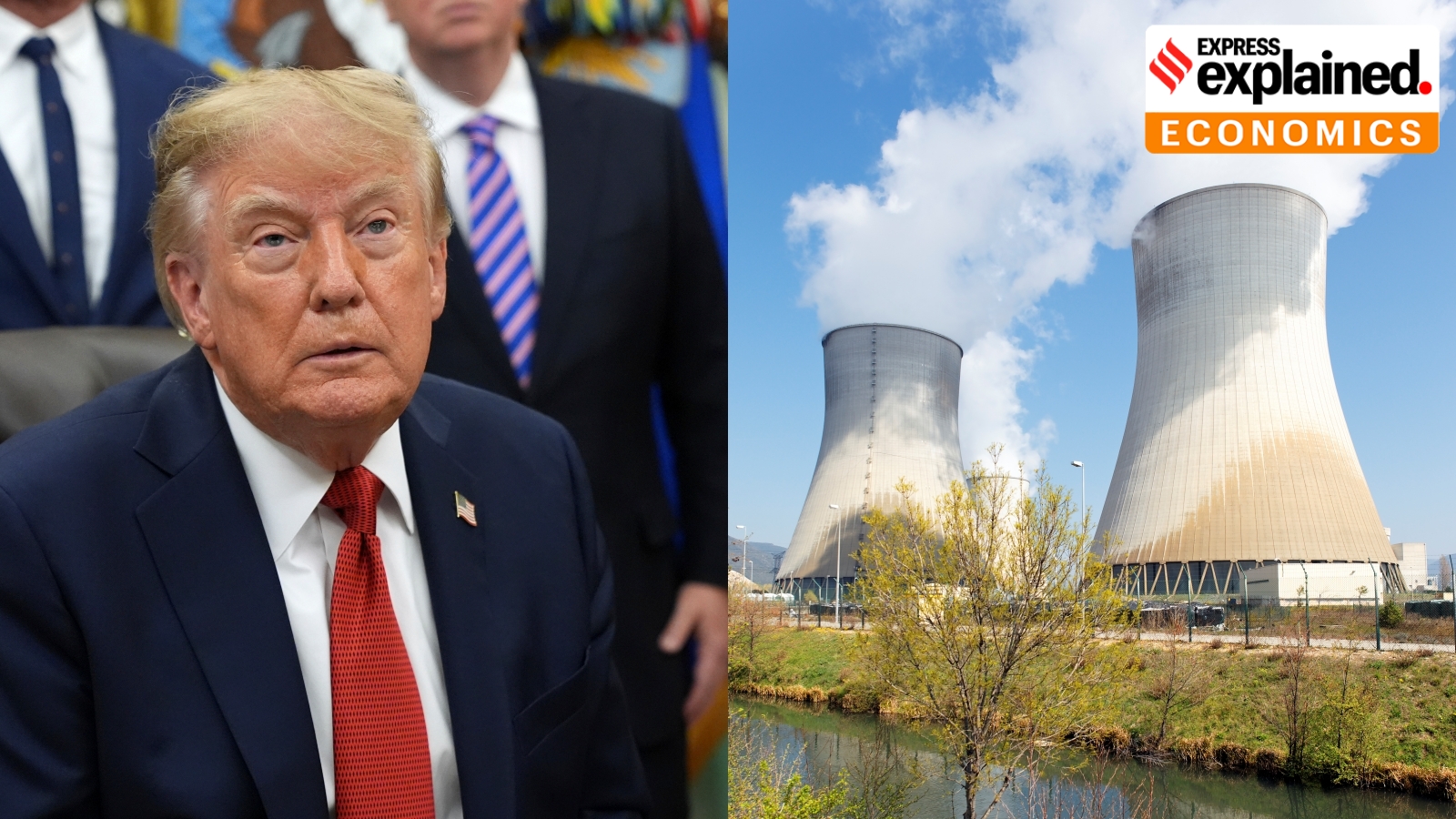
US President Donald Trump Friday signed into law the ‘Lindsey O. Graham Sanctioning Russia and Iran Act of 2026’, giving himself the authority to impose tariffs of up to 100% on top importers of Russian oil and gas, such as China and India.
For India, the development comes at a particularly sensitive time, with the India-US bilateral trade agreement negotiations in their final leg. Trade policy circles in India believe the new law could provide the Trump administration with an additional lever to exert pressure on New Delhi during the negotiations. The timing is also significant as it comes days ahead of Chinese President Xi Jinping’s scheduled visit to the US, which would be his first visit to the White House in a decade.
The law is designed to squeeze Russia’s energy revenues amid its war in Ukraine. But it also creates an exception to ensure that the US can continue to import from Russia a material that is crucial for its nuclear power industry — low-enriched uranium (LEU).
“Exception for certain imports of low enriched uranium for nuclear reactors – this title shall not apply with respect to imports into the United States of low-enriched uranium described in paragraph ..” the law says.
This lays bare the central contradiction at the heart of the US’s words and actions against Russia. As the US has been forcing developing countries to move away from Russian oil, it has been steadily increasing uranium imports from Russia even after the Ukraine war.
Russia is one of the US’s biggest sources of enriched uranium. In 2025, the US imported enriched uranium worth $1.02 billion from Russia, or 23.42% of its total enriched uranium imports for that period, according to data from US International Trade Commission (USITC).
Since the Russia-Ukraine war began, US imports increased by 23.75%, from $829.75 million in 2022 to $1.02 billion in 2025.
Apart from Russia, other countries from which the US imported enriched uranium in 2025 include UK at $1,352.72 million, France at $886.47 million, the Netherlands at $648.68 million, Germany at $307.65 million, China at $118.48 million, Japan at $30.59 million and Belgium at $12.61 million.
Uranium found in nature consists largely of two isotopes — U-235 and U-238. Natural uranium contains 0.7% of the U-235 isotope, while the remaining 99.3% is mostly the U-238 isotope, which does not contribute directly to the fission process.
Energy production in nuclear reactors comes from the “fission”, or splitting, of U-235 atoms, which releases energy in the form of heat. Since natural uranium contains only 0.7% U-235, LWRs require uranium to be “enriched” — which means raising the concentration of U-235 relative to U-238 to sustain a fission chain reaction.
According to the US Energy Information Administration, the existing US commercial fleet of 96 large light water reactors requires about 2,000 metric tonnes of uranium (MTU) of low-enriched uranium per year, representing approximately 15 million Separative Work Units — the standard unit of measurement that represents the amount of effort or work needed to separate uranium isotopes during the uranium enrichment process.
This is because nuclear reactors in the US are based on light water reactor (LWR) technology, which uses light water, or ordinary water, to cool and moderate the reactor. These LWRs require low-enriched uranium in its fuel, in which uranium is enriched from 0.7% to 3-5% U-235. This is mainly because light water absorbs some neutrons that would otherwise sustain fission.
But the US itself has very limited enrichment capacity and depends heavily on imports to run its 98 gigawatt-electric nuclear fleet comprising 96 LWR reactors.
With respect to LEU supply, in 2024 the US imported about 81% of the LEU needed to meet commercial nuclear power demands, according to the US Energy Information Administration, and about 20% of total U.S. LEU demand was sourced from Russia that year. Global uranium enrichment capacity is also highly concentrated. According to the International Energy Agency, 99% of the global enrichment capacity is concentrated in four suppliers, with Russia accounting for 40% of global enrichment capacity.
Others include China National Nuclear Corporation at 15%, Urenco, a British-German-Dutch consortium, at 33%; and France’s Orano at 12%.
Even though China buys more Russian crude than India, trade policy circles in India believe Washington may put greater pressure on New Delhi, partly because it could be wary of potential retaliation from Beijing.
There is precedent for such an approach. In August 2025, the US imposed an additional 25% tariff on Indian goods over India’s purchases of Russian oil, while China was spared a similar measure. The additional tariff on India was withdrawn only in February 2026.
While India had not signed a trade agreement with the US, both countries had reached a deal in February and had also released a joint statement. Besides, New Delhi has been opening the market in some sectors of US interest during the last several months.
India has so far agreed to several US demands as part of the trade deal, particularly in the digital sector. Most prominently, during the last Union Budget, the government announced a tax holiday to foreign companies for setting up data centres in the country until 2047, seemingly acting on a key US demand.
Last year, the government had abolished the 6% ‘Google tax’ amid tariff pressure as the US said that digital services taxes are against its tech companies — the likes of Apple, Amazon, Google and Facebook. India has also stepped up energy imports from the US, opened its nuclear sector and reduced duty on a range of items of US interest.
The US has also shown accommodative signs. In July, the US imposed 10% tariffs on India, lower than the 12.5% rate proposed in March when the United States Trade Representative (USTR) identified 60 countries under Section 301 of the US Trade Act, citing imports of goods produced with forced labour.
The Ministry of External Affairs (MEA) said on Thursday that the government remains committed to ensuring the nation’s energy security “through diversified sourcing and based on evolving market dynamics”. It said in a statement that the proposed legislation’s implications for the India-US relationship as well as the global energy market have been flagged in discussions with US representatives.
Experts said that for New Delhi, meaningfully reducing Russian oil imports is just not an option in the prevailing circumstances of global energy supply tightness amid the West Asia crisis. Even for Washington, taking away millions of barrels of Russian oil from the global market when energy flows from West Asia remain highly constrained wouldn’t be prudent.
According to vessel tracking data from commodity market analytics firm Kpler, India imported 2.08 million barrels per day (bpd) of Russian oil in August, accounting for 45% of the country’s total oil imports. The share was even higher, at over 50%, in the preceding two months.
Ravi Dutta Mishra is a Principal Correspondent with The Indian Express, specializing in economic policy and financial regulations. With over five years of experience in business journalism, he provides critical coverage of the frameworks that govern India's commercial landscape. Expertise & Focus Areas: Mishra’s reporting concentrates on the intersection of government policy and market operations. His core beats include: Trade & Commerce: Analysis of India's import-export trends, trade agreements, and commercial policies. Banking & Finance: Covering regulatory changes and policy decisions affecting the banking sector. Professional Experience: Prior to joining The Indian Express, Mishra built a robust portfolio working with some of India's leading financial news organizations. His background includes tenures at: Mint CNBC-TV18 This diverse experience across both print and broadcast media has equipped him with a holistic understanding of financial storytelling and news cycles. Find all stories by Ravi Dutta Mishra here ... Read More