
DR Congo politician killed after radio appearance on Ebola prevention
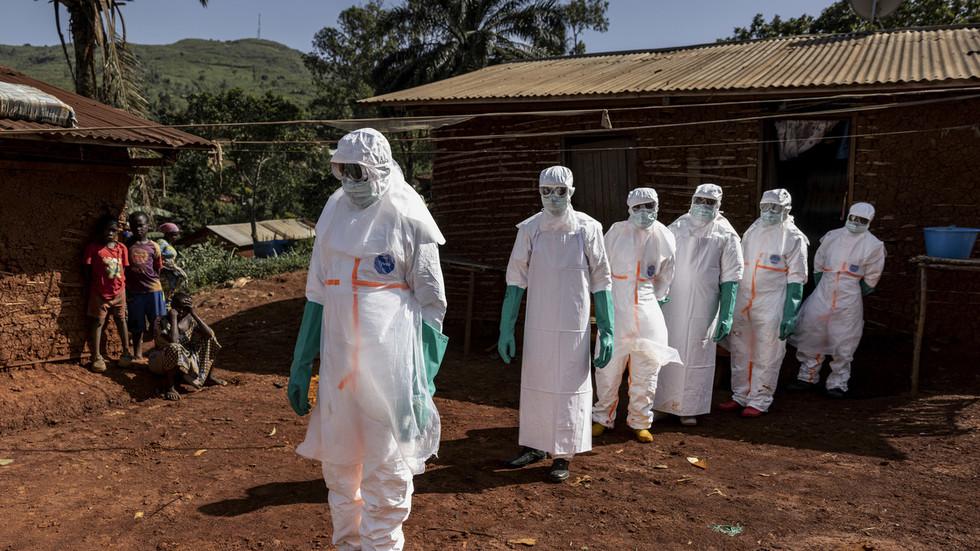
FILE PHOTO. © Michel Lunanga / Getty Images An official from the Democratic Republic of the Congo’s ruling party has died after being attacked following a radio appearance in the Ebola-hit eastern city of Butembo, local media reported on Monday.
Marie-Celestin Karondwa, a spokesperson for the Union for Democracy and Social Progress (UDPS) in Butembo, was assaulted on Sunday and later died from his injuries, the Congolese Press Agency (ACP) reported, citing a party statement. His property was also looted and his home set on fire.
As quoted by Reuters, the party said he was “an innocent victim for having defended the party’s position on the existence of the Ebola virus disease... and the threat it poses to the population.”
The motive remains unclear, although the party has linked the attack to his public support for measures against Ebola. The UDPS called for an investigation and for those responsible to be brought to justice.
READ MORE: Ebola outbreak: Is the US panicking with new travel bans? The killing comes amid resistance to the Ebola response in eastern DR Congo. The World Health Organization (WHO) has said insecurity and attacks on health facilities are complicating efforts to contain the outbreak by restricting access for response teams, disrupting surveillance and discouraging people from seeking care.
The WHO recorded 12 attacks on health care between the declaration of a public health emergency of international concern on May 17 and mid-August, with additional incidents under verification. Similar resistance has hampered efforts to contain previous Ebola outbreaks in the region.
The Ebola response is also being complicated by insecurity and mass displacement. The WHO has said conflict is restricting access for response teams and hampering disease surveillance, contact tracing, and access to care.
The DR Congo’s mineral-rich east has been plagued by decades of violence, with dozens of armed groups, including M23, fighting Congolese forces for power and control of resources such as gold and coltan. Clashes escalated in early 2025, killing thousands and forcing large-scale displacement, according to UN agencies. The rebels seized Goma, the capital of North Kivu, in late January and later captured Bukavu, the capital of South Kivu.
Ceasefire efforts have repeatedly faltered, including Qatar-facilitated talks in Doha. Congolese authorities have long accused Rwanda of supporting the militants, allegations backed by a UN panel of experts. Kigali has denied the claims. The accusations have strained Rwanda’s relations with Western partners, including Belgium. In March, Kigali severed diplomatic ties with Brussels, accusing it of harboring “neo-colonial delusions” and interfering in the conflict.
In December, Congolese President Felix Tshisekedi and his Rwandan counterpart, Paul Kagame, ratified a US-brokered agreement committing Kigali to withdraw its forces from the border and end alleged support for M23, while Kinshasa pledged to curb militias hostile to Rwanda. US President Donald Trump has said the pact, which includes calls for a joint security mechanism, gives Washington rights to local mineral wealth. The fighting has continued despite Trump’s claims that he ended the decades-long conflict.
The outbreak has meanwhile continued to grow. As of September 27, DR Congo had recorded 8,116 confirmed cases and 3,924 deaths, according to the country’s National Institute of Public Health (INSP). The case fatality rate stood at 48.3%.
READ MORE: Russia continues Ebola response in Uganda The disease is caused by the Bundibugyo species of Ebola virus. There is currently no approved vaccine or specific treatment for the strain, although candidate vaccines and treatments are being studied, according to the WHO.
Russia has provided assistance to countries affected by the outbreak. Rospotrebnadzor has sent specialists to Uganda and supplied Russian-developed PCR diagnostic tests to Uganda, DR Congo, and the Republic of Congo.
In July, Russian Foreign Minister Sergey Lavrov said Moscow was prepared to establish mass production of a vaccine adapted to the Bundibugyo strain once it obtained the necessary biological material.
This website uses cookies. Read RT Privacy policy to find out more.


