Electoral court exposes ANC's incompetence as party fails to submit crucial documentation - IOL
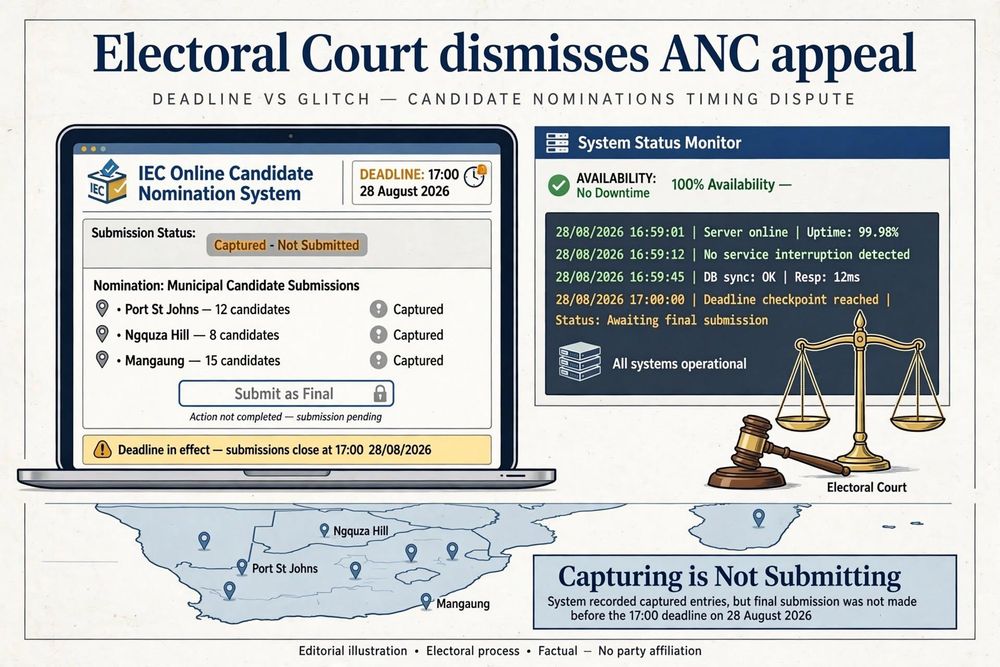
The Electoral Court has rejected the ANC's appeal against the IEC, highlighting serious administrative failures within the party. With potential candidates excluded from the November ballot, the implications for the ANC and South Africa's electoral integrity are profound.
The Electoral Court has done South Africa a service. On Wednesday, 16 September 2026, it dismissed the African National Congress's appeal against the Independent Electoral Commission and upheld the IEC's refusal to treat an incomplete nomination as a completed one.
The Court confirmed what the Commission had already established on the facts: there were no computer glitches, no offline time, and no mysterious vanishing of data on the IEC's side. The ANC simply failed to meet a deadline that every other serious contestant had known about for months. For that clarity, and for the Court's refusal to rewrite the electoral rules to rescue a governing party from its own sloppiness, the country should be grateful.
The facts are not complicated, however much Luthuli House has tried to wrap them in fog. Political parties had until 17:00 on 28 August 2026 to submit ward nominations and proportional representation lists through the IEC's Online Candidate Nomination System. The ANC captured information for 181 candidates in six municipalities, Port St Johns, Ngquza Hill, Walter Sisulu and Sundays River Valley in the Eastern Cape, uMshwathi in KwaZulu-Natal, and Mangaung in the Free State, but did not complete the system's final submission step. Capturing is not submitting. Uploading documents is not pressing "submit as final." The IEC said so. The Electoral Court has now said so. That should have been the end of the matter.
Instead, the ANC did what it does when it fails: it invented a villain. Secretary-General Fikile Mbalula marched to the microphones with the now-familiar routine — technical glitches, a system that supposedly "did not capture" three percent of the party's lists, a Commission allegedly sitting on information already in its possession. He even suggested that the ANC was not asking for special treatment, while asking a court to treat an unfinished online process as if it had been finished. This is not argument. It is the pass-the-buck reflex in its purest form: blame the IEC, blame the button, blame anyone except the organisation that had weeks to complete a basic administrative task and still managed to botch it.
The IEC's own digital trail undercut that story. Server logs showed one hundred percent availability. There was no downtime. ANC officials were still successfully submitting lists for other municipalities in the final minutes before the cut-off, including submissions recorded at 16:56 and 16:57. A system that accepts a list at 16:57 is not a system that has collapsed. What collapsed was the ANC's internal discipline. Tellingly, Mbalula was later forced to concede that the party's own lists contained inaccurate and unverified identity numbers.
The so-called glitch was, in truth, the ANC's own administrative wreckage: last-minute factional horse-trading, unverified branch data, and a Secretary-General more interested in performing outrage than in running a competent nominations process.
I say this not as a distant commentator, but as someone who spent years inside that organisation at the highest communications level. I watched the slow rotting of the ANC's administrative capability, and with it the collapse of its moral and ethical centre. Factionalism and personal self-interest replaced the interests of the movement, and, more importantly, the interests of the country — as the first priority of too many leaders. Lists became weapons in internal wars. Positions became spoils. Deadlines became optional for those who imagined that incumbency would always rescue them. The culture that once prided itself on organisational seriousness gave way to cover-up, late-night panic and public denial. What the Electoral Court has recorded in six municipalities is only the latest, and most humiliating, expression of that decay.
The same decay is written on the walls of the ANC's own headquarters. Luthuli House is not the nerve centre of a governing party. It is a physical confession of the rot, a building in disrepair and neglect, while the people who occupy it still demand the right to govern a republic. Administrative capacity is not an abstract slogan. It is the ability to run a building, meet a deadline, finish a form, and tell the truth about a failure. A party that cannot run Luthuli House, and cannot run even small local government authorities, has little basis on which to claim any wider authority at all.
A party that cannot organise its own candidate lists has no credibility standing before communities and asking for their votes. South Africans should read this ruling for what it is: further confirmation that the ANC cannot be trusted with the basic administrative competence required to run local government, let alone the country. The same organisation that could not complete an online form by 17:00 is the organisation that has run municipalities into insolvency, left communities without water, electricity and sanitation, and answers every audit finding with another press conference about "capacity constraints." Failure first, blame second: that is the method. When Eskom collapsed, the ANC blamed sabotage and the weather. When municipalities failed to pay creditors, it blamed "inherited challenges." When lists were not finalised, it blamed the IEC.
Blame has become the golden thread running through the party's response to every failure, not an occasional lapse in a bad week, but a method. Point at the Commission, the courts, the weather, a third force, anyone except the people who actually failed. That is why Mbalula's conduct in this episode deserves particular condemnation. The Secretary-General of a party that still imagines itself the leader of society has spent weeks performing indignation instead of accepting responsibility. He accused other parties of "snitching" when they insisted that the same rules apply to everyone. He treated the integrity of an election timetable as if it were a private ANC family dispute, and spoke as if clicking a button were an obscure legal mystery rather than the last step in a process the IEC had published, explained and left open for weeks. None of it changes the record: the ANC missed the deadline.
In long-held Eastern Cape strongholds such as Port St Johns and Ngquza Hill, the ANC now faces the prospect of having no candidates at all on the 4 November ballot. In Mangaung, uMshwathi, Walter Sisulu and Sundays River Valley, its proportional representation lists have been excluded. That is not a technicality inflicted by a hostile Commission. It is the price of treating administration as an afterthought while leaders fight over slates, patronage and personal advancement. A liberation movement that once organised underground networks under apartheid conditions cannot, in 2026, finish an online nomination on time. That sentence should shame every honest person still wearing ANC colours. It should also instruct every voter.
Because if Luthuli House cannot administer six municipal lists, why should anyone believe it can administer a metro budget, a water treatment works, a defence force, or a national energy system? The Auditor-General's reports have already answered that question in the language of irregular expenditure, disclaimed audits and collapsing service delivery. The Electoral Court has now answered it in the language of electoral law. A party that cannot keep its own headquarters in order, and that answers every exposed failure with another excuse, has a diminishing claim on public trust.
This ruling should not be spun away by another Mbalula briefing. Electoral deadlines exist so that elections remain free, fair and equal, and so that no incumbent can stroll past a cut-off that binds everyone else. The Court, by dismissing the appeal and granting the DA leave to intervene, has protected that principle. The IEC, by refusing to reopen a closed process and placing its server evidence before the Court, has done its job. Parties that met the deadline, including the Economic Freedom Fighters, which submitted its candidates and is ready to contest wards across the country, were entitled to that certainty. Voters are entitled to it too.
The ANC now says it will "exercise its legal rights" and pursue a further appeal. It is entitled to approach higher courts. It is not entitled to rewrite reality. No appeal can convert an unsubmitted list into a submitted one, manufacture downtime the servers show did not occur, or restore the administrative culture that factionalism has eroded. The honest course would be to apologise to the candidates failed by their own party, confront the disarray at Luthuli House, and stop deflecting from its own failures. That course seems unlikely to be taken.
South Africa does not need another decade of this. Communities that queue for water, sit in darkness and watch councillors fight over tenders have already paid for ANC incompetence. They should not pay again because a party unable to keep even its own headquarters in order could not get its officials to complete an online form. The Court's decision is an indictment: the governing party cannot even govern itself. Voters now have one more documented reason to hold it to account on 4 November.
* Ambassador Carl Niehaus is an EFF Member of Parliament.