Electricity VAT here to stay despite 165% tariff surge - IOL
VAT charged on electricity supplied through government's Free Basic Electricity programme is effectively taxing a grant.
South Africans will continue paying VAT on electricity despite tariffs having surged by as much as 165% over the past decade, with Treasury saying zero-rating remains off the table.
National Treasury says removing VAT from electricity is not on the agenda, even as rising tariffs place increasing pressure on household budgets.
Electricity prices have increased 101% since 2021 and by up to 165% over the past decade, according to DebtBusters. Treasury says it is aware of the increases but has not specifically assessed the impact of VAT on electricity costs for lower- and middle-income households.
“National Treasury is aware of the electricity tariff increases over the past few years but has not specifically done an assessment of the impact of VAT on electricity for lower- and middle-income households,” it says.
Treasury argues that maintaining a broad VAT base is important for the efficiency of the tax system and that zero-rating electricity would result in lost revenue. The electricity, gas and water sector contributed about R22.21 billion in net VAT during the 2024/25 financial year, according to the South African Revenue Service's 2025 Tax Statistics.
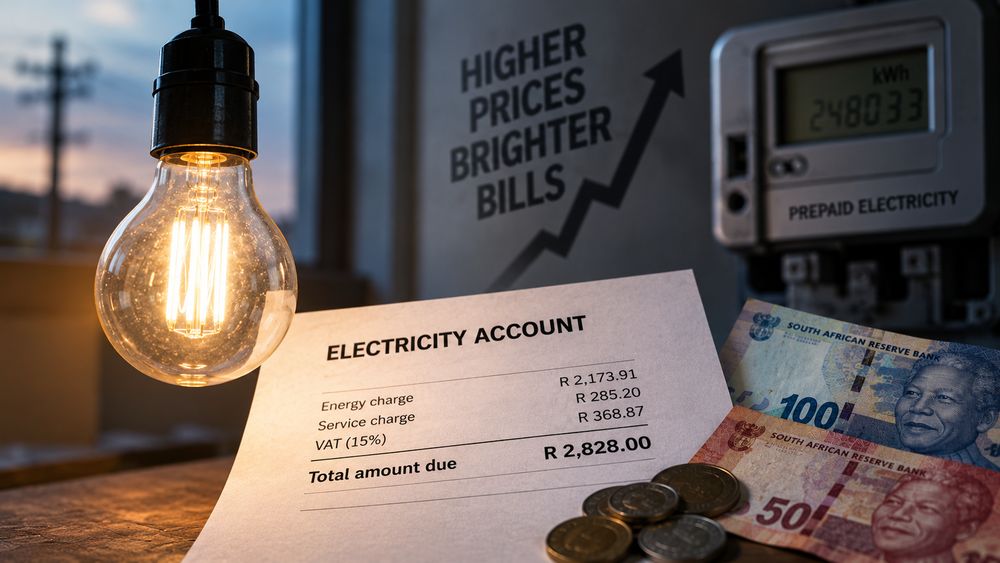
For households, VAT adds R150 to every R1,000 spent on electricity. A household buying R3,000 of electricity a month pays R450 in VAT, or R5,400 over a year. EnergyBee estimates a typical three-bedroom South African family home uses between 700kWh and 900kWh a month, costing roughly R2,900 to R3,750 in summer at around R4.17/kWh.
The uMkhonto weSizwe (MK) Party is among those calling for electricity to be added to the basket of goods that are zero-rated for VAT. MK MP Crown Prince Adil Nchabaleng says the party raised the proposal with Treasury during last year's debate over increasing VAT.
“We have outrightly stated very clearly that we would like to see electricity as a zero VAT-rated item in the basket of items that are zero VAT rated,” Nchabaleng says. He argues VAT adds to the burden on households already struggling with electricity costs.
“I don’t think it makes any sense to have electricity charged VAT, given the fact that we have an ailing economy that has not yet performed,” Nchabaleng says.
National Treasury says removing VAT from electricity is not on the agenda, even as rising tariffs place increasing pressure on household budgets.
Nchabaleng also questions charging VAT on electricity supplied through the government's Free Basic Electricity programme, describing it as effectively taxing a grant.
Organisation Undoing Tax Abuse executive director Advocate Stephanie Fick says the organisation does not have a definite position on removing VAT from electricity, but says power “should attract VAT unless you argue that it is an essential service and should be exempt.”
The difficulty is the effect on state revenue. “The state will lose a lot of income it can’t afford. If we were an effective state, it is definitely something to consider,” Fick says.
Treasury has not calculated the current cost to the fiscus of zero-rating residential electricity. It has also not modelled alternatives such as removing VAT only from the first 50kWh, 100kWh or 200kWh used each month.
The question of VAT relief on electricity dates back to the introduction of VAT in 1991, when a committee considered zero-rating a basic amount of electricity but concluded support for poorer households should instead be delivered outside the tax system.
Treasury revisited the issue in 2007. Its analysis found zero-rating electricity would disproportionately benefit higher-income households because they consume more electricity and would therefore receive a greater share of the tax saving.
An independent panel reviewing the zero-rated basket reached essentially the same conclusion in 2018 after receiving submissions calling for electricity to be included. Government has instead continued to rely on Free Basic Electricity to provide relief to poorer households.
Qualifying indigent households receive 50kWh a month, with R21.6 billion allocated for basic energy in the 2026/27 Budget. However, Treasury says an intergovernmental working group is considering whether the 50kWh allocation remains adequate.
It cautions that increasing the allocation would not necessarily solve the problem because many households that already qualify are not receiving their full entitlement due to weaknesses in registration, targeting and delivery systems.