Ethiopia’s fragile peace deal falters as civil war looms
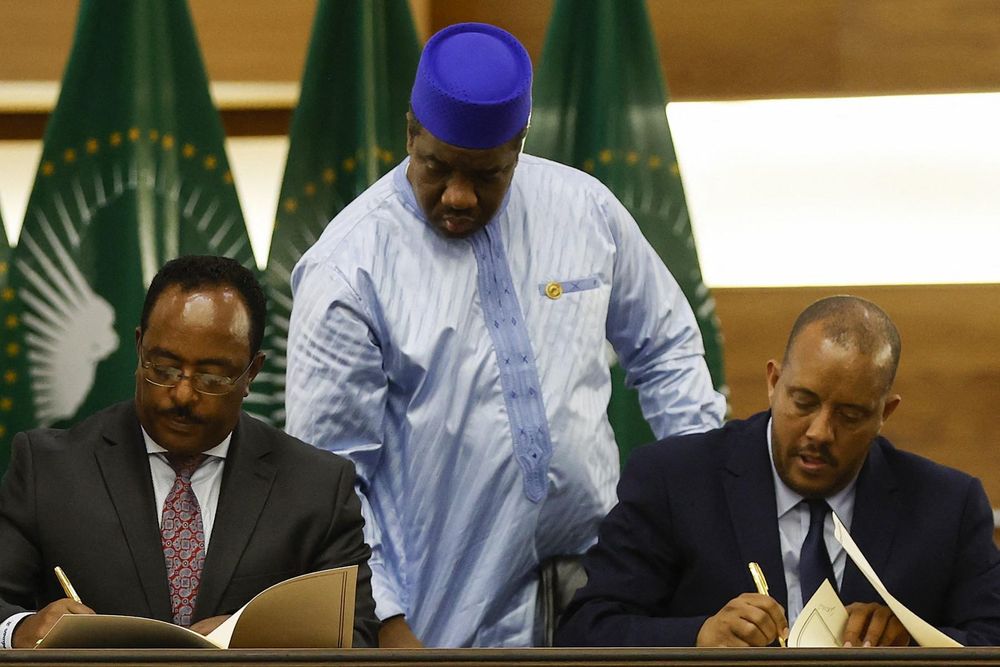
Redwan Hussein (left), representative of the Ethiopian government, and Getachew Reda (right), representative of the Tigray People's Liberation Front (TPLF), sign a peace agreement between the two parties in Pretoria on November 2, 2022. The 2022 African Union-facilitated Pretoria agreement ended two years of ravaging war but did not bring lasting peace, says the writer.
Unresolved conflict is flaring up and pushing Ethiopia into a new war. Former adversaries have joined forces against Prime Minister Abiy Ahmed's government. Fighting that began in Tigray has spread into neighbouring Amhara and Afar and continued through the last week of September.
On 20 September 2026, seven opposition and armed groupings formed the Ethiopian Peoples' Forces Alliance for Survival. They declared their intention to remove Abiy's government and replace it with an inclusive transitional authority.
The alliance comprises the Tigray People's Liberation Front (TPLF), the Amhara Fano National Movement, the Oromo Liberation Army, the Ogaden National Liberation Front, the Afar Revolutionary Democratic Unity Front (Ugugumo), the Benishangul Peoples' Liberation Movement, and the Gumuz Peoples' Democratic Movement.
During the 2020–2022 Tigray war, Tigrayan and Amhara forces fought each other, while Fano fought alongside the federal government against the TPLF. Fano later turned on Addis Ababa. The Oromo Liberation Army has fought a lengthy armed struggle against the Ethiopian state in Oromia.
Now, former battlefield enemies sit at the same table to unseat Abiy. The alliance is a tactical coalition of convenience. Their territorial ambitions, political traditions and visions for Ethiopia differ.
A new armed alliance does not automatically mean Ethiopia has entered another full-scale civil war on the scale of 2020–2022. It is, however, a clear warning that the fragile peace negotiated in Pretoria in November 2022 is not holding.
Fighting is under way. On 22 September, federal airstrikes and drone attacks hit targets in southern Tigray. On 23 September, Tigrayan forces seized the airports in Mekelle, Axum and Shire. Tigrayan forces and Fano fighters have clashed with federal troops in Amhara. Tigrayan units advanced into parts of Afar. Communications have been disrupted in Tigray and parts of Amhara.
Médecins Sans Frontières has reported that hospitals in Korem and Alamata received over 420 war-wounded between 22 and 25 September, while Suhul Hospital in Shire received more than 300. Forced recruitment, including of children, has been reported.
By 27–28 September, federal forces claimed to have regained Sekota in Wag Hemra after Tigrayan-aligned fighters entered the town on 25 September. Tigrayan forces claimed control over Erebti; that report has not been independently confirmed. Ethiopia's army said it had killed 272 Tigrayan fighters in North Wollo. The figure has not been verified.
United Nations High Commissioner for Human Rights Volker Türk called for immediate de-escalation to avoid a return to full-scale war. Multiple armed groups, unresolved territorial disputes and rival political authorities can easily ignite a wider war.
The 2022 African Union-facilitated Pretoria agreement ended two years of ravaging war between the federal government and the TPLF. The ceasefire succeeded in halting hostilities. It brought a measure of disarmament and greater humanitarian access. Essential services were restored, and a transitional political process was pursued.
However, it did not bring lasting peace. Nor did it address territorial disputes or issues of identity, political power, and sovereignty. The status of disputed territories, particularly Western Tigray, remains unresolved. Displaced people have yet to return home.
Disarmament is still the unfinished business of war. There has been little accountability for war atrocities. The relationship between Addis Ababa and Tigray has never healed.
Political tensions rose sharply this year. In May, the TPLF restored the regional legislative council that existed before the war and reinstated its chairman, Debretsion Gebremichael, as regional president.
June's election did little to resolve Ethiopia's legitimacy problem. Some opposition parties boycotted the vote. Abiy's Prosperity Party won a majority of parliamentary seats in a deeply flawed election.
Voting did not take place in Tigray and was unavailable in parts of Amhara and Oromia because of insecurity. The result may have given Abiy another parliamentary majority. It is a hollow victory. He still lacks a national mandate.
Ethiopia is central to the Horn's security and economy. The consequences of renewed war will extend far beyond Tigray. Escalation will threaten routes linking the country to Djibouti, its major maritime trade corridor.
Wider conflict will drive forced migration toward Sudan and other neighbouring states. It could also inflame existing regional disputes, especially given Ethiopia's tense relationship with Eritrea and its unresolved disputes with Sudan.
Ethiopian officials have accused Eritrea of funding and supporting forces opposed to Abiy's government. Eritrea has denied involvement. Tensions between Ethiopia and Eritrea remain high, especially as Ethiopia continues to pursue secure access to the Red Sea.
The United Arab Emirates has a heavy hand in Ethiopia's affairs. During the earlier 2020–2022 Tigray war, the UAE supplied an air bridge and drone assistance to the government. Now, as conflict is brewing again, Abu Dhabi has been quick to strongly condemn the TPLF offensive and express its solidarity with the federal government.
The danger is not only that the country could return to the conflict it purported to leave behind in 2022. It is that it could return to war with the same unresolved political questions, and with a more crowded field of armed actors.
Last week, Cameron Hudson, a former US official, called the alliance announcement "a starter's pistol for possible civil war." The first shots have been fired. Ethiopia could well erupt. A new rebel alliance, a collapsing ceasefire and external patronage are pushing Ethiopia — and the Horn with it — back into war.
A fragmented Ethiopia will reverberate through Eritrea, Sudan, Somalia and Djibouti. This is a continental emergency. War is no solution. Nothing less than a fair and sustainable political settlement that finally addresses the domestic disputes that fuelled the violence in 2020 and now again in 2026 will do.
External military patrons must also be frog-marched out of Ethiopia and the region. The Horn has a historical duty to protect itself from further fracture and militarisation.
* Kim Heller is a political analyst and author of No White Lies: Black Politics and White Power in South Africa.
** The views expressed do not necessarily reflect the views of the National Media Group.