Europe's Matterhorn dry as Swiss glaciers lose record ice in 2026
Swiss glaciers have lost more than 5% of their ice volume this year, marking one of their worst years of melting on record after a winter with little snow was followed by a summer of record heat.ONE YEAR! A lost battle against climate change (Morteratsch Glacier, Eastern Switzerland)Not "just a bit" of ice that is disappearing. The scale is massive and hard to believe, but image sequences like this are helping.Webcam @VAW_glaciology pic.twitter.com/mIRTrPWyKi— Matthias Huss (@matthias_huss) October 1, 2026
The Glacier Monitoring Switzerland (GLAMOS) and the Swiss Commission for Cryosphere Observation said glaciers lost 5.5% of their volume in 2026.
The loss was the second-largest on record, behind 2022.
Over the past five years, Swiss glaciers have lost nearly one-fifth of their ice, according to the latest assessment.
The findings come after Switzerland experienced its hottest summer on record, with June, July and August each setting monthly temperature records.A WINTER OF SCARCE SNOW AND HEAT
The severe melt was driven by two factors arriving one after another.
Winter snowfall was unusually low, leaving glaciers with a much thinner layer of snow to protect their ice from the summer sun.
That protective cover then disappeared early as repeated heatwaves swept across the Alps from May to September.
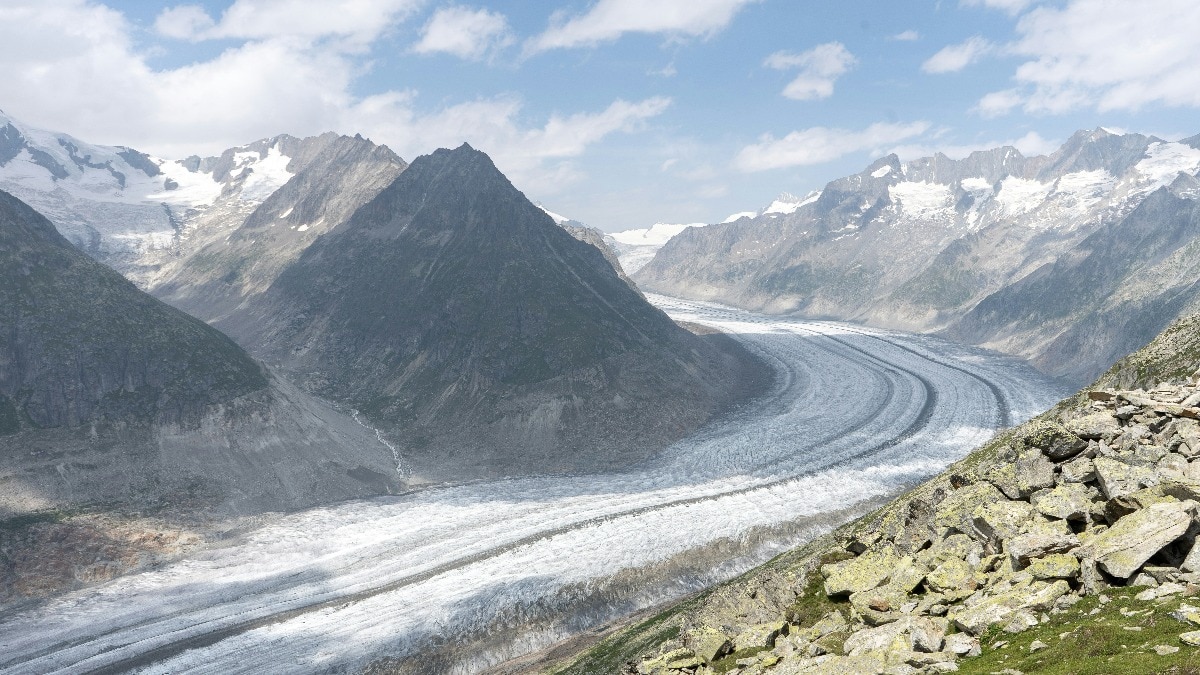
The famed Matterhorn Glacier is exceptionally dry and bare of snow due too, all thanks to record summer heat and low winter snowfall.
This particular lack of ice exposes rock, triggers rockfalls, and threatens Alpine glaciers as a whole. Head of Glacier Monitoring in Switzerland (GLAMOS) Matthias Huss poses on the Scex Rouge glacier. (Photo: Reuters)
"It was a very dry winter with too little snow. This means that the protective layer for the ice was limited and disappeared early in the season," Matthias Huss, director of GLAMOS, told Reuters. "And then we had these heatwaves extending from May to September with record temperatures."
The scale of the loss was visible even at high altitudes.
Huss said a 4-metre-long measuring stick placed into a glacier in late July was completely covered by ice. When researchers returned, more than 3 metres of the stick was exposed.
"It is clearly a catastrophic year, I would say this," Huss said. A drone view shows the melting of the Rhone glacier in Switzerland. (Photo: Reuters) 2.2 LAKH CRORES LITRE OF WATER LOST
Between July and September alone, Swiss glaciers lost about 2.2 lakh crore litres of water, more than four times the annual freshwater consumption of Swiss households.
"In total, for all Swiss glaciers, we estimate that glaciers have lost more than 2,000 billion litres of water this year. Difficult to imagine. It's more than four times the annual freshwater consumption of Swiss households," Huss said.
The melt can temporarily provide additional water during dry periods, but that benefit will diminish as the glaciers become smaller.
Switzerland's largest glacier, the Aletsch, recorded its biggest annual melt on record. The Glacier de Tsanfleuron also lost more than 4 metres of average thickness. The Rhone Glacier near Goms, Switzerland, is partially covered to slow down the melt. (Photo: Reuters)
Huss said the pace of change was becoming increasingly worrying.
"Over the last 10 years, the loss of Swiss glaciers is between 25 and 30%. If we compare this to a bit previously, for example, in the 1990s or around 2000, we lost normally about 10% per decade," he said. "We are seeing extreme years almost every year now, and this is really a worrying situation."- Ends