
France’s Last Corsetry Workshop: How Chantelle Saved a French Tradition - Le Figaro
Pour sauvegarder un article vous devez être connecté, vous pourrez ainsi les consulter sur tous vos appareils.
In Épernay, the family-owned company founded in 1876 has fought to preserve century-old techniques in France’s last major lingerie factory. Today, it is reviving an ambitious production effort, even welcoming some 60 brands seeking French manufacturing.
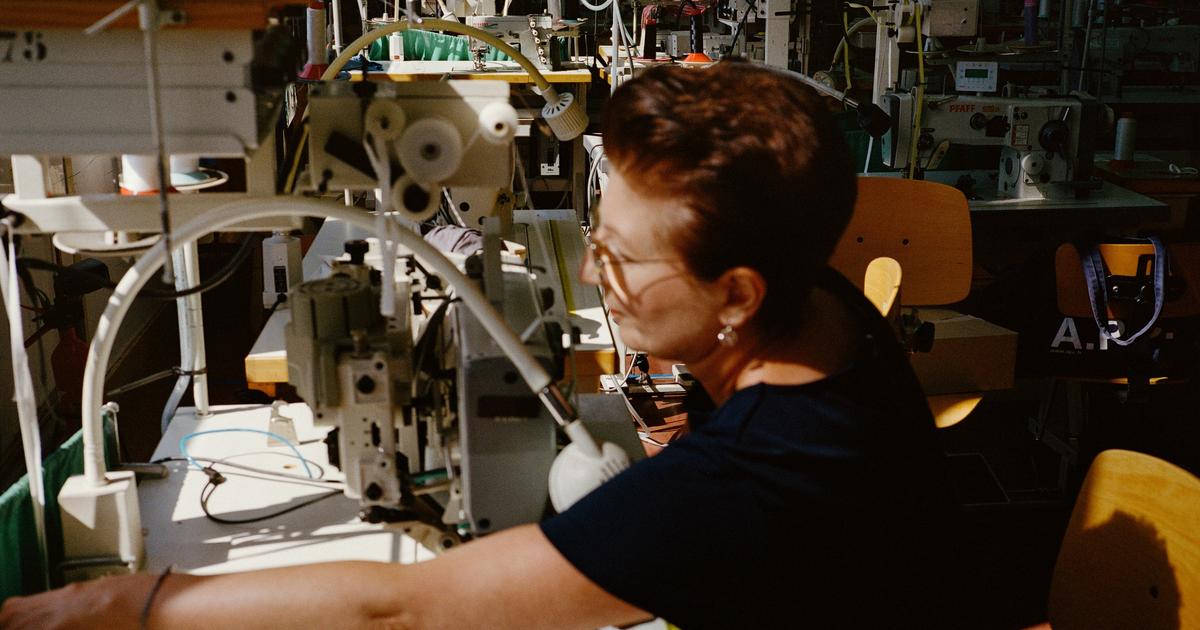
Conversations are hushed; movements are efficient. At the Chantelle factory in Épernay, in the Marne department of northern France, 85 seamstresses work without looking up, focused on a few millimeters of stitching or hand-cut lace. Here, no one rushes. Yet everything moves quickly. From one workstation to the next, a bra passes through some 40 pairs of hands.
The factory, which opened in 1962, is now the last corsetry workshop still in operation in France. A piece of French industrial history, it is a rarity at a time when textile manufacturing has largely left the country.
But to understand Épernay, you have to travel about a hundred kilometers south, to Romilly-sur-Seine. There, in 1876, the Kretz family laid the foundation for what would become the Chantelle lingerie brand by inventing an elastic knit fabric designed to make corsets less restrictive. Those corsets would give way to girdles, and then to bras.
Over the decades, the brand has supported women’s empowerment with several iconic models. First came the Fête line, symbolizing shapewear that had become more feminine; then Fleurs, with its floral lace and playful sheer details; followed by Champs-Élysées, recognizable by its bust-enhancing silhouette and glamorous look; and finally SoftStretch, whose patented technical fabric hugs the body like a second skin while providing an invisible shaping effect.
“Chantelle’s history can be told through six or seven designs,” says CEO Guillaume Kretz. “But also through powerful slogans such as ‘Chantelle, the girdle that never rides up’ in the 1960s, ‘Move, they won’t’ in 1970, or ‘Chantelle loves all breasts’ 10 years later.”
Kretz, who represents the sixth generation, continues: “These styles have stood the test of time because they have always met our customers’ needs. The proof is that many of them keep buying the same bra, sometimes for 50 years.”
The choice of Épernay was no accident. In 1962, the factory’s location in the city center, just a short walk from the train station, made it easy for the 250 seamstresses to get to work without needing a driver’s license. Sixty-four years later, while the machines have evolved and the number of seamstresses has dwindled, the heart of the craft remains intact.
On the cutting tables, a bra initially looks like a puzzle. More than 25 components — lace, tulle, elastic, underwires, hooks and straps — must be assembled. “A bra requires about 40 manufacturing steps,” says Delphine Chapelot, site director. “Each one requires its own specific equipment. It takes about three months to learn the basic techniques.”
Rolls of lace arrive from France, Italy or Switzerland. The materials are then cut, molded, assembled and inspected. In a largely automated apparel industry, lingerie production has resisted and still requires manual expertise. Even before manufacturing begins, workers position each lace pattern by hand to ensure symmetry.
“Once you know how to make French lingerie, you can practically do anything with your hands. Living fabrics stretch, shrink, and are constantly shifting. It is probably the most complex textile product to make,” Chapelot says.
At her machine, Anaïs guides an elastic trim with millimeter precision. A few workstations away, Laurence assembles the cups. Then, Isabelle sews a crosswise seam that will determine how the bust is supported. “I’ve been here for 42 years. I am retiring in a month… and I still haven’t grown tired of it,” she says with a smile.
These are skills that can no longer be learned elsewhere. Awarded an "Entreprise du Patrimoine Vivant" (Living Heritage Company, or EPV) designation in 2025, the facility now trains its new recruits in-house. “There are no longer any external training programs for corsetry. So our role is to pass on this expertise,” Chapelot says.
Although the factory had long since been transformed into a development center — where the latest designs were conceived before being manufactured in other group factories around the world — the market has changed. Just as “Made in France” was regaining its appeal, specialized workshops were disappearing.
“We thought it was a shame to keep such a facility solely for making prototypes. Six years ago, we revived production here in Épernay,” the director recalls. Today, the workshop manufactures Chantelle’s premium lines as well as those of some 60 French brands — from the newest to the most established — that have come here seeking “a living institution of French craftsmanship.”
This quest for perfection also explains the price of a Chantelle bra, which runs around €100. “The goal is not just to produce, but to reproduce — exactly and with the same high standards — the same model thousands of times. That is precisely what French craftsmanship excellence is all about.”
Innovation also involves a battery of tests. Prototypes undergo washing and durability cycles, as well as testing on the human body: employees go home each week with a tulle pouch containing prototypes still in development. They will wear them for several weeks before sharing their feedback with the design department. Straps that are too short, backs that ride up, underwires that dig in — nothing escapes their notice.
“We do not design a bra without thinking about the women who will wear it,” says Renaud Cambuzat, the creative director working to modernize the brand, notably through campaign imagery that is in tune with the times. “Lingerie is intimate. Comfort is essential, but it must never detract from femininity or seduction.”
SoftStretch embodies this philosophy. Launched 10 years ago and widely copied ever since, this ultra-stretchy line is designed to feel like a second skin and adapt to various body types. It has become a global success, with more than 10 pieces sold every minute.
“It is an extremely technical product that you completely forget you are wearing,” Kretz says. “Rather than simply meeting a need, our products have always been a step ahead of their time. SoftStretch was a revolution when it was created. Our independence, our own factories, and the in-house management of all our operations allow us to innovate and create.”
But the challenge is no longer just industrial. Over the past decade, habits have been changing: In France, 40% of women do not buy a new bra every year. “The challenge for Chantelle is to remain relevant while staying true to its heritage as a corset maker, with 150 years of history,” the CEO says. “We have a responsibility: to preserve this expertise and pass it on to future generations. This French legitimacy drives us to prepare for the next 150 years.”


