From Durban’s holy places to global pilgrimages: finding unity in faith - IOL
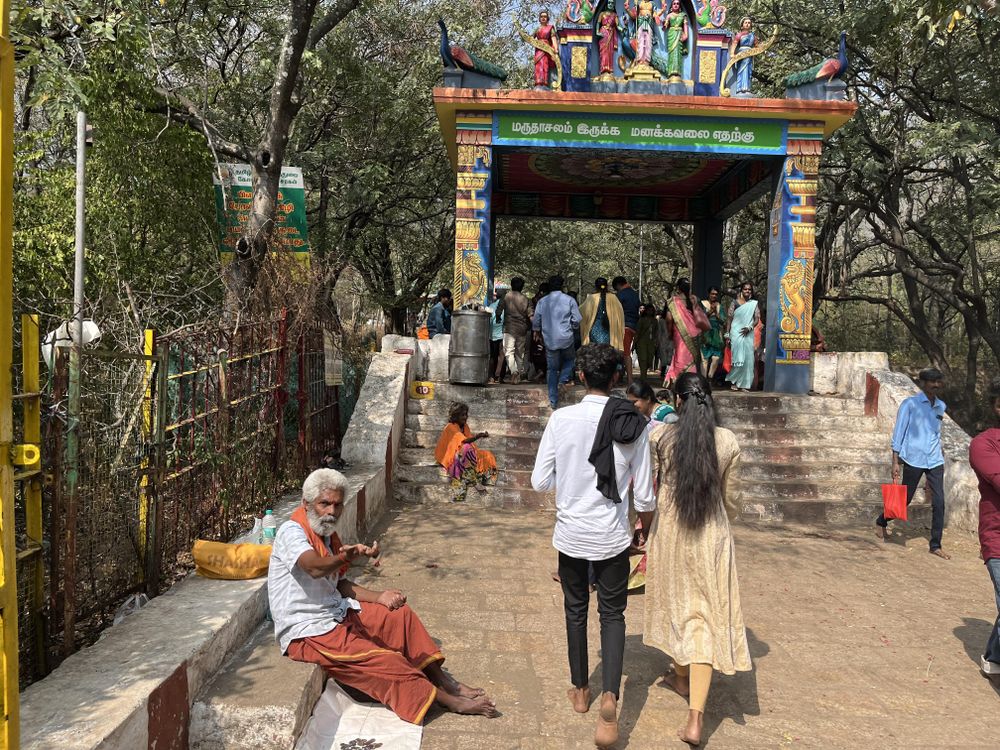
Earlier this year, the author walked the 837 steps to the 8th century shrine of Lord Muruga at Maruthamalai in Coimbatore, India.
ONCE on a walkabout in the Queen Street-Berea Station precinct, the acclaimed author and storyteller, Aziz Hassim, conjured a curious sight as he constantly bowed his head, clasped his palms and made the sign of the cross. “These are dangerous times laaitie,” he gurgled, “one needs all the protection”.
Hassim’s award-winning books dramatising history and heritage include The Lotus People, The Revenge of Kali and The Agony of Valliamma. We had just walked out of a meeting and jam scones at the Denis Hurley Centre. “The car is safe, let’s walk a bit,” he insisted.
St George’s Cathedral in Cape Town is home to the revered Black Madonna.
Our short tour took in the imposing Emmanuel Cathedral, the entrance to the Juma Masjid, Badsha Peer and Professor Fatima Meer’s grave at the Brook Street Cemetery. Behind a locked gate in the latter vicinity rested a small community of long-departed Parsis. A kaleidoscope of Hindus, Christians and Jews, including the boxing legend Seaman Chetty and Mrs Marie Baumann of the biscuit fame, communed on the other side of the fence.
As we paid our respects, our deepest thoughts lay with our unattended footwear left at the entrance. On our trot back to the basement parking of the Victoria Street Market, he pointed in the direction of the old MK Gandhi Library, since reincarnated as a storeroom, with the revelation: “There was once a Hindu temple there on the library side of the road. The mosque site used to belong to a Hindu.”
After the energetic morning, we retired to the Britannia Hotel for trotters and beans and some refreshment. The octogenarian lecturer and literature aficionado, Thayalan Reddy, is one of the few remaining of the social circuit who were raucously entertained by Hassim’s stories of the old Durban. Even in adulthood, I was able to learn from Hassim that there is more that unites us than divides us.
Faith in my family derives from the village goddesses of the Dravidian country in southern India. It is a documented heritage stretching back millennia. As a child, I was taught to worship the earth, its rivers and mountains, as well as the birds in the sky, the animals in the bush and the fish under the ocean.
Somewhere along the way, between the reformist clerics and the excitable British, we came to be pigeonholed as Hindu, a description derived from the archaeological evidence of the Indus River Valley civilisation. More recent excavations by the Archaeological Survey of India in the vicinity of the Vaigai River from Thani to Ramanathapuram in Tamil Nadu suggest a civilisation that may go deeper into antiquity.
Nevertheless, the Hindu identity we embraced with fervour, along with the grand pantheon of gods and goddesses who among them removed obstacles, bestowed good health, prosperity, and even a guiding hand with one’s studies.
The unity of faith is annually demonstrated by the Chinese community in Penang, Malaysia, as they join Hindus in observing Kavady.
Periodically, there is a confluence of great traditions and observances. South Africa marks Heritage Day on Thursday. A pall hangs over our nation as violent crime targeting women dominates the headlines. Something has gone drastically wrong in the moral fabric of our society. While law enforcement must seek out the perpetrators, it falls to our faith leaders to take an active part in the healing of those hurt and affected by these dreadful crimes. Prayers have been said in our churches, mosques, temples, synagogues and other places of worship.
Each day, as I keep a month-long fast and reflection during the Hindu holy month of Puratassi, my mind is on personal purification of mind and body, as well as where we can each play a small part in the healing of our nation. Whatever the sceptics may suggest, prayer has a powerful impact on the inner being.
Walking the holy ground of Durban with Hassim more than two decades ago was a sort of pilgrimage. There is something special in taking blessings from the clutch of peacock feathers at the tomb of the saint and the sprinkling of holy water in the Catholic cathedral. During this month of Puratassi, there may be an estimated one million people a day who will make the pilgrimage through the seven hills of Tirumala that is the abode of Lord Venkateswara.
Last year, over 530 000 pilgrimages walked the Camino de Santiago, leading to the Cathedral of Santiago de Compostela in northwest Spain, which holds the remains of St James. Barely 150km from Tirupati in Chennai, there is a minor basilica that honours the 72AD martyrdom of the apostle St Thomas. During the first 20 days of Ramazaan this year, the Grand Mosque in Mecca recorded over 73 million pilgrims on hajj or umrah.
Of the 1.4 billion Catholics in the world, some 50 000 had the privilege of celebrating Easter Sunday Mass at the Vatican this year. Every year, over 100 000 people undertake a three-day walk, barefoot, up to Nhlangakazi, the holy mountain of the Shembe.
My travels around the world and our own continent have carried me through several great pilgrimages, and many more are in store. The people of India have popularised the Sanskrit slogan - Vasudeva Kutumbakam – to highlight that the world is one family and that we are all sisters and brothers guided by some holy hand.
Kiru Naidoo is a local historian who will share his insights at the Glenwood Book Fair at Phansi Museum this weekend. Entry is free.