Germany: Is it possible to replace the chancellor?
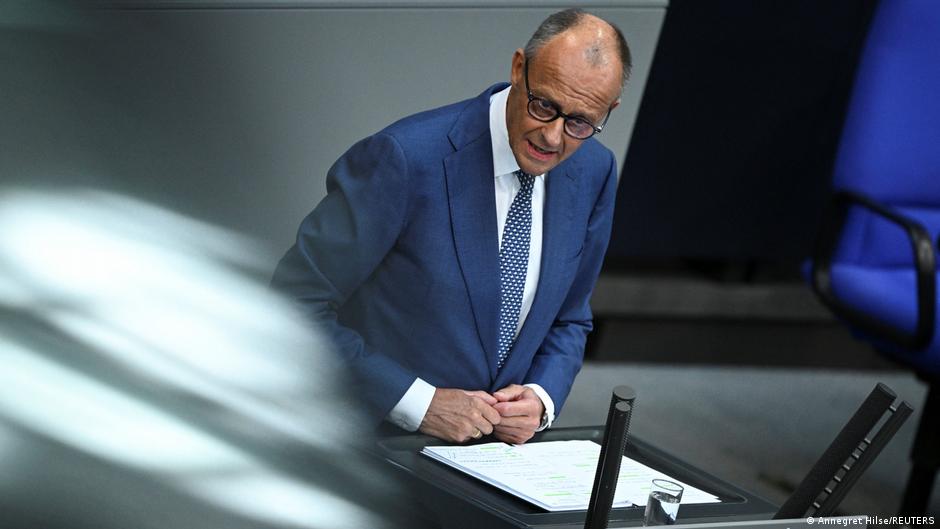
Sixteen months into office, Friedrich Merz has record low approval ratings, triggering a debate abour his futureImage: Annegret Hilse/REUTERSAdvertisementIt is the hot topic this week in Berlin: Does German Chancellor Friedrich Merz still have the backing of his own party, the Christian Democrats (CDU), and the coalition partners, Bavaria's Christian Social Union (CSU) and the center-left Social Democratic Party (SPD)? Will he be ousted by his own people? How would that actually work? Can he just step down?
Support for the chancellor has reached a record low: In the latest "Deutschlandtrend" representative survey, conducted by pollsters Infratest-Dimap for German public broadcaster ARD in early September, only 13% of respondents said Merz was doing a good job.
In early September, Merz's CDU party suffered a resounding loss in Saxony-Anhalt's state parliament election, seeing their result halved compared to the previous state election five years ago.
The election result has reinforced criticism of Merz, even from within his own ranks, also for his communication style, which frequently alienate his audience.
But Friedrich Merz remains chancellor. What are the options to change that? Germany's constitution, the Basic Law, grants the position a strong standing. German chancellors are not so easy to unseat.
Merz himself can decide to resign for any reason. That would not necessarily mean the end of the coalition government he leads. An example: In May 1974, then Chancellor Willy Brandt of the SPD resigned after a spy from the communist East Germany (DDR) was discovered to have been working in his inner circle. The governing parties, the SPD and the business-oriented Free Democrats (FDP), quickly agreed to continue their alliance.
Only 10 days later, Finance Minister Helmut Schmidt, also of the SPD, was elected as the new chancellor. To do this, an absolute majority of all lawmakers in the Bundestag, the lower house of parliament, was needed (not only those present during the vote). This majority is called the "chancellor majority". Schmidt achieved this effortlessly, eventually got reelected and remained head of the German government for 8 years.
How likely is Merz to step down? Today's chancellor seems determined not to give up.
If a new majority was formed through new alliances in the Bundestag or if a chancellor fell so far out of favor that their own supporters no longer believed in them, the instrument of a "constructive vote of no-confidence" could come into play. That means the majority of lawmakers vote in favor of a new candidate for chancellor.
An example: Helmut Schmidt of the SPD, lost the support of his junior coalition partner, the FDP, in 1982. The FDP wanted to push through changes to the economic policy, which Schmidt rejected. They joined forces with the conservatives from the CDU and CSU, and jointly put CDU leader Helmut Kohl forward as a new chancellor. He won a majority in parliament, replaced Schmidt and moved into the chancellor's office where he remained for 16 years.
The probability of this happening in Merz's case is very remote. The conservatives and Social Democrats do not want to end their coalition. There is no clear rival candidate for Merz. North Rhine-Westphalia's State Premier Hendrik Wüst of the CDU is seen as a possible successor, but has not made a step forward. Besides: The CDU is usually very loyal toward its political leaders; ousting the chancellor via a vote of no confidence on the open stage of the Bundestag is simply unthinkable for most conservative lawmakers.
The German parliament cannot simply dissolve itself and call new elections. Lawmakers can call a confidence vote on the chancellor and his government. Several chancellors have already used this mechanism, coupling it with a vote on a contentious issue.
This is how, in November 2001, then-Chancellor Gerhard Schröder (SPD) put forward a confidence vote in the Bundestag and linked it with the question of whether his government should deploy the German military to Afghanistan to support the NATO mission led by the US following the 9/11 attacks. Schröder won; he remained in office and continued with his military policy.
However, Merz has already announced that he sees no point in calling a confidence vote now. There are also no signs of large breakaway movements from members of his coalition in Parliament.
If a chancellor loses a confidence vote, however, this can bring about the dissolution of parliament and spark fresh elections. Following the defeat in the Bundestag, the chancellor can ask the German President to dissolve parliament and call voters to the polls. The president is not obliged to do so, but usually does.
It seems that Merz has ruled out this option. Neither the SPD nor the conservative Union (of CDU/CSU) are interested in calling new elections at a time when their approval ratings are low.
So, will things remain the same? Right now, it seems so. However, things have been so dynamic in recent days and weeks in Berlin political circles that nothing should be ruled out.
This article has been translated from German.