
Germany news: Far-right AfD gets first house speaker in a German state parliament
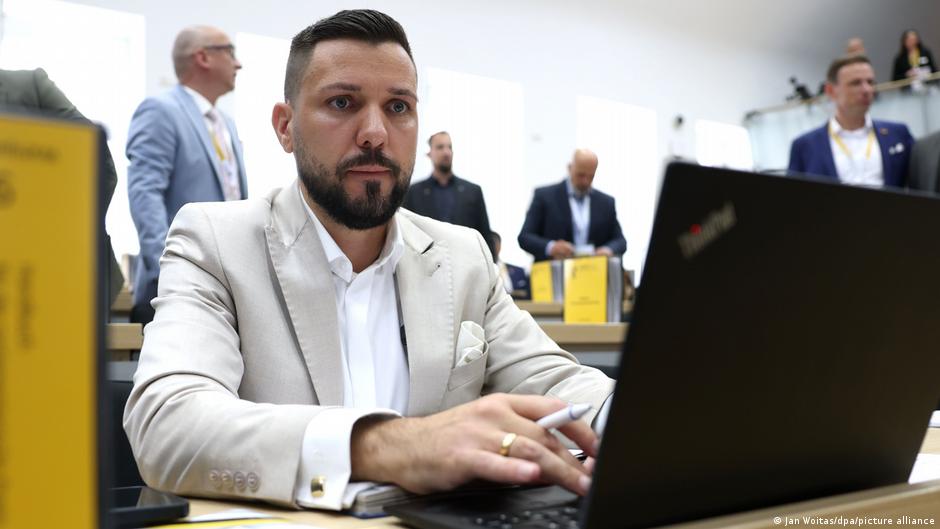
Tobias Rausch, the far-right Alternative for Germany's (AFD's) nomination for speaker in Saxony-Anhalt's state parliament, has been elected with the help of the populist BSW party.
Rausch gained 48 votes in favor to 29 against from 82 eligible votes. There were five abstentions.
The AfD holds 39 seats in the parliament and the BSW five, giving Rausch the majority he needed to win the post, as the other parties combined — all of which reject working with the AfD — also hold 39 seats.
The result, however, means that members of parties besides the AfD and BSW voted for him.
Rausch, 35, thus becomes the first member of the AfD — a party classified by domestic intelligence in Saxony-Anhalt as a "confirmed right-wing extremist" organization — to become speaker in a state parliament in Germany.
The new speaker is a real-estate entrepreneur by profession and has been a member of parliament for the AfD in Saxony-Anhalt since 2016.
The parliamentary session was accompanied by several anti-AfD protests in front of the parliament building.
The vote for speaker is separate from that for state premier.
The AfD's lead candidate, Ulrich Siegmund, who won the September election with 44% of the vote — thus falling short of an absolute majority — intends to stand for the position in December.
As no other party so far wants to form a coalition with his party, it is still in question whether he can win a vote or form a government.
The AfD says it is in dialogue with the BSW and individual parliamentarians to seek the necessary support.
Ursula von der Leyen, President of the European Commission, warned on Tuesday against major cuts to the European Union's next long-term budget.
"I am aware that balancing all of these constraints is not easy. I am also aware of the difficult budgetary situation in the member states," von der Leyen told the European Parliament in the French city of Strasbourg.
"But I would like to caution against large cuts. They would risk undermining critical priorities that we have all agreed upon," she added.
Negotiations on the long-term budget for the 2028-2034 period are currently underway. The EU's long-term budget, also known as the Multiannual Financial Framework (MFF), is the European Union's seven-year spending plan that sets how much the bloc can spend and on which priorities, such as agriculture, regional development, research, defense, migration, and climate policy.
The European Commission has proposed a budget of around €1.76 trillion (about $1.98 trillion). The budget is financed mainly through contributions based on the size of member states' economies.
The current MFF for 2021-2027 amounts to around €1.2 trillion.
Traditionally, Germany has opposed increases to the proposed budget, while other countries favor maintaining subsidies for economically disadvantaged regions. This time has been no different, with German Chancellor Friedrich Merz calling for major cuts.
Ireland, which currently holds the rotating EU presidency, is expected to present a new compromise proposal in the coming days.
European Council President Antonio Costa aims to secure an agreement on the new budget by the end of the year.
The number of applications from people wishing to refuse military service on grounds of conscience has risen sharply.
Altogether 12,102 such applications were made in the first eighth months of the year, according to figures from the Federal Office for Family Affairs and Civil Society Functions (BAFzA) — more than triple the number in the whole of 2025 (3,879).
The sharp increase comes after Germany's new military service law came into effect on January 1.
That law foresees mandatory medical screening for young men born in 2008 or later, with an eye to recruiting volunteers to expand the armed forces.
Although compulsory military service has been suspended in Germany since 2011, it remains enshrined in Germany's Basic Law.
The right to refuse armed military service as a conscientious objector also remains in place.
Parliament can decide to introduce needs-based conscription if recruitment targets are not reached under the current voluntary system.
In August, orders from German factories fell faster than expected, marking the first decline in four months. Orders were down 10.6% compared to July.
According to the statistics agency Destatis, the decline in orders from large German manufacturers highlights the fragility of the recovery in Europe's largest economy.
Germany's economy has been stagnant for an extended period and has only been recovering slowly, supported by massive public spending. However, recent data have shown signs of strengthening.
The German Economy Ministry said that August's orders data represented a "significant setback." It also noted that, excluding the drop in large orders, the overall situation was virtually unchanged from July.
The August decline was driven by weaker domestic demand. Orders fell by more than 60% in the category that includes military vehicles, aircraft, ships, and trains.
Orders in this sector have increased as Germany spends vast sums on its military to confront an increasingly hostile Russia and amid concerns about US security guarantees for Europe.
The ministry stressed that the growing importance of public procurement has made orders "highly volatile."
By comparison, new orders from June to August were 1.3% higher than in the previous three-month period.
The energy crisis stemming from the conflict in the Middle East has created additional challenges for Germany's economic recovery, but the economy has weathered the impact better than initially feared.
Experts recently doubled their growth forecast for this year to 1.3%.
August Hanning, who served as the head of Germany's BND foreign intelligence agency from 1998 to 2005, has been arrested on suspicion of espionage, according to various media sources.
Police in Lower Saxony have been deployed to a high school in the town of Langwedel after being alerted to a possible rampage attack by an alarm, according various German media.
Later, officers confirmed that the situation was resolved. It remained unclear if a false alarm was triggered or if a serious security threat had been brought under control.
A German-Russian man has been sentenced in Latvia to seven years in prison and one year on probation after being found guilty of collecting and supplying money and goods to Russian military personnel.
The man was detained by Latvian authorities while on one of his car trips allegedly transporting the goods across the Latvian-Russian border.
The man denied supplying sanctioned goods, saying he was transporting humanitarian aid such as wheelchairs, crutches and nappies.
The Latvian news agency LETA cited the responsible court in Riga as having said he was in fact carrying goods including night-vision devices and telescopes.
Prosecutors used correspondence, photographs and videos found on the man's mobile phone to back their case against him.
The verdict against the man, who holds both German and Russian citizenship, is not yet final and can be appealed.
Foreign Minister Johann Wadephul has highlighted the consequences of climate change for global security as the Berlin Climate and Security Conference kicks off in the capital.
"Particularly in fragile states, climate change exacerbates poverty and hunger — and can thus also become a fertile ground for extremism and terrorism or lead to waves of migration," he said.
Wadephul also emphasized the importance of climate protection in enhancing national security.
"When Russia once more deliberately attacks the energy infrastructure in Ukraine, decentralized, renewable energy sources could become a form of life insurance," he said.
"Investment in climate protection is also investment in our security," he added.
The Berlin Climate and Security Conference, which has been held annually since 2019, brings together some 250 international actors in the fields of climate, peace and security.
Participants include representatives from countries particularly affected by climate change and from the UN, EU and scientific and civil society organizations.
The newly elected state parliament of Saxony-Anhalt is poised to hold its first session on Tuesday, over four weeks after the far-right Alternative for Germany (AfD) party won elections there with almost 44% of the vote.
The AfD holds 39 seats in the legislature, the same number of seats as the conservative Christian Democratic Union (CDU), the Left Party, Greens and Social Democrats (SPD) together.
During the session, parliamentarians are to vote for a speaker, with the AfD, as the strongest force, empowered to nominate the first candidate.
The AfD has put forward long-serving parliamentarian Tobias Rausch, 35, for the post, a choice that the populist BSW, which holds 5 seats, has pledged to back.
All the other parties refuse to work with the AfD under a policy known as the "firewall," and the CDU chairman in the state has advised members of his party to abstain from the vote.
If Rausch is elected, he will become the first AfD speaker of a state parliament in Germany.
However, if he fails to be elected in a first round of voting, all the other parties can put forward their own candidates.
There will be no vote on who will lead the state.
The session will be accompanied by protests by civil society groups who see the AfD, which has been classified as a "confirmed extremist" organization by domestic intelligence in the state, as a danger to Germany's democracy.
DW's newsroom in Bonn wishes all its readers guten Tag as much of Germany continues to experience what is here called a "golden October" of mild, sunny weather.
The new parliament in the eastern state of Saxony-Anhalt is poised to sit for the first time after elections in September handed a landslide victory to the far-right Alternative for Germany (AfD) party.
The session is being watched closely to see whether the AfD succeeds in installing its first speaker in a state parliament in Germany, with the populist BSW party pledging to back the AfD's nomination for the post.
One of Germany's top cultural events, the Frankfurt Book Fair, is also getting underway with preliminary events, including a press conference, before its doors open on Wednesday for specialist visitors.
And Foreign Minister Johann Wadephul has warned that the climate crisis could undermine security and fuel new waves of migration as the Berlin Climate and Security Conference kicks off in the capital.
Read on here for more on these and other stories.

