Germany, US ink deal to deepen defence cooperation between industries
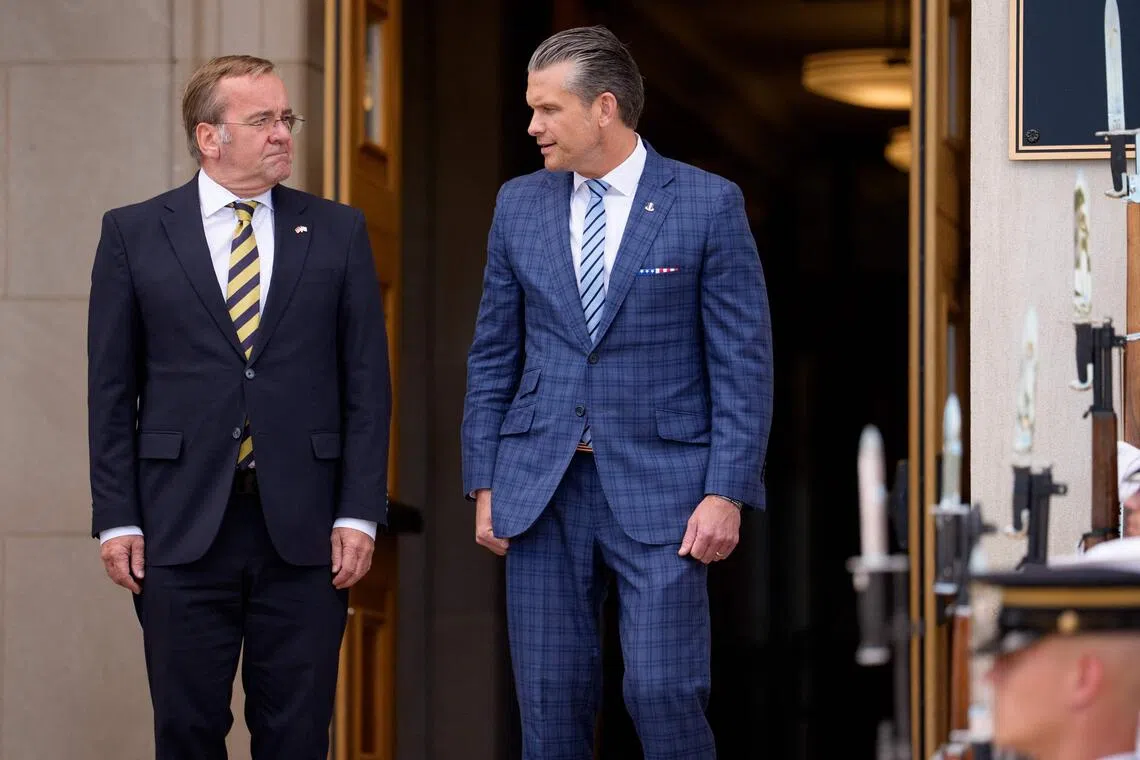
US Secretary of Defence Pete Hegseth (right) welcomes German Defence Minister Boris Pistorius (left) at the Pentagon on Sept 15, 2026.
WASHINGTON - German Defence Minister Boris Pistorius and his US counterpart Pete Hegseth discussed how defence companies can deepen transatlantic cooperation and boost weapons production as both sides look to fill low stocks of air defence missiles and deep strike weapons.
During bilateral talks in Washington on Sept 15, Pistorius and Hegseth signed a political agreement designed to deepen cooperation between defence manufacturers so that European companies can produce certain US weapon systems via licensing and vice versa.
“If we pool our strengths even more closely, we can deliver the systems that we and our NATO partners urgently need for deterrence and defence more quickly and in greater numbers,” Pistorius said in a statement before his meeting with Hegseth.
“In this way, we are strengthening the readiness of Germany, the United States, and the entire alliance.”
Pistorius pointed to existing company agreements that enable the manufacturing in Germany of fuselage sections for the US-made F-35 fighter jet and the PAC-2 guided missiles for the Patriot air defence system.
Additional projects under discussion include collaborations on Army Tactical Missile System, or ATACM, projectiles, Stinger surface-to-air missiles and Advanced Medium-Range Air-to-Air missiles, known by the acronym AMRAAM, the German defence ministry said in a statement after the talks.
In unusually warm words, Hegseth – who has frequently slammed NATO allies over the Iran war and defence spending – lauded Germany’s increased defence outlays.
He also thanked Pistorius for taking a leading role in NATO’s new burden sharing.
“Defence spending is just the first step,” Hegseth said, adding that Germany needed to put its “very large and historic industrial base to work for the common defence.”
Hegseth said the US-Germany deal the two ministers signed would “significantly intensify our bilateral defence industrial cooperation.”
German officials are pushing US counterparts to also enable the production of the more advanced PAC-3 interceptor, as well as Tomahawk cruise missiles, in Europe.
But so far, US manufacturers Lockheed Martin Corp and RTX Corp’s Raytheon have shown little interest in granting those licences to European firms.
Earlier in 2026, Germany agreed to purchase the long-range, subsonic Tomahawk cruise missiles to close a dangerous gap with Russia.
But numbers and delivery dates remain subject to negotiations, while European governments rush to develop their own deep precision strike missiles.
The US startup Covenant earlier in September revealed plans for the mass production of its heavy-payload Anthem long-range cruise missiles in a new factory near Leipzig in eastern Germany.
Germany, Britain and France are separately in talks to develop and produce precision deep-strike weapons as they aim to deter Russia from using its Iskander missiles against Berlin and other European capitals.
“Germany has a strong industrial base, highly trained skilled workers, and cutting-edge technological expertise. This enables us to create additional production capacity,” Pistorius said.
The German minister also discussed the future of transatlantic cooperation within North Atlantic Treaty Organisation, whose member states President Donald Trump has assailed for not spending enough on defence.
“I will discuss with our American partners how we can lead NATO into a new phase – with a stronger Europe within a strong transatlantic alliance,” Pistorius said.
He added that Berlin was “investing resolutely” in its armed forces and is currently “making the second-largest contribution to our joint defence efforts within NATO after the US.”
In July, Pistorius pushed back against calls by Trump that NATO allies should be unconditionally loyal to Washington.
NATO was not about blind obedience, Pistorius said at the time, adding that decisions within NATO were taken by free consensus without being dictated by individual member states.
The US had floated the idea of granting political and economic benefits to NATO allies that spend more on defence, raising the prospect of a two-tier alliance. BLOOMBERG