Germany's far-right AfD makes history again in Saxony-Anhalt
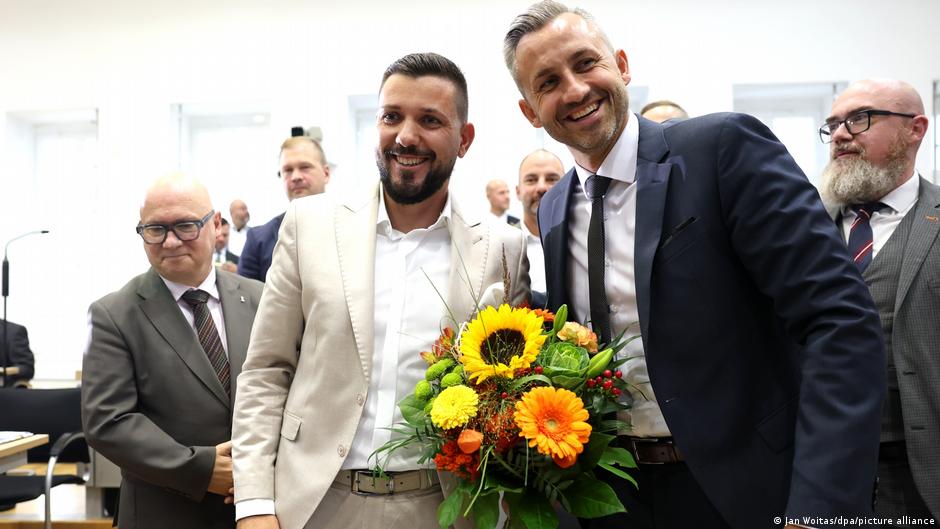
AfD leader Ulrich Siegmund (r) congratulated Tobias Rausch (l) on his election as parliamentary speaker in Saxony-AnhaltImage: Jan Woitas/dpa/picture allianceAdvertisementFirst thing in the morning, about 500 people gathered on Cathedral Square in the center of Magdeburg, the capital of the state of Saxony-Anhalt, to send a clear message that October 6 is not just another ordinary day. "Against Forgetting — Fascism Must Remain a Crime," read one of their banners. "No cooperation with the far right," read another.
Directly across from the imposing cathedral, in the state parliament building on the other side of the square, Tobias Rausch of the Alternative for Germany (AfD) was elected as speaker of the state parliament at 12:40 p.m. He received 48 votes — 9 more than the number of seats the AfD holds in the state parliament.
And this marks a turning point not only for Saxony-Anhalt but for all of Germany. For the first time since the end of World War II, a German state parliament has elected as its president a representative of a party that the Office for the Protection of the Constitution, the domestic intelligence agency, has classified as right-wing extremist.
The parliament's inaugural session was opened by Eva von Angern, a member of the socialist Left Party and the senior-most member of the parliament, who had earlier been outside participating in the demonstration across the square. She noted that only a few women in German history had held such a high office. Among them, Von Angern said, was communist Clara Zetkin, who served as senior member of the Reichstag in 1932 — shortly before the Nazis seized power.
Nobody in the AfD caucus showed any support for these words. "Human dignity shall be inviolable," Von Angern then quoted from Germany's Basic Law. This includes, she added, people of different genders, worldviews, religions and skin colors. And she quoted former Federal President Richard von Weizsäcker. "He said: 'One expresses one's own dignity by respecting the dignity of others.'" Once again, no one in the AfD expressed any enthusiasm.
Tobias Rausch, a 35-year-old real estate agent, is little known outside of Saxony-Anhalt. Many observers describe him as relatively approachable, and he describes himself as "not a hardliner." However, his name made headlines nationally at the beginning of the year when numerous AfD politicians were accused of nepotism.
Rausch himself admitted to employing several of his friends from his soccer club in his legislative office. That did not prevent his caucus from nominating him as president of the state legislature. Officially, the office is the highest-ranking position in the state.
After his election as parliamentary speaker, Rausch asserted: "I will not serve in this office as the speaker of a single parliamentary group, but as the speaker of all parliamentary groups." He added: "Rules must apply even when the majority changes."
Not everyone in the state parliament trusts this gesture of goodwill. During the first session following the election, a glance at the seating arrangement of the packed plenary chamber underscores the sheer force with which the AfD intends to shape policy here going forward: The AfD parliamentary caucus — composed of 37 men and two women — had taken its seats in the center, keeping a firm gaze on the lectern. The fact that this can be intimidating is clearly intentional.
Not everyone in the state parliament trusts this gesture of goodwill. During the first session following the election, a glance at the packed plenary chamber underscores the sheer force with which the AfD intends to shape policy here going forward: The parliamentary caucus — composed largely of men — seated itself prominently in the center where they could keep a firm eye on the lectern. Observers remarked that this can be intimidating.
Unlike in other parliaments, where the far-right party would normally sit far to the right, it has positioned the "old parties" that it despises — namely the center-right Christian Democratic Union (CDU), the center-left Social Democratic Party (SPD), the socialist Left Party and the environmentalist Greens — around the edges. The AfD was able to push this seating arrangement through in preliminary talks before the state parliament convened to vote. The message is clear: We are the center. A new era has begun in Saxony-Anhalt.
The election that took place on September 6 of this year in Saxony-Anhalt was certainly the most closely watched regional election in Germany in many years. Several hundred journalists, including several from international media, traveled to Magdeburg for the election.
Among the 1.7 million eligible voters in this German state, located between the Elbe River and the Harz Mountains, one thing was clear months before election day: the Alternative for Germany (AfD) — which has been partially classified as right-wing extremist — would emerge as the strongest party. Some polls even predicted that the party would secure an absolute majority of the votes.
In the end, the AfD garnered 39 of the 83 seats, just shy of the 42 seats it would have needed for an absolute majority.
Added together, the CDU, the Left Party, the SPD and the Greens also come to a combined total of 39 seats.
The Alliance for Social Justice and Economic Reason (BSW), founded by former Left Party politician Sahra Wagenknecht, holds just five seats and yet could be the deciding factor in whether AfD's top candidate, Ulrich Siegmund, can actually become the state premier. The BSW had announced that it would vote for Rausch as parliamentary speaker, but not for Siegmund as head of the state government.
Nevertheless, Siegmund plans to stand for election in the state parliament in December. It will again take place by secret ballot. Siegmund has been displaying confidence, saying he intends to win in the first round of voting. And if he fails, he intends to call fresh elections.
On this point, the new parliamentary speaker, Tobias Rausch, commented on private TV channel RTL the morning before his election: "If we don't have a majority in the first round of voting, we won't have a majority for the rest of the legislative term either — in that case, it means the parliament doesn't want us to govern." Whatever happens, Saxony-Anhalt is facing turbulent times ahead.
This article was originally written in German.