
Germany's FM Wadephul meets Lavrov on UNGA sidelines
Tired of missing our real-time updates? Click here to add us as a Preferred Source on Google. Then tap the "Star" or "Preferred" to keep DW News at the top of your feed.
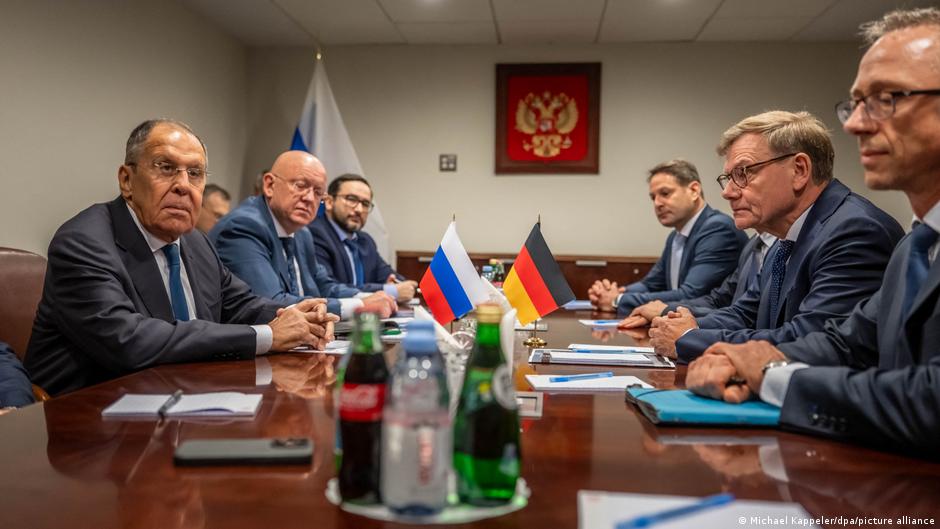
German Foreign Minister Johann Wadephul is meeting his Russian counterpart Sergey Lavrov at the sidelines of the UN General Assembly in New York.
A correspondent for the Russian Interfax news agency reported Wadephul and Lavrov, followed by aides, shaking hands before the press was asked to leave.
Russian Foreign Ministry spokeswoman Maria Zakharova said the meeting is taking place at the German initiative.
Moscow has been sanctioned by the EU over its full-scale invasion of Ukraine which the Kremlin launched in February 2022. The last meeting between on this level was held in January of that year, between veteran diplomat Lavrov and Germany's then-top diplomat, Annalena Baerbock, who was on a visit to Moscow.
Moldovan Prime Minister Vasile Tofan used part of his time before the General Assembly to present a vision of small nations serving as "regulatory sandboxes" for new technologies.
"Technology is moving faster than regulation almost everywhere, and artificial intelligence is widening that gap," said Tofan, who worked as an investor and businessman before becoming the head of Moldovan government two months ago.
"We want Moldova to become a place where emergent technologies can be tested responsibly through regulatory sandboxes, where regulators learn alongside companies, rules adjust with evidence, and good ideas do not wait years to reach the real economy."
"When an entrepreneur arrives with a technology for which the law has not caught up yet, the answer should not simply be 'There is no rule for this.' It should be 'Let us find a safe way to test it'," he said.
Addressing the UN General Assembly, Chinese Vice President Han Zheng called for safeguarding the post-WWII order, saying the world wanted "peace, not war."
"We should turn into action the vision of common, comprehensive, cooperative and sustainable security, and reject the Cold War mindset and bloc confrontation," Han said.
"Major countries shoulder special responsibilities for safeguarding international peace and security and they should take the lead in complying with the rules, upholding the rule of law, and doing what's right."
"No matter how international dynamics evolve, China remains unchanged in its pursuit of peace and development, in its dedication to safeguarding fairness and justice and in its commitment to multilateralism," said the Chinese vice president.
"China will join hands with all other countries to build a community with a shared future for humanity, and make the world a better place for all of us."
Speaking at the UN on Saturday, Chinese Vice President Han Zheng said the world should reject "unilateral military actions that violate the UN charter and circumvent the Security Council authorization," in an apparent reference to the US attack on Iran.
"China holds that the sovereignty and security of the countries in the Middle east, including the Gulf, should be respected, international industrial and supply chains should be kept stable and unimpeded, and global trade should be safeguarded," he said.
In his speech, Han also spoke out against the US blockade of Cuba, albeit without explicitly mentioning the US.
He said China called on "the relevant country" to lift its blockade against Cuba and stop using the threat of force against the island nation.
In regards to Israel and the Palestinians, the Chinese official urged bringing the two-state solution back "on the right track" and "at an early date."
Welcome back to DW's coverage of the UN General Assembly Debate in New York City.
On day 5, China and Germany are some of the major countries addressing the event.
As the fourth day of the 81st UN General Assembly comes to a halt, we are pausing this blog for the night.
Today was another address-packed day, with several small island nations stressing the urgent need to address climate change, as they are most vulnerable to its consequences.
Norway and Sweden stressed the importance of continuing to support the UN, including with funds, as well as making it more representative by giving Africa a permanent seat on the Security Council.
Meanwhile, Pakistani Prime Minister Shehbaz Sharif took aim at India, rehashing in his address a short-lived conflict between the two countries last year. Sharif said his country faced "external aggression from India under a false pretext," adding that his country's response was "its inherent right of self-defense."
Before the session wrapped, India used its right of reply to address Pakistan's "bizarre remarks," and accuse its neighbor of terrorism. Pakistan was quick to respond, accusing New Delhi of "export[ing] terrorism and violence."
We will be back again tomorrow, when addresses from India, Germany, Russia, China, Saudi Arabia, the UAE, Canada, and others are scheduled.
The speakers for the small island nations of St. Kitts and Nevis, Samoa and Tonga called to attention the inaction of world leaders on climate change.
The island nations are disproportionately vulnerable to the climate crisis, with the deputy prime minister of Samoa, Mulipola Anarosa Ale Molioo, calling climate change "the single greatest threat" facing the country and the world.
Molioo stressed the need to scale up climate financing so small island nations weren't the ones bearing the burden of climate change.
Fatafehi Fakafanua, Prime Minister of Tonga, said Pacific leaders have been warning about the climate crisis, with little support for years.
Fakafanua said the question was not whether the world has heard the message of climate change but rather, he asked, "why has it still not acted?"
The deputy prime minister of St. Kitts and Nevis, Geoffrey Hanley, outlined some of the solutions his country has undertaken, such as investing in desalination and improving food security.
Hanley said that small states, who stand most at risk from the consequences of climate change, were still delivering big solutions.
But he said, because no small island state can perpetually adapt to the climate crisis, "adaptation cannot excuse inaction elsewhere."
Iran has given the US a seven-day plan that would involve reopening the critical Strait of Hormuz to maritime navigation, Foreign Minister Abbas Araghchi said on Friday.
Speaking to reporters at the United Nations General Assembly on Friday, Araghchi said the plan was delivered via Qatar and the choice now rests with Washington to meet the conditions Tehran has laid out.
"Iran does not accept coercion, threats or intimidation, and Iran will not surrender its sovereign rights under pressure," he said.
Pakistani Prime Minister Shehbaz Sharif also took aim at India in his speech as he discussed the limited military clashes between the uneasy neighbors last year.
"A year ago, Pakistan faced external aggression from India under a false pretext," the prime minister alleged. "Pakistan exercised its inherent right of self-defense under Article 51 of the United Nations charter."
He praised the country's military saying, "They silenced the enemy, repulsed its attack, and taught it a lesson it shall never ever forget," as the UN's TV feed cut to an Indian observer in the assembly shaking his head as he listened.
Pakistan considers Indian missile strikes on May 7 to be the start of the low-level conflict, that ran for less than a week, while India contends that the strikes were retalliation for an attack in Indian-administered Jammu and Kashmir in late April. New Delhi had accused Pakistan of supporting cross-border terrorism, which Islambad denied.
Sharif praised US President Donald Trump's "resolute and visionary leadership," crediting it with saving "hundreds of millions of lives in South Asia" by intervening and helping to broker a truce "when two nuclear neighbors stood at the brink of all-out war."
Sharif asked "who knows the extent of devastation that could have taken place" without Trump's "clarity of thought and action" at a critical moment.
He said it was necessary to ensure that South Asia "never reaches this precipice again," and said that doing so would require "a just and fair resolution of the Kashmir dispute."
He said Kashmiri people had been waiting eight decades for the UN to "fulfill its solemn commitment of a free and impartial plebiscite under its auspices." He also criticized recent "attempts to alter the legal status of Jammu and Kashmir through demographic reengineering and other illegal measures."
He also criticized India for its decision to hold a treat on the Indus River System in abeyance, saying this move had "no legal basis whatsoever."
Pakistan's Prime Minister Shehbaz Sharif touted his country's efforts to mediate in the war between the US and Iran since February, particularly in reaching the Islamabad Memorandum of Understanding that brought an uneasy calm to hostilities for a few weeks earlier this year — albeit without resolving many of the wider issues in the conflict.
"Regrettably, Mr. President, recently we have witnessed a dangerous surge of hostilties," Sharif said. "Yet amid the roar of missiles, drones and guns, the voice for diplomacy must echo even louder and stronger."
"The Strait of Hormuz and Bab el-Mandeb are arteries of the global economy," Sharif said, also referring to the western entry to the Red Sea coming under increasing pressure from the Iran-aligned Houthis. "They must remain open, connecting nations, not becoming the chokepoints of confrontation."
Sharif said these waters "must carry the promise of prosperity, not the perils of war."
He said Pakistan condemned recent "deplorable" Houthi attacks against Saudi Arabia "in the strongest possible terms," not least the reported attempted drone attack on the holy city of Mecca, which he said had "outraged Muslims across the globe."
Prime Minister Edi Rama told the chamber that while Albania was not a developer of "frontier models" in AI, "we are a nation that has already lived the future others are still debating," given how outside actors had tried out the technology's darker capabilites on its citizens.
Rama said he felt he owed the chamber a "simple message," if not necessarily the one most commonly discussed during the week.
"The greatest immediate danger is not that artificial intelligence will stop obeying humanity. The greatest danger is that it will obey the wrong human beings perfectly," he said.
"The public debate imagines machines that awaken, acquire ambitions and turn against their creators," Rama said. "But the systems confronting us today do not wake up with hatred in their hearts, they multiply ours. They have no ambition of their own, they serve the ambition of others. They carry no flag, but they can be deployed by a state. They tell no lie for their own benefit, but they can tell a billion lies on others' behalf."
Rama mentioned how Albania had become the first government to launch an AI minister. He said this showed his government's belief that "inside an accountable state," the technology could be used to "reduced the distance between citizens and public services."
But he said Albania had also learned how "artificial intelligence outside accountability can be used to eliminate the distance between a lie and the human mind."
He relayed the story of the so-called "Flamingo Revolution," a "fabricated narrative of an Israeli invasion of the Albanian coast."
This entirely fictional invasion "was manufactured, was personalized and delivered through voices, pages and channels citizens already trusted." Rama explained how the details of the overarching story were personalized to maximize their impact with the individuals reading them.
"Different fabriactions entered different emotional worlds, all serving the same strategic lie," he said. "The consequences were real. Citizens had their own reasons to protest — don't take me wrong. But suddenly, they started to protest also against a phantom enemy. Antisemitic tropes entered our public discourse for the first time ever."
Rama said that amid the AI disinformation drive, "fear became anger, anger became mobilization and fabrication became political reality."
"And this was not a laboratory experiment. I'm not talking to you about a science fiction movie. It was a Tuesday, in Tirana, our capital city."
Rama said it wasn't an algorithm that invented the objective, but rather a human actor. The algorithm didn't develop hatred, but "it discovered how to activate ours."
He called this particular use case "systematic fraud as a service," and warned its potential for use in scenarios like elections were just as real as in trying to amplify animosity to war in the Middle East.
Prime Minister Philip Pierre from the Caribbean island of Saint Lucia said his country "laments the continued conflicts and human suffering across the globe," listing some of the most notable wars in Ukraine, Gaza, the wider Middle East and Sudan.
He said his country of around 184,000 people called for the establishment of a Palestinian state with full UN membership.
Pierre then turned to a Caribbean conflict that has featured rather less this week in New York, Haiti.
"Member states of this organization must act in a manner that will restore the trust of the people of Haiti in the United Nations," Pierre said. "Some member states have failed to meet the commitments and pledges to the gang suppression force in Haiti, whose one-year mandate ends this month."
He urged the Security Council to renew the force's mandate, and called on member states to provide it with sufficient "resources to operation effectively and successfully."
He said that while gang violence was "the main factor to be resolved," the crisis in the country was "multidimensional."
"The international response must include long-term socio-economic assistance that will help restore an acceptable quality of life for the people of Haiti," he said.
Tuvalu's Prime Minister Hristijan Mickoski told the assembly that climate change "is and remains the single, greatest existential threat to Tuvalu's survival, security and sustainable development."
He said the low-lying archipelago of some 10,000 people acknowledged global efforts to contain the climate crisis but said the "pace and scale of global actions remain insufficient."
Mickoscki called for a "fast, fair, just and orderly transition away from fossil fuels."
He called for moves to provide climate financing "as grants" to allow countries like his to better prepare and adapt for coming changes.
He said his country was keenly anticipating the pre-COP meetings this October, prior to the main UN COP31 summit in Turkey in November.
"Tuvalu may have only 26 square kilometers of land," he said, "but we are custodians of some 750,000 square kilometers of ocean, which makes Tuvalu a large ocean state."
Tuvalu is also known as one of just 12 countries in the world to retain full diplomatic relations with Taiwan, rather than having formal ties to China.
Mickoscki said that the UN "must also uphold the principles of dignity, inclusion and equality" for everyone.
"Yet, too many communities remain outside the structures designed to serve all humanity," he said. "Tuvalu therefore calls for arrangements that enable the meaningful participation of the 23.3 million people of Taiwan in the United Nations and its specialized agencies and mechanisms."
He said that Taipei had consistently demonstrated that it was an "able, trustworthy and constructive partner," saying its UN exclusion "undermines both the spirit and effectiveness of multilateral cooperation."
The People's Republic of China took over the Chinese seat at the UN — and the Security Council veto that came with it — in 1971, more than two decades after the Chinese Communist revolution. Since then, Taiwan has been excluded from the UN for more than half a century since then, with no clear route towards membership, given that it is only possible with Beijing's blessing.
Not far away, during his state visit to Washington DC to speak with President Donald Trump, China's Xi Jinping on Thursday appealed to Trump to change the US stance on Taiwanese independence from not "supporting" it to openly "opposing" it.
Lebanese Prime Minister Nawaf Salam told the UN that "without mutual trust, peace and security cannot take root among states, nor can competition among them flourish."
He said that the UN was founded, more than 80 years ago, on "the promise that the force of law would replace the law of force."
But Salam said that wars and conflicts still plague a world that spends more on armaments than on development.
"The problem is not the absence of rules," Salam said. "It is their selective application, if not their outright non-application."
He did not mention Israel by name in his preamble but did later in his speech.
"Our position on the war has been clear from the outset," Salam said. "We want it to end. We want the ceasefire consolidated. We want Israel to withdraw from all Lebanese territory up to our internationally recognized borders, in accordance with the 1949 General Armistice Agreement and as affirmed by Resolution 1701. We want the release of all our detainees, the safe and dignified return of our people to their villages and towns, and a reconstruction of what the war destroyed."
Under the tense ceasefire deal between Lebanon and Israel, brokered by the US, Israel is supposed to withdraw its forces from a self-declared "buffer zone" in southern Lebanon. In turn, Lebanon's government is supposed to move its military fores into these areas and stop Hezbollah from using them to launch attacks into northern Israel. The current goal is to create so-called pilot zones where the Lebanese army moves in and Israel's troops move out.
The process is making only gradual progress, as both sides accuse the other of failing to meet their obligations.
